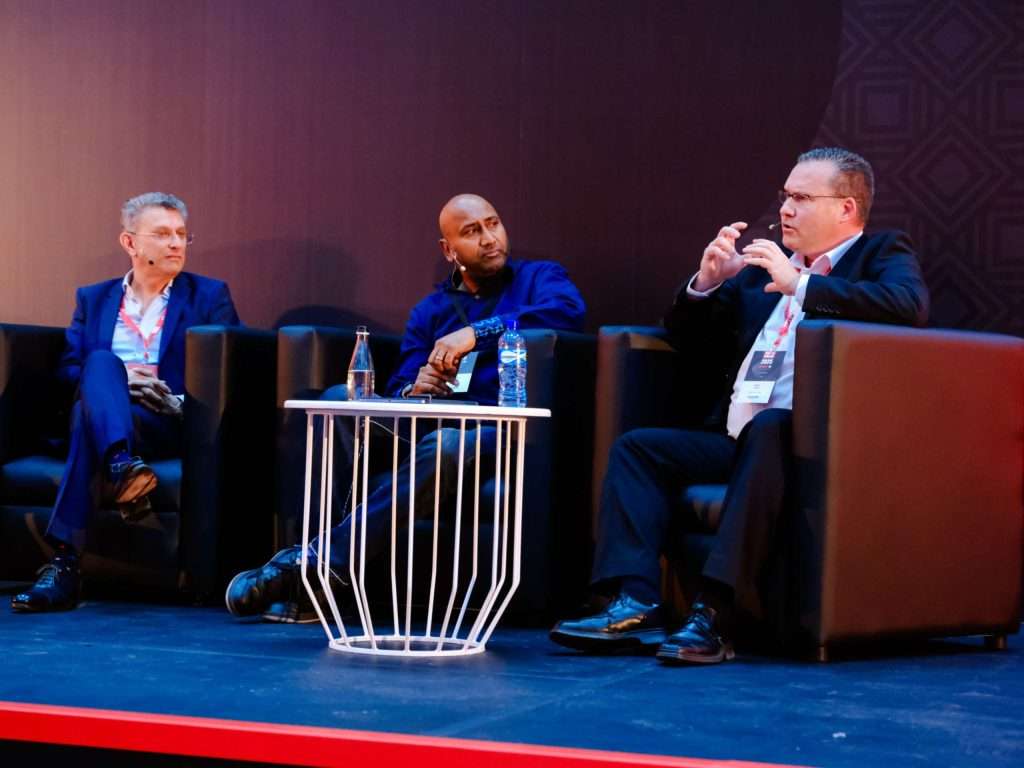
Three of South Africa’s leading CFOs shared what it truly means to balance leadership, life, liquidity and the relentless expectations of stakeholders at the recent 2025 Finance Indaba. Zaf Mahomed, CFO at Oceana Group, Riaan Davel CFO at DRDGold and Anbann Chetti, CFO at African Bank.
Their discussion cut to the core of modern financial leadership. It wasn’t about profit margins or quarterly performance, but about what happens when the pressure mounts, crises unfold and difficult truths must be told.
For Zaf, the role of a CFO in turbulent times is not unlike that of an emergency room doctor diagnosing, prioritising and stabilising under pressure.
“When you’re in a crisis situation, normality does not exist. People want certainty and when there’s uncertainty, they panic. In business, just as in life, when something goes wrong, people struggle to cope with what’s not normal,” Zaf noted.
Zaf has learnt that leadership in distress is less about providing answers and more about grounding people in truth.
“When a company is under distress, honesty is the one thing that’s constant. There’s an old saying, if you speak the truth, you never have to remember a lie. In a crisis, people expect honesty from the CFO because you know the numbers, you know where the bodies are buried,” Zaf highlighted.
He compared the role to triage, ensuring the organisation’s vital functions keep going.
“If the heart stops beating, that’s a problem. So, you stabilise what matters most, liquidity, communication with banks and shareholders and make sure everyone knows that even if there’s no perfect plan, you’re heading in the right direction,” he conveyed.
Navigating competing demands
Riaan described balance as both a discipline and a philosophy. At DRDGold, one of South Africa’s oldest continuously listed mining companies, he has spent more than a decade navigating the competing demands of shareholders, regulators, employees and communities.
“Often as CFOs, we forget about ourselves,” he said. “Each one of us is also a stakeholder in the business and must play a role.”
Riaan painted a picture of a company deeply rooted in South Africa’s industrial and social fabric. DRDGold’s operations stretch across vast urban mining sites from Carletonville in the west to Brakpan in the east touching communities that live alongside the company’s tailings facilities.
“Unlike other businesses, we operate where our communities live and work. That creates unique challenges. Our regulator is a major stakeholder too, because we work in a highly regulated mining and environmental space. Balancing those expectations is a daily exercise,” he explained.
Riaan emphasised that sustaining balance required more than personal effort; it began with cultivating a strong leadership team. His focus on building a capable group of people gave him the freedom to manage both the company’s direction and his own wellbeing. He believes that true success is measured not just by profit, but by the company’s positive impact on the environment and communities affected by mining.
“Two and a half years ago, I began preparing for succession. I’ve built a fantastic team and that gives me space to also look after myself,” he said. “For us, profit is necessary, but it’s not the purpose. Our purpose is reversing the environmental legacy of mining and adding to quality of life. That’s how we define success.”
Having the right people
For Anbann, leadership at African Bank means leaning on people and teaching them to think beyond numbers.
“In simple terms, we’re in the business of buying and selling money,” he said. “But what’s really important is having the right people around you. Early in my career, being technically strong made up 80 or 90 percent of the job. But as you grow, it’s your EQ, your ability to engage and connect, that really matters.”
He spoke with quiet conviction about how leadership must evolve with the life of the business. At African Bank, that evolution has been profound, a transformation rooted in rebuilding trust while reigniting purpose. The bank’s 50-year journey, he said, has been anything but linear, and leading through that history demands both humility and clarity of vision.
“We’re a 50-year-old brand with a rich, complicated history. People remember the curatorship, but there’s so much more. Today, we’re rebuilding and that means surrounding yourself with people who understand both the business and the customer,” he pointed out.
For Anbann, the numbers in finance are only as meaningful as the human stories behind them. He believes that purpose is the true currency of leadership, the bridge between technical expertise and social value.
“Finance isn’t just about saying something is up 10 percent or down 10 percent,” he explained. “It’s about asking why. When you understand the customer behind those numbers, your work becomes meaningful.”
That human-centred mindset shapes how he runs the bank’s operations. With 438 branches across the country, Anbann refuses to view them as traditional banking outlets. Instead, he sees them as living retail spaces where data meets daily life.
“I ask, how many people walk through our doors every day, how many come to take credit, to buy insurance or to open an account. Once your team starts asking those questions, they stop thinking of finance as spreadsheets and start seeing it as service,” he emphasised.
Later, when asked about empathy in leadership, Anbann reflected on how easy it is for CFOs to lose touch with their teams under the pressure of constant deadlines.
“As finance people, we’re always chasing something, the month-end, the quarter, the forecast. But empathy comes from investing in people when the craziness isn’t there. Spend time understanding your staff when things are calm, because in high-pressure moments, that understanding carries you through,” Anbann noted.
He paused before adding softly, “If you build emotional trust during quiet times, your team will give you grace when things get tough. It’s like a bank, if your empathy account is full, you can make withdrawals when you need to.”
A shared language
The conversation returned to Zaf, who has seen both rescue and recovery up close. Having worked in companies under distress, he said he knew that leadership is often about confronting uncomfortable realities.
He spoke candidly about the lessons learnt through business rescues and restructures.
“When you sit down with banks, they’re not interested in profit. They want to know if you have cash to survive. Sometimes, that means telling a shareholder they’ll lose 80 percent of their investment. I’ve done that and it’s not easy,” he recalled.
As the session drew to a close, a single thread tied together the reflections of the three finance leaders, purpose. Each had spoken of finance not merely as a technical function, but as a shared language of service: to shareholders, communities, employees and society at large.