Finance Indaba attendees heard how finance and HR can join forces to align talent strategy with business goals – all with agile tech tools.
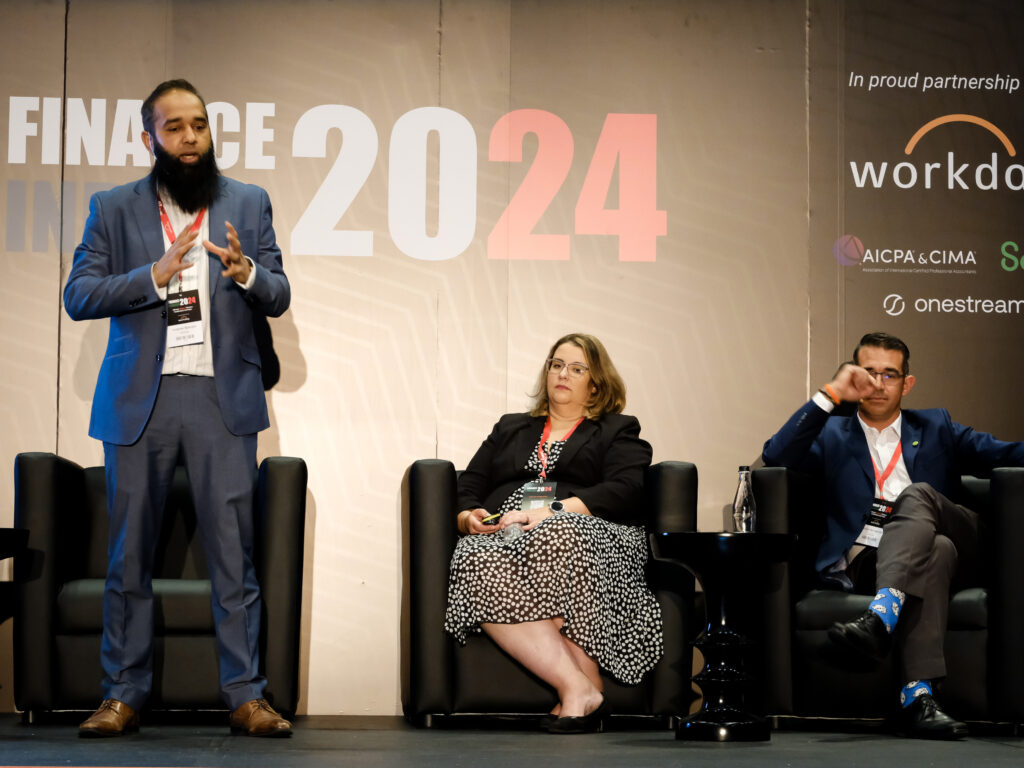
In a masterclass entitled Bridging the gap between finance and HR: Driving your organisation’s success, Luqman Saloojee, Workday senior solution consultant and Andries van den Berg, finance and performance leader at Deloitte, led an informative session on how finance and HR can use data-driven technology to take workforce planning to the next level.
They were joined on stage by Nicolien Von Zeuner, finance and performance manager at Deloitte. They each played a C-suite role: Andries as the CFO, Nicolien as the CHRO and Luqman as the CIO.
“It’s easy to aggregate numbers, but more difficult with humans. Strategic workforce planning needs to happen on an ongoing basis because life happens, and organisations need the right talent at the right time and place, at the right cost. Technology bridges these needs,” said Andries.
As ‘CFO’, Andries highlighted that many processes and a lot of planning are still Excel-based, and to understand exactly what the workforce planning strategy blueprint looks like is tricky. “You want to be able to change your mind, but there’s a whole Excel process that kicks off, also known as ‘Excel hell’,” he added, to knowing chortles and nods from the audience.
Yet, technology moves at such a pace and skills are evolving so quickly that finance and HR leaders alike need to stay ahead of the curve.
For Nicolien, as the ‘CHRO’, workforce planning is more than just filling positions – it’s about aligning talent. HR looks at how to get and retain the right people, the organisation’s skills gap, development and succession planning, DE&I, and more. Yet the CFO is usually only concerned with headcount and risk.
Andries admitted there is a tension, because as the ‘CFO’, cost control and risk mitigation is imperative. He added that the workforce of the future needs to be planned five years ahead, otherwise there will be operational disruptions.
In steps the ‘CIO’. “My salespeople have a love-hate relationship with marketing, and finance loves to hate HR: how do they come together and not hate me?” asked Luqman.
“The answer lies in providing the right data at the right point in time. Organisational change and design are top of mind for 53 percent of financial managers, and workforce planning isn’t as adaptable and collaborative as it should be. But the right tools with reporting capabilities can help the organisation plan for now-now, just now, and later, so that all role players, from HR to finance, can take action.”
In doing so, said Luqman, workforce planning takes on a new meaning – it becomes agile instead of siloed and static. A tool like Workday Adaptive Planning, fed by real-time data delivered in a configurable dashboard, enables scenario planning analysis, talent demand against supply forecasting, and how to grow talent with learning courses and instantly see the cost, among other capabilities.
“There’s a huge buzz around AI, but Workday has been infusing AI into our solutions for the past 10 years. Embedded conversational AI further simplifies HR and financial planning, as it democratises and demystifies data and its analysis.
”How to get the process started? Start somewhere realistic, and don’t bite off too much, advised Andries. Take on low-hanging fruit like headcount and salaries and ensure there is one source of truth that everyone understands and agrees with.
“Get to a point where workforce planning is part of the organisation’s DNA, where you use technology to take a snapshot of up-to-date information, then financial and HR leaders can make decisions based at the pace that is needed,” he concluded.