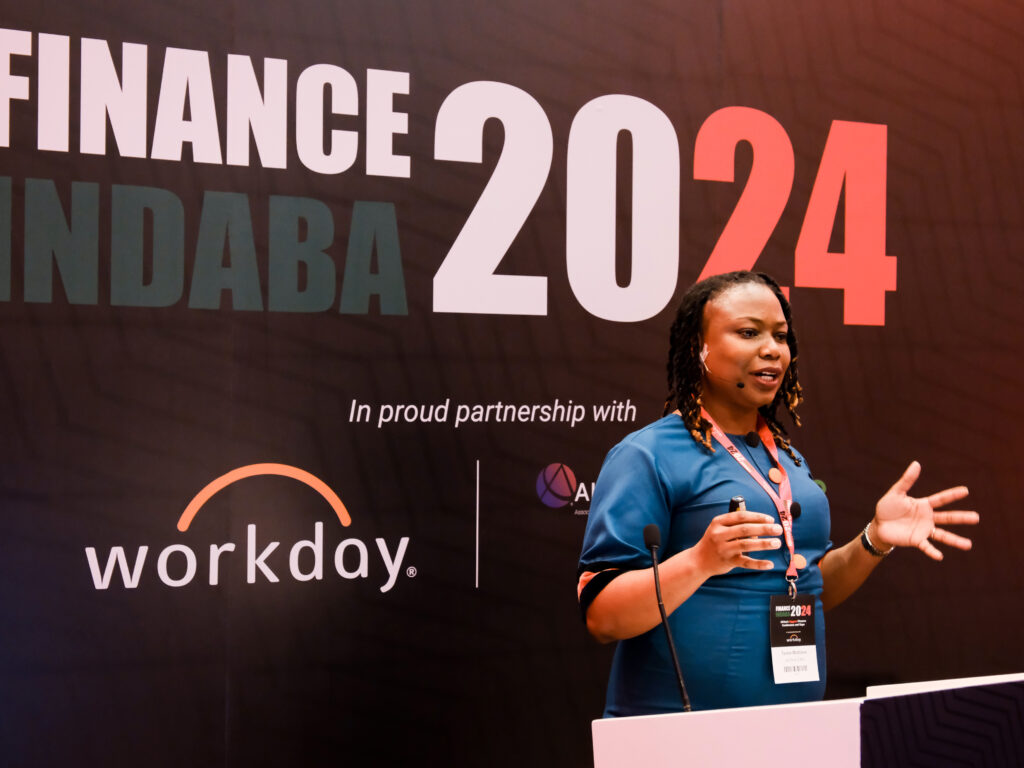
AICPA & CIMA VP of Africa Tariro Mutizwa unpacked the skills and business structures that will define business success in the future, calling on finance leaders to not only think about the short term.
AICPA & CIMA released their Future of Finance 1.0 research programme in 2018, where it looked at redefining the finance profession in a digital world. Since then, the Covid-19 pandemic and new technologies like ChatGPT have continued to disrupt the finance space, forcing us to find more socially and environmentally sustainable ways of working.
Following this, AICPA & CIMA recently launched its Future of Finance 2.0 research programme, where the focus shifted to redefining the finance profession for a more sustainable world. “As finance professionals working in organisations that are part of society, we need to be aware of how our decisions impact others,” AICPA & CIMA VP of Africa Tariro Mutizwa pointed out at the 2024 Finance Indaba.
This requires leaders to be responsible for more than just their yearly KPIs. “We have to stop thinking in the short term and start thinking into the future. This means being more socially aware and more mindful about the impact our decisions have,” she explained.
She pointed out that businesses focused on impact grow better than those who work with short-term, money-focused schemes, and don’t consider the damage they leave behind.
Information for impact
Historically, finance professionals have been required to report on past information. Now, they have to use this information to plan for the future. “Past knowledge is very important because it gives us a starting point to compare and analyse our growth, but also to create future wisdom and knowledge that leaders use to influence,” Tariro said.
She explains that the ability to impact the future is a sought-after skill from finance professionals. This impact is informed by four key areas:
Reporting accuracy – if you analyse the wrong information, you’re going to make the wrong decisions.
Analysis and insight – you can’t just present the report, you have to tell the story behind the data and explain how it is informing our decisions.
Partnering and decision-support – accounting can’t be siloed, it has to be a collaborative approach across all functions of the organisation.
Cost efficiency – we can’t just go for infinite growth when we have a finite planet.
“It is up to management accountants and finance professionals to take their organisations from past knowledge to the future,” Tariro added.
Sustainable finance structures
Thirty-five percent of finance professionals surveyed during the Future of Finance 2.0 programme revealed that 61-80 percent of their functions will be automated in the next three to five years.
Seventeen percent are moving to hierarchical structures, where all of their functions are in-house, with many roles at lower levels and fewer at higher levels.
Twelve percent are embracing a segregated structure, with much smaller in-house teams and outsourced routine transactional processes.
Twenty-eight percent are considering a diamond structure, where all functions are in-house, and process automation creates an opportunity for mid-level roles offering higher value services.
thirty-nine percent are taking a segregated diamond approach, with a smaller in-house team and both routine processes and some higher-value services being automated and outsourced.
“It’s important to think of how you want to organise your function to support the business because these will set the pace at which your organisation is evolving,” Tariro said.
Future mindset and upskilling
However, Tariro noted that, if the mundane tasks in a function are automated or outsourced, the leaders and workers in that function need to elevate their skills. “Currently, there is a big gap between what is being demanded from finance professionals and what they can deliver. The gap in financial and regulatory accounting skills is very small, because we’re all adept at counting the numbers. The gap increases around leadership, communication, influencing and critical thinking skills,” she said.
There’s also a big demand for business solutions architects, who can integrate functional and IT solutions, data modelling and analysis.
“But what businesses need most from their finance professionals is a business partner, with business acumen and people leadership skills,” Tariro added. “Those who are more concerned about losing their jobs to automation can’t be a business partner, because that’s micro-level thinking.”
She explained that the people entering the workforce now are digitally aware, value communication and understand how to engage with data and what it means. “They didn’t grow up in the era of profiteering and being better than the next person. They want sustainability, and we won’t be able to partner with them if we don’t change our mindsets.”