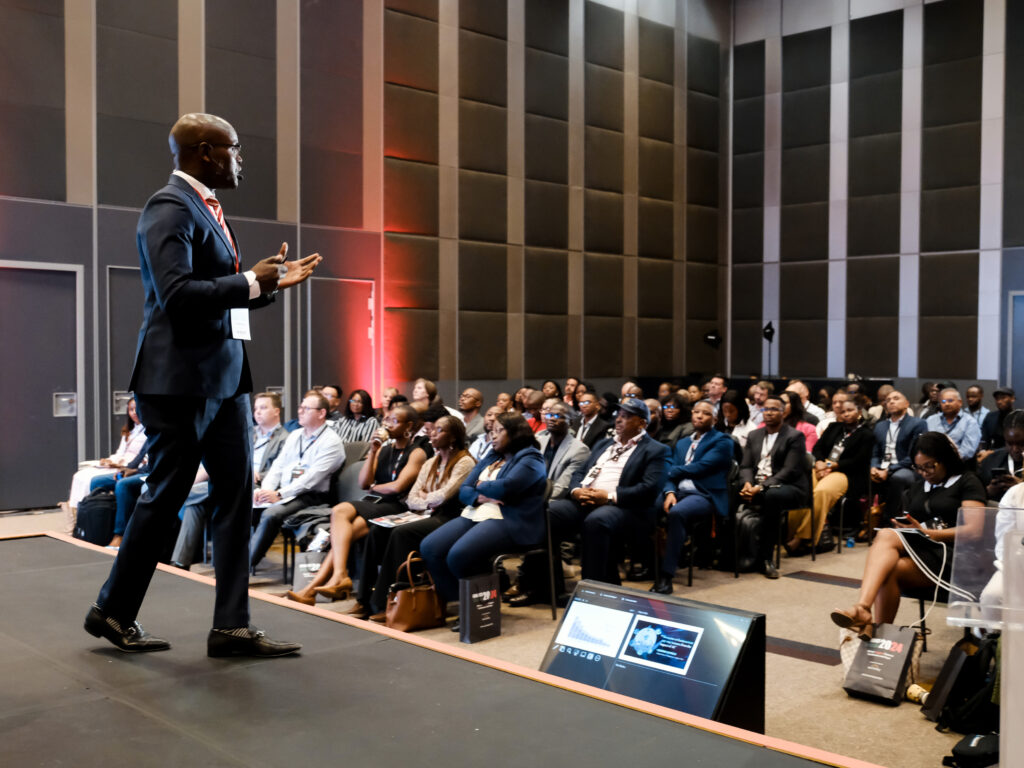
According to Dr Mark Nasila, data is quickly becoming a primary resource. He took the stage at the 2024 Finance Indaba on 10 October, where he made an impassioned plea for AI strategies that cater to Africa’s unique situation.
During a session on data, AI and Africa at the 2024 Finance Indaba, Dr Mark Nasila, chief data and analytics officer at First National Bank, noted that Africa had always played catch-up with technological advancements, warning that if the continent continued to sit back, the next generation would be mere consumers of technology.
“The world is going through a transformation that is reimagining industries, significantly changing the way we work, and has introduced so much risk and uncertainty about what is happening. AI is changing the meaning of life,” he told the audience.
According to Mark, data, which he considers today’s most valuable resource, is behind the hype around AI. Statista projects global data creation will grow to more than 180 zettabytes in 2025. This resource, he reckons, should be jealously guarded.
“AI can execute complex language tasks. No one imagined that ChatGPT could generate human-like text. This has allowed businesses to unlock resources by automating tasks and allowed people to focus on high-level tasks. It has enabled innovation and disruption,” he said.
As industries across the global economy continue to integrate AI into their operations, he noted that geopolitical realities such as the wars in Ukraine and Gaza would force all companies to invest in the technology. According to Mark, complex regulatory requirements and the rise in global interests had resulted in a need to innovate. He cited a study by Goldman Sachs that showed that organisations that use generative AI could boost their productivity by 1.5 percent.
“You work for eight hours a day, but are you productive for eight hours? Probably only two. Just by using AI, you could increase your productivity,” he said.
He also noted that AI and digital technology had created an entirely new set of demands among consumers. These demands, influenced by cultural expectations, had created a need for hyper-personalisation. Consumers of digital content on entertainment platforms such as Netflix, for instance, were on the lookout for TV series and films tailored to their interests. Television viewers have also found their content options expanded on video streaming platforms.
For organisations, AI presents the opportunity to automate repetitive processes, allowing workers to do more in the same amount of time. This, Mark predicts, will result in mass labour displacements. He however warned that inaction would make organisations uncompetitive and render them unable to meet the demands of their customers.
The reluctance to integrate AI into operations, Mark warned, could also result in lower-quality jobs, leaving workers engaged in tedious and mundane tasks. In this way, AI helps businesses realise value. He urged business leaders to come up with transformative models in creating industries for the future.
“The first phase of AI has been about modernising businesses. We must be alive to the impact of AI on national security. Many countries are facing threats driven by AI. In the near future, nations that lead in AI integration will be able to create trade policies and frameworks that influence the global order,” he said.
Mark called for urgent regulatory control and ethical frameworks to govern the use of AI, which has raised concerns around issues such as consent and data privacy. He proposed the use of AI to increase the efficiency of public services and create novel opportunities in Africa. In the midst of the skills-crunch observed across various industries, Dr Mark called for swift action to guard against brain drain.
“No country in the world has realised prosperity by outsourcing the processing of its primary resources. In this age, data is a primary resource. We need policies to govern its processing,” he said.
The second phase of AI, he reckoned, would require countries to take control of their AI development infrastructure and value chains. Key in this phase would be the creation of solutions tailored for Africa’s unique circumstances.
He identified six critical pillars for the successful realisation of this phase, namely digital infrastructure; workforce development; research, development and innovation; regulatory and ethical frameworks; and stimulating the industry.
He noted that AI was already operating under a trust deficit, and more needed to be done to retool workers for the demands of the future. Mark also called for international cooperation, noting that the countries poised to gain the most from AI were situated in North America, Asia and the Middle East.
So far, only seven African countries have drafted national AI strategies, with none having implemented formal regulation. These are Tunisia, Ghana, Mauritius, Egypt, Rwanda, Senegal and Benin. According to Mark, failed AI strategies could result in reduced economic competitiveness and exacerbate income inequality.
He also warned that it could increase dependence on foreign solutions and ramp up security and cybersecurity risks. Consequently, he called for solutions contextualised to the needs of Africa, saying AI strategies must be driven by unique national identities.
“Look for AI use cases within your context based on your unique challenges and opportunities. This will influence the value you get from AI. The value of your AI strategy is not based on what you promise, but what you measure. If you say you are digitising, I will ask, what are you measuring?” he said.
Citing Singapore’s initiative to improve AI literacy among people above the age of 40, Dr Mark noted that AI training must factor in an understanding of its limitations and ethical concerns. Noting that accountability was a major blind spot, he urged an awareness of how AI will influence the future.