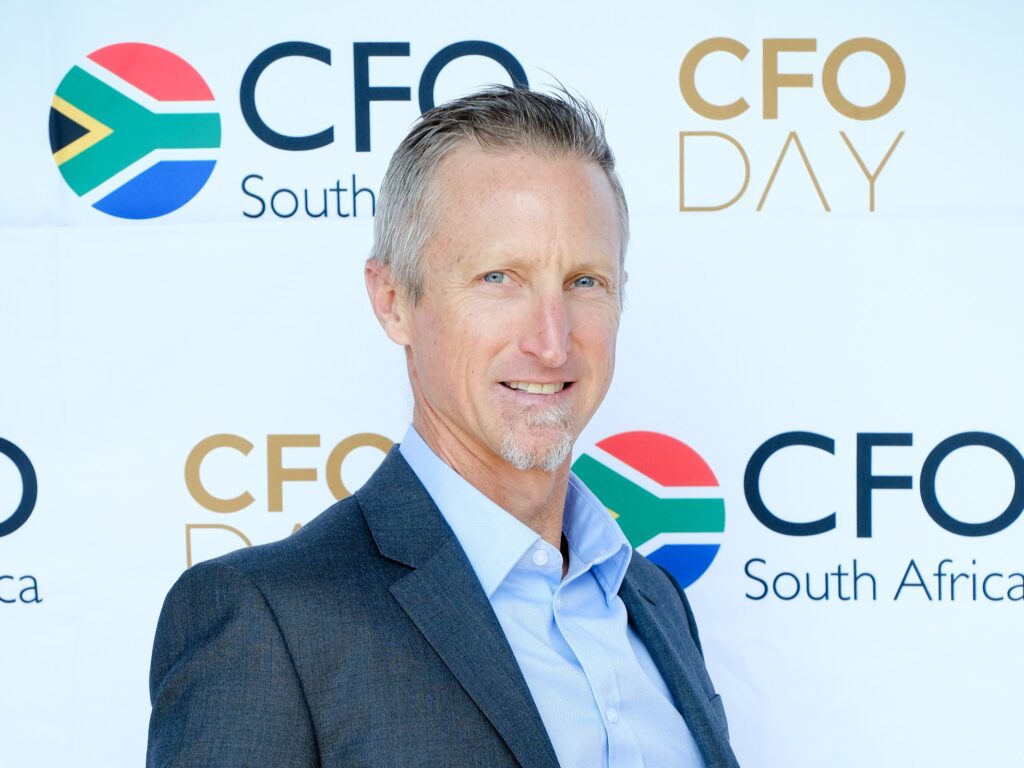
Speaking at the 2025 Executive Day, Nedbank CFO Mike Davis outlined the financial services provider’s approach to digital transformation, emphasising co-operation between finance and technology, governance structures, and the role of AI in enhancing efficiencies and client experience.
Mike Davis, CFO of Nedbank, spoke about the importance of digital transformation in financial services during a panel discussion at the annual Executive Day.
“Digital transformation to an organisation like ours, doing financial services, is an imperative,” Mike said. He stressed that technology continues to evolve and that transformation is a never-ending journey rather than a finite goal.
Mike explained that Nedbank had initially drawn on international research before developing what he described as a best-of-breeds approach. This involved identifying technologies that could be replaced, retained, or refactored, packaging this strategy as strategy evolution and presenting it to the board for sponsorship.
Mike explained that the chief executive spearheaded the effort, but he co-chaired it with the Nedbank CIO. “We thought long and hard on, and decided whether we keep this project within tech, or whether we keep it within finance. We took a position that, given the size of the spend and the fact that if you capitalised the spend, we would have to charge something for it, we’d have to run it under businesses,” he said.
He emphasised that the scale of spend required financial oversight while the complexity of execution necessitated shared responsibility with technology. The governance structure was therefore jointly co-chaired by the CFO and CIO. This model evolved into what Mike termed a two-part system, or a co-ownership system, in which each business unit was represented by both its business and technology representatives.
CFO and CIO working hand-in-hand
This approach aimed to streamline delivery by involving finance, technology, and business units simultaneously. “By partnering with technology and business, and with the finance team, you now effectively deliver through what we call squads. You’re effectively building tech solutions with the business alongside them,” Mike explained.
Mike also highlighted the role of customer feedback in shaping solutions. He referred to the two-in-a-Box model, which he describes as a working relation between the Business and Group Technology. He said the voice of the client must dictate design, ensuring solutions addressed real client pain points. This included creating omnichannel environments where customers could transition seamlessly between online and physical platforms.
He further noted the importance of data access and modelling in delivering productivity and value. Partnerships, including with Microsoft, had supported innovation, with Nedbank running 50 new business cases to test emerging technologies.
On AI, Mike said it was vital to engage early: “The way we look at AI is really across three dimensions. Either AI is going to help in our ability to manage risk or result in us leveraging efficiencies, in other words, being able to do things quicker, faster, cheaper. Or thirdly, it’s going to result in us being able to effectively lift revenues through, for example, a better experience for clients.”
He added that leveraging AI to analyse spending patterns would enable the bank to align offerings more closely with client needs.
“Services themselves are vital. You need to look after people’s savings and investments and this reinforces the role of digital transformation in strengthening both client experience and organisational performance,” he said.