You are the driver of a runaway tram that is headed down a narrow road where a dozen school children are playing. The only diversion is to the right, where an elderly woman is selling vegetables. Would you let the tram continue on its path or divert it?
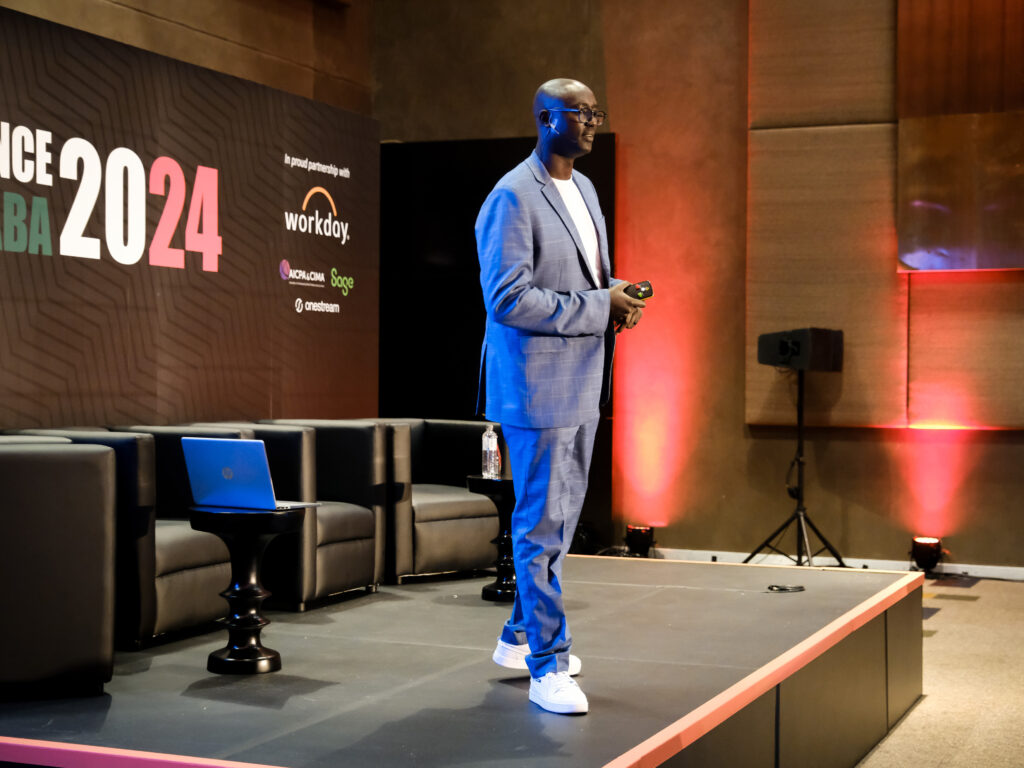
Author KC Rottok Chesaina recently presented this age-old trolley question to participants at the 2024 Finance Indaba, prompting varied responses. The question illustrated a common ethical dilemma and mirrored many conundrums finance professionals often encounter.
“An ethical dilemma is a choice between breaking a rule that has been set and pursuing a moral principle. An ethical dilemma could send you to prison. With a moral dilemma, you may not end up in jail, but you may not sleep well at night,” he said.
KC enumerated five threats accounting professionals must confront when making ethical decisions. These include self-interest threat, self-review threat, advocacy threat, intimidation threat, and familiarity threat. Participants also mentioned tax avoidance as an ethical grey area, which although legal, may be of debatable moral consequence.
Attendees also debated the fate of former Steinhoff CEO Markus Jooste, who was fined R475 million for contravening the Financial Markets Act by issuing false statements about the company, settling on the general consensus that his conduct exhibited all five threats.
“You are marking your own homework. You are deciding between Jane and John, and you argued for Jane to be hired, but you're also the one evaluating her performance. That's an example of a self-interest threat.”
He noted that individuals operated under different moral codes, which could lead to varying results when confronted with ethical questions. He provided a number of tests one could employ to determine a course of action. One such test is the sleep test, which requires accounting professionals to ask themselves whether they would sleep well having taken a given course of action.
The tombstone test
He also recommended the tombstone test, which invites finance professionals to imagine how they would feel if their actions were inscribed on their tombstones for all to see. KC also invoked the ‘reasonable person’ test, which examines whether a decision would survive public inquiry. Ultimately, KC noted, cultural differences influenced decision making.
The conceptual framework KC presented requires accounting professionals to identify threats to compliance with the fundamental principles of integrity and evaluate the threats identified. This entails consulting company policies and procedures and obtaining legal advice. In this sense, ethical conduct requires collaboration.
When confronted with ethical dilemmas, accountants have the option of conditional compliance, partially declining to act on requests they find objectionable. They may also communicate an outright refusal or report the matter to the authorities. KC also presented resignation as an option.
He cited the case of Cynthia Cooper, former VP for internal audit at WorldCom, who was warned by management against reporting irregularities. They threatened to not only fire her but also a large number of internal audit staff. She stood by her decision to report the conduct, after which the company shut down, with tens of thousands losing their jobs and senior management ending up in jail.
While ‘ethics’ and ‘morals’ are often used interchangeably, the former comprises rules set by society, companies, or governments, while the latter are a value system that helps users discern right from wrong. An ethical dilemma is a conundrum between breaking a rule and the pursuit of a moral principle, while a moral dilemma is a conflict between two moral principles. Regardless of the choices one makes, KC advised taking steps to mitigate negative consequences.
He also advocated courage, comprising three elements. One such element was conviction, which KC reckoned was a fundamental prerequisite. He also urged accounting professionals to develop fortitude to bear the consequences of their actions and seek support from family and friends.
Key to ethical conduct is the articulation of core corporate values. KC advised identifying company values, which must be ingrained in the company’s culture. He also urged accounting professionals to familiarise themselves with whistleblower policies, which offer protection to persons who blow the lid on financial impropriety.
In conclusion, KC advocated fidelity to the principles of integrity, objectivity, professional competence, and confidentiality.
Join the first-ever CFO South Africa CPD Day – an opportunity for finance professionals to learn, engage and grow, while completing 8 verifiable CPD hours before the reporting deadline. Taking place on 18 November in Melrose Arch, this event will cover mission-critical topics for finance professionals, including IFRS, Sustainability and Ethics. Book your seat today!