Perhaps the most underrated aspect of crowdsourcing is its potential to disrupt the current cost structure that supports talent management. Crowdsourcing makes sense when thinking about the perennial constraint that businesses face: costs. Cost containment remains a priority, and with people costs (including salary, training, perks, etc) accounting for close to or over 60 percent of the cost structure of most companies, crowdsourcing offers the potential to greatly reducing this expenditure.
By Terrence Taylor, Senior Consultant Executive Development at Google
- Will crowdsourcing make talent management obsolete?
- How to crowdsource new talent
- Read: Agile teams crucial for CFOs
Crowdsourcing may be so disruptive that it could not only make talent management obsolete but also all the supporting services in the talent management value chain, including assessments and talent acquisition via external channels such as head hunters.
Let's look at the following table to gain insight into how compelling and cost-effective crowdsourcing can be. It seems to me that at a minimum, talent management needs to create a Head of Crowdsourcing Role, and People Executives and their Heads of Talent must become comfortable with the realisation that crowdsourcing will one day replace talent management.
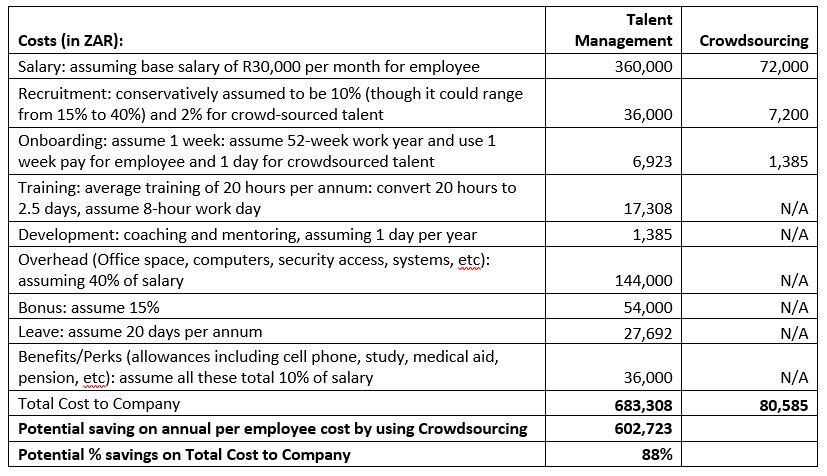 Crowdsourcing saves on salary, recruitment and onboarding costs, while eliminating training, development and contingent costs. Furthermore, crowdsourcing does not incur agency fees from recruitment agencies, including head hunters. Crowdsourcing seems well suited to help organisations find the right talent at a fraction of the cost. Indeed, it may prove to be a compelling strategy for sourcing the right talent to get work done.
So, the intriguing question becomes: in the new exponential environment of business, is it worth it to pay an 88-percent premium to have full-time employees when businesses can crowdsource talent on demand at a fraction of the cost?
As CFOs, consider the value add you could bring to your exco and your organisation by sponsoring a study of how your organisation can fundamentally restructure your company's income statement and balance sheet by reducing people costs up to almost 90 percent while significantly reducing contingent liabilities from benefits/perks such as pension and leave, thereby freeing up cash flow to invest in growing the business.
I wrote this series to spark thought and debate. I have not researched all the costs and freely admit to making assumptions based on insights from working in leadership development over 12 years and talent management for just over 12 months. While my opinions may seem cavalier, they are considered. I have formed them by paying close attention to the forces that are driving today and tomorrow's exponential business environment, and I have shaped them by considering how the People function can tangibly, compellingly and cost-effectively contribute to making or keeping business successful in an exponential and VUCA future.