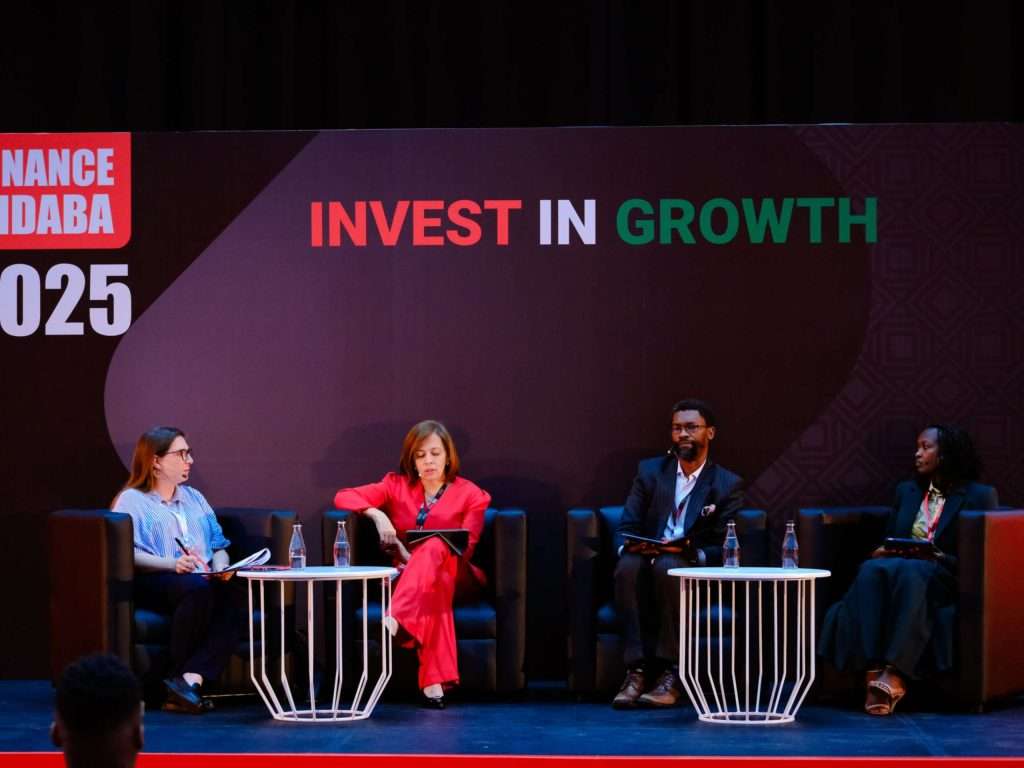
At a time when shifting US policies continue to unsettle global markets, finance leaders discussed the effects of the US policy storm at the recent 2025 Finance Indaba during a session titled Playing the Trump card: How local businesses can navigate.
The conversation brought together Anele Geza, CFO at BAIC Automobile, Fawzia Suliman, CFO at the Johannesburg Stock Exchange and Jubilant Speckman, CFO, Foskor.
Each represented a different pillar of the South African economy, manufacturing, capital markets and energy, yet they spoke with one shared concern: how to keep business steady when global power shifts alter the rules of trade.
Anele began by grounding the discussion in the reality of global turbulence. BAIC, based in Gqeberha, assembles and manufactures heavy and light commercial vehicles as well as passenger SUVs, but its vision, he said, extends beyond production. He described the company as part of a broader ecosystem where business and community progress together.
“We pride ourselves in contributing to community development,” he said, framing manufacturing as both an economic and social responsibility.
When speaking of the impact of US policies, Anele’s tone carried both concern and determination. He explained that the current volatility did not emerge by accident but by design.
“The global trends we are seeing were intentional and disruptive by design. They have paralysed markets, including our own. Leaders have become fearful, reacting instead of thinking strategically,” he noted.
For Anele, the path forward begins with introspection and deliberate action. He urged fellow finance professionals to rethink strategy, rather than react to uncertainty.
Localisation the key to resilience
“It’s not enough to name and shame what the US has done. We have to go back to the drawing board and ask, what economic policies can we adopt to defend our economy?” he posed.
He outlined the consequences of tariffs, describing how they drive up export costs and weaken competitiveness. Yet, rather than dwell on the challenge, Anele turned to solutions. He believes localisation holds the key to resilience.
“Every time you want to export, your goods become expensive. Employers hesitate to invest, retrenchments rise and the value chain collapses. That’s how the automotive and agricultural sectors both feel the strain. We need to refine our value chains and localise key components. If we can produce more locally, we can reroute to different markets and reduce dependence on one volatile export route,” Anele observed.
Anele said BAIC had already begun localising several products that were once imported. While the company had previously brought in heavy and medium commercial vehicles, it was now assembling them at its own plant. He explained that this shift not only supported local component manufacturers but also contributed to job creation. In his view, South Africa is well-positioned both geographically and economically to serve as a corridor to export markets while strengthening its domestic industrial base.
Renewed attention
Where Anele spoke of production and policy, Fawzia turned to the markets, the pulse point where those forces are most visible. Her tone carried a quiet confidence, reflecting both data and perspective. She began by pointing out that, despite the noise of global politics, local markets were showing resilience.
“Many of you might have heard that the JSE is one of the best-performing markets globally this year,” she said. “We’ve reached the 100, 000 index level, a milestone few would have predicted given the policy uncertainty.”
Fawzia went on to explain that the same volatility shaking international markets has, in some ways, benefited South Africa. As investors seek stability through diversification, emerging markets have drawn renewed attention.
“We’ve seen foreign inflows into government bonds, though equity flows remain negative. Even so, domestic institutions have stepped in, pension funds, insurers and asset managers attracted by the value in local companies,” Fawzia highlighted.
She said the JSE’s performance reflected a renewed sense of confidence, pointing to a more than 30 percent increase in value traded this year. In her view, geopolitical shifts had fuelled trading volumes as portfolio managers repositioned to manage risk. Fawzia also highlighted a rise in derivatives hedging, which she saw as a clear signal that investors were actively seeking protection against potential market pullbacks.
Fawzia’s message was clear, South Africa should view this period as one of opportunity rather than uncertainty.
“Countries are starting to look inward, to become more self-sufficient. As South Africa, we need to use this period to strengthen internally. Engage more deeply with the EU, China and within Africa through the Continental Free Trade Area. The next three years should be about building resilience, so we’re ready for whatever comes post-Trump,” she stressed.
Sparking innovation
Jubilant brought the discussion back to the practical realities of production and export. Her perspective, drawn from years in energy and mining, emphasised the importance of anticipating disruption before it arrives.
“We mine phosphate rock in Phalaborwa and produce granular fertiliser. Forty percent of our rock is exported mainly to Europe, Asia and the Middle East while the rest supports local agriculture,” she noted.
Jubilant acknowledged that while some industries have been directly affected by US tariffs, others remain indirectly exposed. But that, she warned, should not lead to complacency.
“We might not be affected now, but disruption will always come, whether it’s tariffs, a pandemic or war,” she said. “That’s why we are mapping our full value chain to see where we can localise.”
To illustrate the point, she shared a practical example of how disruption can spark innovation.
“Phosphoric acid is part of our process. There’s a food-grade version used in products like Coca-Cola, but we don’t make it locally. So we’re exploring how to set up a plant here. That would create jobs and expand beneficiation in South Africa,” she explained.
For her, agility and diversification define the modern CFO. Finance leaders, she said, must look beyond numbers to strategy and foresight.
“We need to demonstrate strategic agility, diversify geographically, review concentration risks and strengthen collaboration between operations and finance. Breaking the silo mentality allows better scenario planning when disruptions hit,” she emphasised.
As the conversation wound down, one theme connected all three perspectives, independence.
Anele championed localisation as a shield of economic defence, Fawzia emphasised resilience anchored in fresh global partnerships, while Jubilant called for agility driven by innovation and beneficiation.