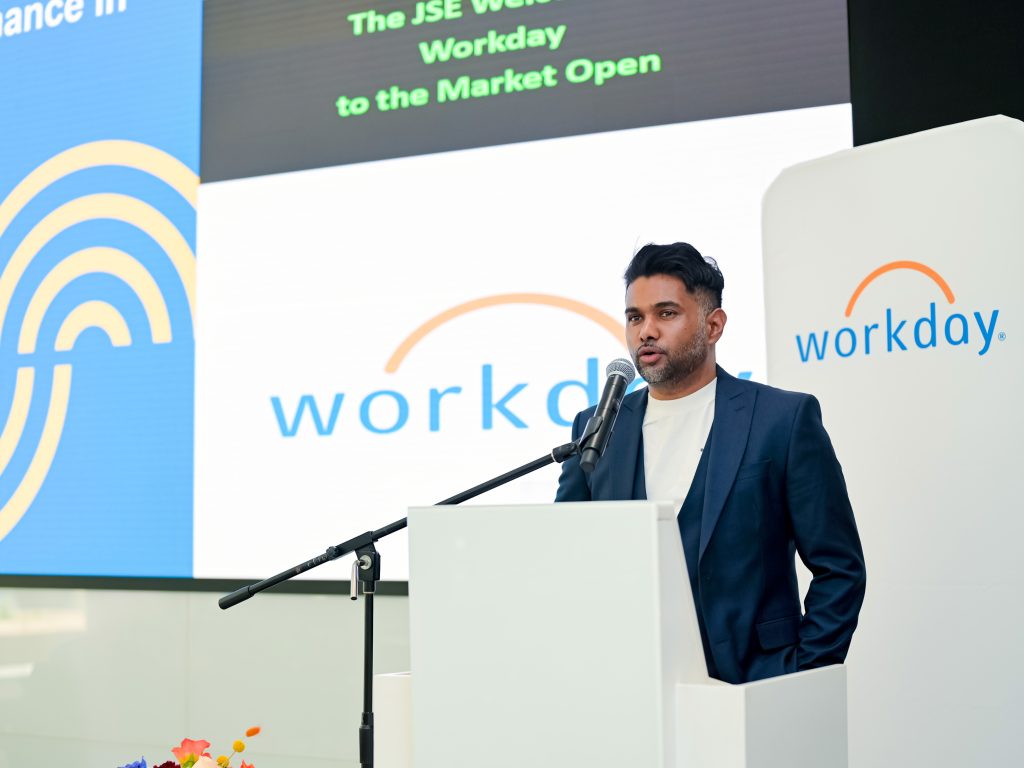
The JSE was the place to be for leaders in the finance world on 23 October, as it was the venue of Workday’s Transforming Finance: The Future of Financial Services with Workday Financials.
During the event, delegates heard from Viren Patel, Workday senior industry advisor covering the financial services industry for the Europe, Middle East, Africa region, as well as Deloitte partner and finance and performance leader, Andries van den Berg, on the future of finance.
After the bell was rung to open the market, the two discussed how finance can be a great partner for business when it comes to strategic growth ambitions, including mergers and acquisitions, as well as launching new products and expanding into new markets.
Viren highlighted that finance needs systems that go beyond the current concept of an enterprise resource planning (ERP) solution to provide insights that allow companies to be better partners for the rest of business.
He was participating in a fireside chat with Andries at the event at the JSE, Africa’s oldest stock exchange, which is also a Workday client.
Viren explained that Workday is a system that not only takes the mundane tasks out of day-to-day financial operations, enabling financial professionals to add value to their companies, but can also enable businesses to expand, even considering different regulatory environments.
“As financial professionals, we need to show companies how they can go to markets beyond just providing the numbers. We can put technology in to help drive value a lot quicker. We need to now be talking beyond ERP and about financial and HR systems with business capabilities,” he noted.
Proper systems, Viren highlighted, allow finance to be business partners.
Andries added that, as the finance function expands beyond just numbers, the “pressure on finance is increasing - it’s going to carry on increasing” - and finance can no longer just continue chasing data.

Speaking to findings from Deloitte’s recent Lights Out Finance report, Andries noted that 92 percent of CFOs expect to embed more technology and automation into their operations soon. This, Viren added, means that they are not happy with the way things are currently working.
Andries explained that a key finding from the report is the amount of time people spend on data means they don’t get to apply their minds to insights. Automation, he notes, can handle tasks such as reading invoices to process information as companies mature in their application of technology.
A key aspect of automation is reducing the time it takes to run end-of-month books, which can take as long as half a month, limiting financial professional’s ability to look towards the future.
Andries said that defining business processes and allowing technology to handle mundane tasks can, for example, reduce the time spent on journalling by 80 percent.

Automation also means that financial information will become a correct single point of truth, reducing auding costs as the time to verify the books will be trimmed, while also allowing any reporting to be pulled quickly. Half of the clients that Deloitte helps have issues with their data, Andries pointed out.
“It’s not artificial intelligence (AI) that is going to take your job, it’s the person who knows how to use AI who is going to take your job.”
Simultaneously, it’s important for companies to retain top talent, which means that they need to ensure that staff have time out and are not working extreme overtime hours dealing with data each month.
This means systems need to adapt to the new world of work in which people want to work remotely so they can “spend time with their dog.”
AI can also bring fun back into accounting by allowing people to enjoy creating insights, however technology is not a silver bullet. It needs to be correctly implemented to be successful, Andries concluded.