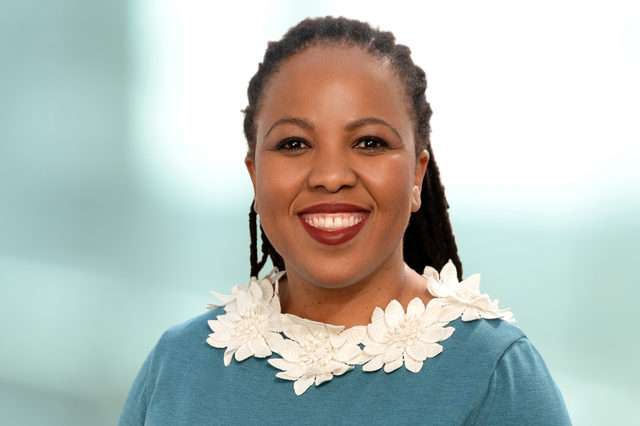
“There’s never been a more wonderful time to be a banker,” says Funeka Montjane, CEO of Personal and Business Banking at Standard Bank. Montjane, a 2015 WEF Young Global Leader, believes that the future of banking lies in creating time for customers with the help of automation, artificial intelligence and FinTech. Speaking about the future of banking at the Singularity University South Africa Summit, hosted on the continent for the first time in collaboration with Standard Bank, Montjane said that we’re living in what Stephen Hawking called ‘the century of complexity’ – in a more compressed and globalised world characterised by rapid disruption, and where information is free.
Montjane - a CA with a Master's in commerce - is credited for transforming the bank's home loans business unit from a loss of R1 billion to a profit of R100 million within a year; a feat which earned her the nickname 'Thatcher' and 'The Iron Lady', among her colleagues. Montjane explained how technology and adopting straight-through processes has enabled bank roles such as waste clerk to be automated in a cost-effective and time-efficient move that is beneficial to both the bank and its customers. "For every day that there is someone shuffling papers, a customer is waiting on the other side. Not only are these roles expensive but they waste time," she said. "Our biggest dream in banking today is to create time for our customers."
All the reconciliation processes that happen at Standard Bank branches and ATMs in Gauteng are automated by one server in a matter of 10 minutes.
"The biggest companies in the world with the biggest market caps, employ the least number of people. The question we need to ask ourselves - particularly on this continent and in this country where we have a problem of unemployment - is, will new jobs be created?"
Montjane believes that the answer lies in FinTech, especially as Standard Bank's relationships with FinTech companies mature. The bank has up to 15 proof of concepts currently at play with various FinTech companies. Montjane predicts that these technological solutions will open new markets and new employment opportunities for economic inclusion.
Standard Bank is doing various proof of concepts on distributed ledgers, which are secured cryptographically and can be shared digitally across a network of users around the world with recorded changes reflecting almost instantaneously. "Imagine the possibility of a single version of truth in real time," Montjane says. "This season of technology has the potential to unleash human creativity to solve our customers' problems, and to build net positive systems and access to funding and markets for entrepreneurs, ultimately because we have both sides of the equation and the supply chain."
Montjane dismissed the commonly held belief that the adoption of new technologies and automation will create an impersonal distance between the customer and the bank. "On the back of mobility, artificial intelligence, robotics and the technologies that exists, I can have a relationship with 10 million customers and 60,000 businesses," she said. "It's an opportunity to say, I know you. I see you. You are an individual. You are not a number."
By: Iga Motylska