
Responsible investing systematically incorporates environmental, social, and governance (ESG) factors into investment analysis to improve risk-adjusted returns. It creates an integrated thinking model that balances financial success with broader ecological and social value creation.
In a world shaped by climate change and social inequality, an organisation’s financial success is closely tied to environmental and social issues. Sustainability plays a key role in capital allocation and investment decisions, yet the understanding of responsible investment remains uncertain.
Components of responsible investing
Although there is currently no generally accepted definition of responsible investment, the concept represents a fundamental shift in how investment decisions are made by investors, asset managers, and owners.
ACCA has identified eight core components of responsible investment – creating an integrated thinking model, which ensures all risks and opportunities are systematically incorporated into investment analysis and capital allocation.
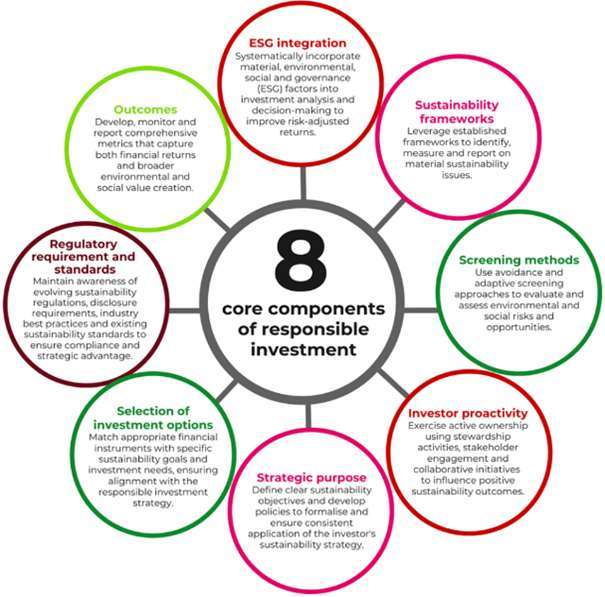
ESG as a part of investment analysis and decision-making
Integrative thinking helps stakeholders assess and prioritise ESG issues in decision-making. Although determining priorities can be challenging, investors typically consider a range of material non-financial factors, combining qualitative and quantitative inputs such as stakeholder expectations, regulatory requirements, and direct and indirect dependencies. This is because a sustainable organisation embraces the three components of economic, environmental, and social action to deliver a long-term future.
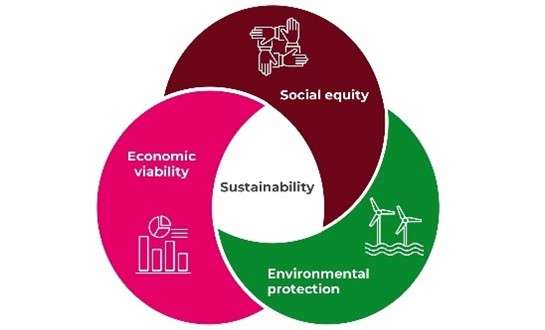
The role of profit in sustainability
Responsible investing does not exclude financial considerations; it ensures stakeholders assess the full range of risks and opportunities in investment decisions and capital allocation. The link between profit, sustainability, and value creation is complex, and corporate reporting now reflects a broader view of a ‘good organisation’ beyond profit to include risk and sustainability.
ACCA’s Principles of good corporate reporting explain that corporate reporting is about communicating how an organisation is operating and responding to changes in its external landscape. While profit remains essential, maximising it at all costs is not the overriding objective of a sustainable business.
Providing decision-useful information for responsible investors
The range of analytical techniques used by responsible investors reflects the organisation-specific nature of ESG information. However, the growing volume of sustainability data presents increasing challenges. Frameworks and standards developed by bodies such as the Task Force on Climate-related Financial Disclosures (TCFD) and the Global Reporting Initiative (GRI) provide a structured approach to addressing ESG issues.
However, the increasing number of guidelines has led to inconsistent terminology and excessive use of metrics. The establishment of the International Sustainability Standards Board (ISSB) is a key step toward a global baseline for sustainability disclosures, though many still experience disclosure overload. This underscores the need to align sustainability with business strategy and focus only on relevant Sustainable Development Goals (SDGs).
The future of responsible investing
While responsible investors recognise that sustainability reporting is still evolving, many would like companies to go further in balancing financial, ecological and social value creation.
Assessing how sustainability factors affect an organisation’s valuation is complex. Investors typically use multiple valuation techniques, with climate risks only partly reflected through investment assumptions and risk adjustments. Addressing this requires more advanced modelling approaches than many organisations currently have in place.
What is clear is that financial institutions are improving their understanding of how sustainability factors affect the resilience of the organisations they invest in. However, a recent trend of distancing from international net-zero and climate initiatives may increase inconsistency in responsible investment practices worldwide. In such an uncertain environment, the eight components of responsible investment provide a valuable anchor and framework for navigating this evolving discipline.
Stakeholder recommendations
For companies, it is important to have a clear ESG strategy that aligns with the broader business strategy. Guidelines such as the UNSDGs should be used as a principles-based framework rather than a checklist. Every disclosure should be assessed for relevance and value, while engaging stakeholders to understand their priorities. Where possible, cross-referencing can enhance information connectivity and coherence.
For investors, scenario planning should be used to evaluate both the short- and long-term impacts of climate change and to communicate effectively with investee companies. Material sustainability issues should be integrated into core decision-making by considering all eight components of responsible investment holistically. Investors should also stay informed on emerging research, standards, and best practices, adapting their approach as needed.
For policymakers, regulations should be clarified and streamlined, building on a global baseline through a robust and inclusive process. Mandatory independent assurance should be required for both financial and sustainability-related information, ideally at the same level. Over the long term, the goal should be for reasonable assurance of sustainability information to become standard practice.