Finance leaders gathered in Sandton as leading solution providers had just four minutes to showcase the ideas and technologies shaping the future of finance, from AI-powered automation to tokenisation and treasury innovation.
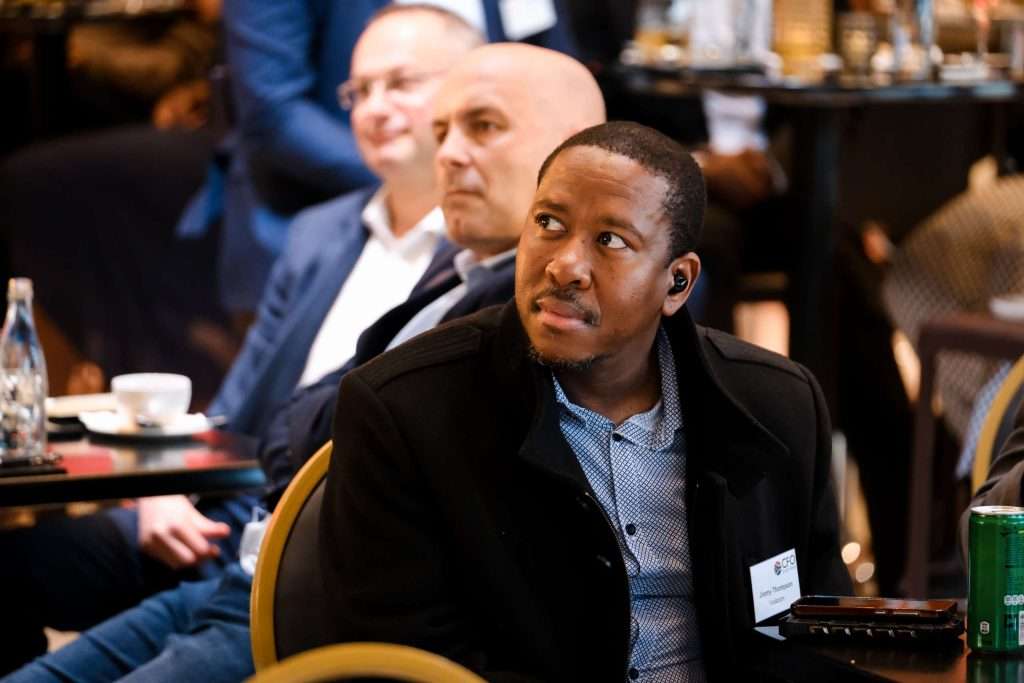
As the winter sun dipped below the Sandton skyline, casting the city centre in warm amber and violet hues, Johannesburg's finance community gathered at The Venue Green Park for the 2026 edition of CFO South Africa's annual Pitch Parade on 30 July. The popular networking event once again challenged leading solution providers to distil their biggest ideas into just four minutes, proving that some of the most impactful conversations can happen in the shortest amount of time.
Representatives from CFO South Africa's principal partners Alteryx and Dimago, executive partners Marsh, Magic Orange, Ninety One, BDO South Africa, STANLIB and Workday, together with associate partners AICPA & CIMA, Caseware Africa and Wings Global Travel, took to the stage to pitch solutions designed to help finance leaders navigate an increasingly digital and complex business environment.
Guests enjoyed drinks, snacks and networking before renowned comedian Mark Banks officially opened proceedings. His trademark humour quickly settled nerves and set the tone for an evening that blended insightful business discussions with plenty of laughter.
AI, automation and smarter finance
The opening round focused heavily on artificial intelligence, automation and the growing need for finance teams to embrace new technologies.
Christiaan Brink, divisional managing director of finance professional and multisector at Caseware Africa, introduced the company's latest innovations, highlighting how AI is reshaping financial reporting and audit processes.
“With agentic AI driving the next wave of technological revolution and transformation, we are very excited to introduce Caseware Verity, our agentic AI assistant. Verity provides a built-in intelligence layer directly into the Caseware cloud ecosystem. It understands the context of your work, professional standards, your firm's policies and the documents you provide, helping finance professionals cut through complexity while maintaining privacy,” he said.
Alteryx lead sales engineer Anique Hakkim echoed the AI theme, arguing that technology alone is not enough without effective implementation.
“AI can analyse data, but what is often missing is the business context behind it. That context sits within your finance teams. They understand how the data evolves and what the rules are. The missing link isn't AI itself – it's execution,” he said.
Dimago chief executive Pierre Naudé turned his attention to one of finance's biggest cost centres: audit fees. Using practical examples, he demonstrated how automation could significantly reduce time spent on repetitive tasks and improve audit efficiency.
"Our experience shows that with clean, fully tested automated processes, between 10 and 20 percent of audit fees can become negotiable. Technology already exists to automate many of these manual processes. What's been missing are people who understand both finance and technology,” he said.
Ninety One's head of South African corporate business, Quaniet Richards, introduced attendees to tokenisation and its growing relevance for corporate treasury.
"Tokenisation isn't crypto; it's a treasury revolution. It's about instant payments, immediate settlement, 24-hour availability and removing unnecessary intermediaries. The underlying investment remains exactly the same, but the technology fundamentally changes how ownership and transactions are recorded,” he explained.
Cash, governance and economic resilience
The second round shifted the conversation towards treasury management, AI governance and the broader economic landscape.
O'lerato Litlhakanyane, senior specialist and client fund manager at STANLIB, challenged finance leaders to think differently about idle cash.
"The question for CFOs is no longer whether they can access their cash. The real question is what that cash can do while it is waiting to be used. The opportunity today is to maintain liquidity while improving how your cash is deployed,” she said.
Workday's head of customer strategy and value, Kirenga Rwigema, focused on the importance of responsible AI.
"Workday agents don't interpret or learn your business rules – they inherit them. From day one they operate within your existing security model, approval workflows and governance structures. They know not only what to do, but who is asking and what they are authorised to see,” he said.
BDO South Africa's Gqeberha office managing partner and automotive sector leader Siyabonga Mthembu reminded attendees that finance leadership extends beyond balance sheets and into the wider economy.
"The numbers matter. The automotive sector contributes more than five percent of South Africa's GDP and supports hundreds of thousands of jobs. If we fail to create an environment where local manufacturing can compete globally, the economic consequences will be significant,” he said.
Marsh strategy and client leader Robert Jacobsz drew inspiration from Formula One racing to explain how organisations should think about risk.
"Formula One teams do not eliminate risk, and neither can you. They build systems, processes and partnerships that enable them to respond quickly when something goes wrong. Your board doesn't care about your risk register – it cares about predictable earnings, cash flow and performance,” he said.
Investing in people and performance
The final round broadened the discussion to leadership, talent development, business travel and technology governance.
Thabang Matsena, manager of business development at AICPA & CIMA, emphasised that finance professionals remain organisations' greatest competitive advantage despite rapid technological change.
"Technology will continue to evolve, but your people remain your competitive advantage. The CFO who knows how to harness AI, lead people and turn insight into action will outperform those who don't,” said Thabang.
Jennifer Beard, head of business development at Wings Global Travel, highlighted the hidden costs of unmanaged business travel.

"Travel doesn't become expensive because of flights or hotels. It becomes expensive because of invisible costs – approvals that arrive too late, fragmented data, invoices that don't reconcile and decisions made before finance has visibility. When you can see every decision, you can control every rand,” she said.
Closing the evening, Magic Orange executives Stephan Coull and Tian van der Walt challenged finance leaders to bring the same governance to technology investments as they do to every other area of the business.
"Technology has become one of the fastest-growing costs on the profit and loss statement, yet it is often the least governed. Finance needs a shared language with technology teams so that every technology investment can be connected to measurable business value," said Stephan.
The event ended with refreshments and networking as delegates reflected on an evening packed with practical ideas and future-focused thinking. From AI governance and treasury innovation to technology investment, leadership and risk management, the 2026 CFO South Africa Pitch Parade once again demonstrated why it has become one of the finance community's flagship networking and thought leadership events.