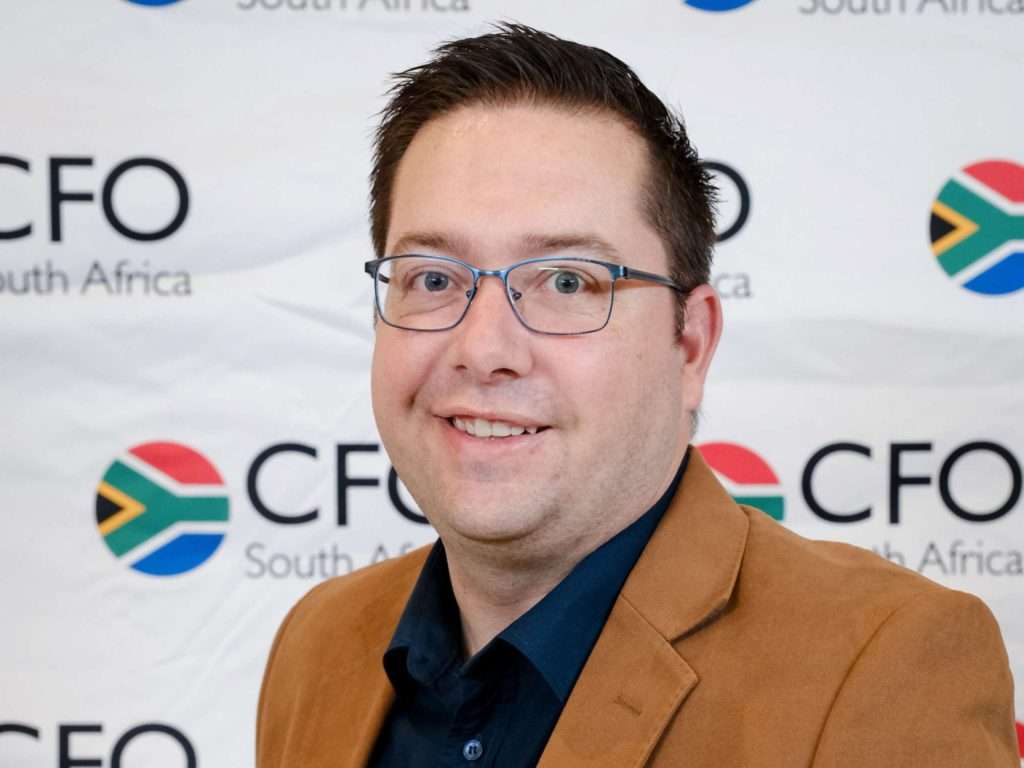
When 2025 CFO Awards nominee David Chadinha was eight years old, he set his sights on becoming a listed CFO. He achieved that dream at 35. But dreams don’t always pan out the way it’s envisioned. It takes discipline, resilience and people-first leadership that turns ambition into a dream realised.
At eight years old, while most children were still deciding what sport they liked, David Chadinha had already chosen his career.
He was going to become the CFO of a JSE-listed company by the age of 35. “Yes, I was a bit of a strange child, but that’s where it started for me. I was going to do this and everything I was going to do would be in service of that goal,” he says, chuckling.
The universe seemed to align with young David’s ambition. As he progressed through school, he found that he had a natural talent for numbers and later accounting in school. Understanding the complex subject matter flowed naturally to the shy high school student.
That clarity of vision became his competitive edge building something more powerful than ambition: discipline.
The baker and the bookkeeper
Described as a ‘Laat lammetjie’, David’s parents’ advancing ages were always in the back of his mind. “My dad retired when I was in standard five (grade seven) and I was always trying to be independent so as not to be a burden to them.”
Shortly after his father’s retirement, David got his first job at the local Spar packing groceries and later as a cashier. He was just 16 years old.
He packed shelves and ran the tills. He also helped with basic bookkeeping, and even worked in the bakery when needed.
“That was just odd,” he says in retrospect. “On a Sunday, the baker wouldn’t pitch up at the bakery and I had to bake the rolls. Not sure how we did it, but we worked it out,” he says.
It was an early lesson in accountability, learning to step up and get the job done.
It was also a first-hand lesson in business operations, the pressure of margins, the importance of cash flow, and the impact of every operational decision.
David applied these early first-hand learnings to his studies at the University of Johannesburg, where he completed his BCom (Cum Laude). With the help of a bursary from Deloitte and strong academic results, he managed to complete his studies at minimal cost to his family.
“I was quite lucky. When I joined university, I got a bursary from Deloitte which covered part of my studies. And then, by studying hard and achieving good marks, I qualified for a discount from the university, so in the end my total cost for my whole degree was only around R4,000,” he says proudly.
Master the fundamentals
At Deloitte, David completed his articles working primarily on the Transnet account – a complex, high-pressure environment that demanded precision and resilience.
“I literally got absorbed into doing a subsidiary audit and then the head office audit virtually the whole year. They had interim audits, quarterly reports and full annual reports, which was great exposure.”
He rose to senior audit manager, mastering governance, financial controls and risk management, but he also understood something critical: auditing builds insight, while industry builds impact.
During this period, David also experienced milestones in his personal life. He got married, and welcomed his first son in 2011 and then his second son in 2014.
“It’s always a balance between growing your career and growing into fatherhood. At times it was exhausting but when I look at the young men they have become today, it was all worth it. ” he says proudly.
At 30, he made the strategic shift from auditing into industry, joining Eqstra, a JSE-listed capital equipment-focused leasing and sales group.
“Auditing was becoming increasingly regulated. You have no real control as you only see the client once or twice a year. They can do whatever they want to during the remainder of the year and yet you’re the one who remains accountable,” explains David.
Over the next seven years, he built what he calls “30 years of experience”.
He was deployed into struggling divisions, tasked with turning around underperforming operations and leading complex system implementations such as a failed ERP rollout in the mining division, a loss-making plant hire division and other large-scale restructures.
Through these experiences one philosophy became central to his leadership: align people; process and systems. “When those three work together, performance follows,” he says.
“Business problems are rarely just financial,” he says. “They’re operational. They’re human. They’re structural.”
At the firm’s plant hire division, which was at that point running up to R2 million-a-month in losses. David managed to get the division to break even, but the exec’s realised that was the best they were ever going to get from that division and instructed David to shut it down.
This was David’s hardest and steepest learning curve to date as people’s livelihoods were at stake and he had to essentially retrench nearly 400 people.
CFO of a top 35 at 35
In 2016, a corporate restructuring of the group created an opportunity. Part of the group operations were acquired, and the remaining contract mining division became a standalone JSE-listed entity.
At 35, right on schedule, David realised his childhood dream. “I became a listed CFO at 35, as it turned out,” he reflects.
But dreams don’t always pan out the way one may intend and David’s tenure as CFO was short-lived.
A few months into his new role, a contractual dispute in Botswana followed by two months of torrential rains brought operations to a halt. The events ultimately forced the board to confront a difficult truth – the business was no longer sustainable. What followed was one of the most demanding periods in his career.
He led complex negotiations with a consortium of banks, managed significant debt obligations and oversaw the orderly wind-down of a billion-rand operation. Through carefully structured asset sales and the transfer of key contracts, approximately 3,000 jobs were preserved.
“It wasn’t the CFO story I had imagined,” David reflects, “but it became one of the most important learning experiences of my life. Within a year, I was tasked with something few leaders ever face – winding down a business with more than 4000 employees and a billion rand business in 12 months,” he said.
That experience changed my perspective in that titles may mark milestones but character is forged in crisis.
With the benefit of hindsight, David says, “There’s always an opportunity in chaos. While I had to wind down the company and let go of a role that I had dreamt about since childhood, the experience I gained from previous roles was about to prove invaluable.”
Trying times ahead
After closing the chapter on his listed CFO role, David’s resilience was tested further. The period that followed proved challenging both professionally and personally. He took up a role at a coal company, but the environment was not the right fit, making it a difficult chapter in his career.
At the same time, David faced a significant personal change. His marriage came to an end during this period and he had to adjust to new custody arrangements for his two sons.
Yet, as is often the case of moments of uncertainty, a new opportunity soon emerged. David was offered a role at his current company, Eazi Access, marking the beginning of a more positive chapter in his journey.
Reset, rebuild and renewal
After an intense period of consolidation, both personally and professionally, David joined Eazi Access in 2019. The business required stabilisation and renewed stakeholder confidence. It was also facing challenges related to corporatisation, shareholders dynamics and a complex debtors book.
For David, however, this was exactly the type of challenge that appealed strongly to the problem-solver in him.
“It was quite nice for me because I joined at a point where I could work together with the other executives to decide on a strategy. So we sat down and drafted a game plan to be executed over three years.”
The first key to success was to rapidly reduce reporting cycles, from two months to 10 working days, and later to six. One version of the numbers, shared transparently. This enabled more real-time decision-making to ensure that the business was agile.
“You can’t expect alignment if everyone has a different view of the truth,” he says. “Trust starts with accurate information.”
He then strengthened the finance function, embedded capital discipline and built a culture of accountability.
But then Covid-19 struck.
Revenue pressure intensified and retrenchments seemed inevitable. Instead, David and the executive team led from the front. The executives took a 25 percent pay cut, with the remaining employees taking a lower cut. This helped protect jobs during the difficult period.
Temporary salary reductions were implemented across the business, directly linked to revenue recovery. Pension relief and TERS measures helped protect employees’ take-home pay.
The result: no retrenchments – and a team that returned fully intact when restrictions were lifted.
“The CFO sets the emotional tone in a crisis,” he says. “If you remain calm and focused on solutions, the business follows.”
Sustainable growth, measured leadership
Post-pandemic, Eazi Access implemented a focused and disciplined growth strategy. Over the past three years, the company has achieved annual growth exceeding 10 percent, significantly enhancing shareholder value.
“I am proud to sit here today, even with all the stress,” he says. “I’ve learnt that leadership is not about control or having all the answers,” he says. “It’s about creating an environment where others can perform at their best.” It’s in team development, leadership succession and building systems that outlast individuals.
On the homefront, and nearly a decade later, David has remarried and welcomed a stepson into the family. “As a father of three boys, perspective is never far away. My sons make me extremely proud everyday in the way they are tackling the world despite any challenges they encounter.”
“They keep me grounded,” he laughs. “And they remind me that growth is ongoing – in business and in life.”
Looking back, he is confident that the eight-year-old who set the audacious goal of becoming a listed CFO at 35, would likely be satisfied with how life turned out.
His parents are also proud of how their son turned out. Although his father passed away in 2024, he lived to see David flourish professionally and personally.
David now takes care of his mother, who now lives close by, and she often spoils the family with freshly baked goods. “We all have to take care of our health,” he jokes, “because my mum is always baking up a storm.”