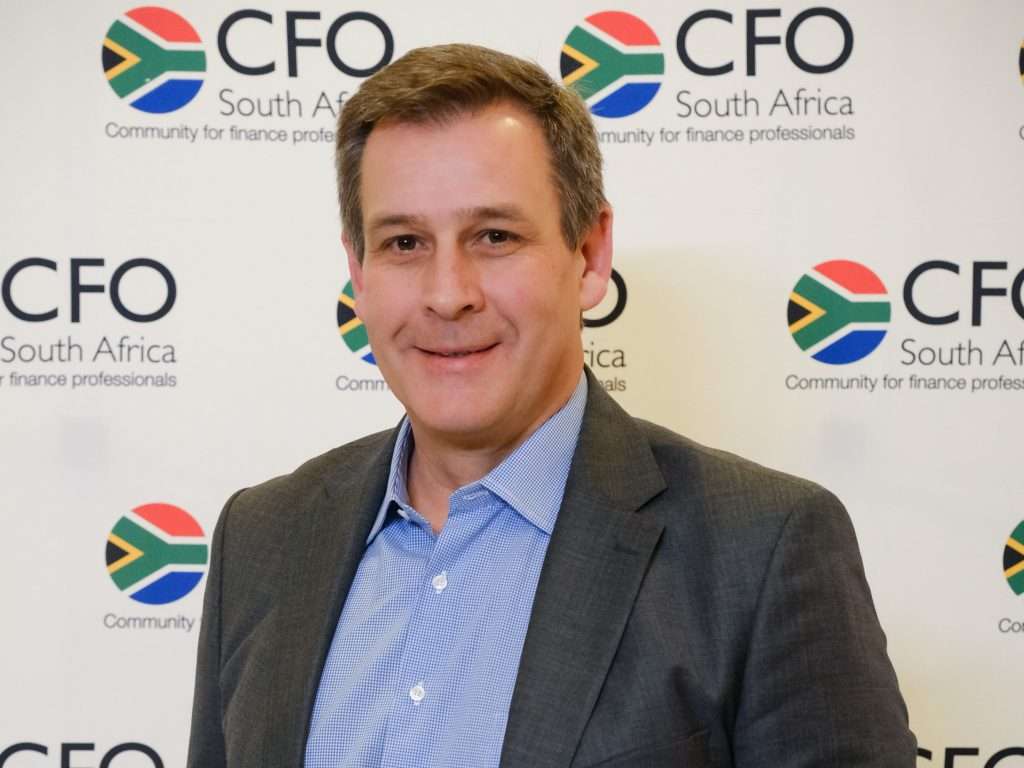
Discovery’s work culture thrives on collaboration, according to group CFO Deon Viljoen – and the design of its head office is a testament to this. And while the group offers various services, there is a golden thread that holds everything together.
Most days, you’ll find Deon Viljoen working at Discovery’s Sandton head office. The company has a flexible but well-considered approach to working from home or the office and is tailored according to what is best suited to each team. While senior management comes into the office every day, other team members come in on average three days per week.
The Discovery culture thrives on collaboration, and the design of its impressive head-office building plays a crucial role in this.
“During Covid-19, we missed the impromptu connection and the natural pollination of ideas that happens when people are together. We do find that certain teams tend to naturally migrate back to the office nowadays,” he said.
Deon, who joined in 2017 as Group CFO and executive director, recognises that Discovery operates in a complex industry and its business model adds an additional layer of complexity. The Discovery Medical Scheme is of course the most prominent, but it should be borne in mind that it is a separately regulated scheme similar to a mutual scheme belonging to the members, with Discovery Health performing all the administration and comprehensive support functions to the scheme and its members.
Today, Discovery Health is by far South Africa’s biggest open health insurance provider. The group also offers life insurance, short-term insurance, investments, and banking.
Shared value model
While there are several different financial services businesses in the group, there is a golden thread that holds everything together.
“To understand Discovery, you need to grasp the shared value model, which connects all its offerings. This model aims to form a relationship with our customers where we guide and influence behaviour to reduce risk. Clearly as an insurer, this reduction in risk results in the unlocking of real financial value that can then be shared with our clients in order to keep that virtuous cycle sustainable.”
The model has its roots in Discovery’s Vitality Programme, which was pioneering when it launched.
“The shared value model was originally developed in Discovery’s Vitality Programme in South Africa, which has the largest datasets with unique insight into longitudinal health and life data and the correlation with healthy lifestyle choices and activity as well as the impact of change in behaviour over time. The real intellectual property is of course actuarial in nature,” he explained.
“We certainly don’t see new technologies as a threat, but rather technologies such as generative AI and developments in data engineering are seen as massive opportunities to support the evolution of the model that is now fast evolving to incorporate hyper-personalisation,” he added.
For example, a client with diabetes would receive specific, personalised guidance and engagement. In essence, clients who demonstrate healthy habits while lowering their risk profiles are rewarded and this impact is not limited to the young and healthy.
“Everything we do is purpose-driven. Since our start in 1992, we have been committed to making people healthier and enhancing and protecting their lives,” Deon said.
Use of AI
Discovery has a large team of actuarial expertise, data scientists, developers and technologists. “We use AI in various forms and applications, but our real intellectual property lies in our ability to understand the impact on health risks resulting from lifestyle choices through our data and then to apply that insight. We use data to constantly refine our model. While Vitality might look like a loyalty programme from the outside, it’s actually a true shared value relationship with our clients and a behavioural change programme,” added Deon.
Independent research has validated the model for its positive impact on reducing healthcare costs, resulting in improved profitability – a portion of which is channelled back into funding incentives that drive positive change.
Today, Discovery is a global leader in the idea of shared value and can feed health and activity data into the actuarial model. “As part of the evolution to hyper-personalisation, our most recent insights and innovations revolve around habit formation. For Discovery, it's important to know how habits are formed, what is required to make good habits sustainable and how better choices play out over the long term, ” added Deon.
A global banner
While Discovery is a South African success story, it’s also a business that has been globalising for several years. Discovery’s pioneering shared value model, underpinned by Vitality, is now available in 41 markets with more than 40 million members. The UK is another core market where the group has both health and life insurance operations. Here, the Vitality brand has become well-recognised and successful. The group’s health business, VitalityHealth, benefits from increased demand for private medical insurance resulting from National Health Service backlogs.
In other parts of the world, including the United States, Canada, Europe and Asia, Discovery under the Vitality Global banner, partners with large insurers by offering them the shared value intellectual property and earning fee income from new business written with a Vitality component.
“The group doesn’t have direct individual clients in these partner markets, but we collaborate well with other insurance leaders,” he said.
Deon, who is also a board member of several subsidiary boards within the group, added that Discovery also has a 25 percent stake in Chinese insurer Ping An Health Insurance. In 2022, Discovery Health joined forces with AIA Group to establish Amplify Health. This joint venture operates in Asia, excluding China and leverages Discovery’s intellectual property in the health insurance space.
Extending the ecosystem
Discovery Bank, founded in 2018, has reached one million clients. The bank, which started out with unsecured lending through the Discovery Card credit card, has also gained traction from a retail deposit-taking perspective.
The bank adds financial wellness into the mix. “The bank is fast becoming the place where the shared value model in South Africa uniquely comes together for our clients. When you open the banking app, you can see your Vitality Health status, your Discovery Insure Vitality Drive status, and your Vitality Money status. We are also capturing various ecosystems in a unique way, and ultimately clients benefit,” Deon said.
Positioned as the world’s first “behavioural bank”, it rewards clients for good financial habits. The digital bank is competing in South Africa’s well-established banking market, which has fierce competition particularly for the middle to upper-income segment.
Discovery’s reliance on technology as an app-only bank, results in a lower cost base and enables faster economies of scale. “The strategy is enabled through fintech for innovation and cost efficiency, but we also worked hard to create a bank where customers are fully supported and offered a full banking value proposition,” added Deon.
This year, the bank launched its home loan offering, which combines competitive pricing with discounts on bond attorney fees and access to a solar energy benefit.
National Health Insurance
Discovery supports the National Health Insurance’s objective of improving health outcomes for all South Africans.
“We fully subscribe to what the government aims to achieve with the NHI. The disparity of medical care between the private and public health sectors absolutely needs to be addressed,” Deon said.
However, the way of going about this, as it is currently proposed, Deon believes, is impractical and funding it will place an unsustainable burden on the country and taxpayers, without any guarantee of achieving those important objectives. It also contains various principles that would face constitutional challenges.
In South Africa, private healthcare and private health insurance are important national assets that could and should be leveraged in order to achieve those objectives. Collaboration between the private sector and public sector, provides for a far more workable and sustainable model than a single funder model, Deon added. The private health sector, including medical aids, can play a role in lifting the level of care within the public health sector.
“Discovery’s purpose of making people healthier and enhancing and protecting their lives is deeply ingrained in our DNA and our culture,” Deon added. “This, in itself, has significant societal benefit in all the markets we operate, and we are extremely proud of that achievement whilst always striving to build on that.”
As another example, the Discovery Foundation invested over R189 million in the past 10 years to support academic medicine through research, development and the training of medical specialists in South Africa. “Discovery is committed to South Africa’s success, including by investing in and contributing to initiatives that support economic growth.”
Deon has enjoyed specialising in financial services. “The financial service industry is complex, and Discovery’s shared value model adds an additional dimension. It’s a stimulating but demanding environment. I never stop learning, and the world is moving very quickly in all spheres, not least of which in health and financial services where we operate,” he said.
Prior to joining Discovery, he was the group CFO at Alexander Forbes for 14 years. He originally joined as finance director of Investment Solutions, an Alexander Forbes investment management subsidiary, and was promoted to group CFO in 2007. He won the prestigious CFO of the Year award while at Alexander Forbes.