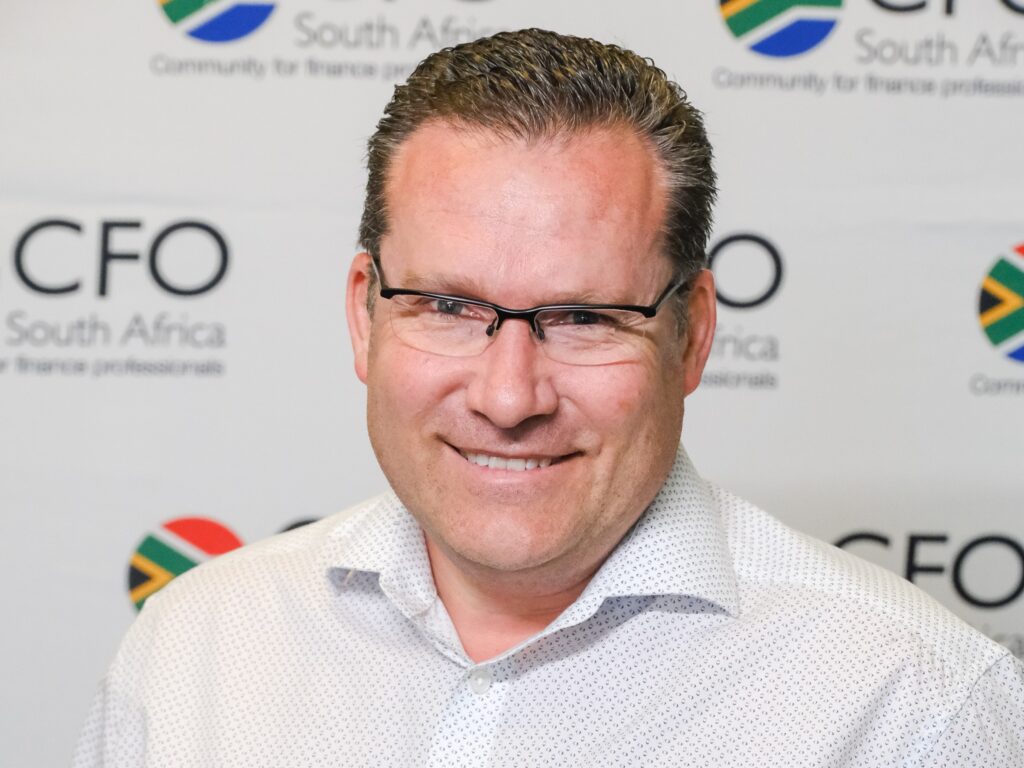
As the CFO of DRDGold, Riaan Davel’s mission is to help roll back the environmental legacy of mining. For the 2024 CFO Finance & ESG Award winner it’s not about how quickly the mining giant can make money, but about how long they can mine - without compromising the environment.
In 2015, Riaan was appointed CFO of DRDGold, a South African gold producer listed on the Johannesburg and New York stock exchanges. Prior to this, he was an audit partner at KPMG for seven years, where he conducted audits for listed mining companies including SEC registrants. As it stands, Riaan has nearly 30 years of experience in the mining industry, mostly in the African mining sector.
At DRD, which specialises in the recovery of gold from the retreatment of surface tailings (the leftovers from the processing of mined ore), Riaan sees ESG as central to the mining company’s purpose. So much so that it’s ingrained in DRD’s business model.
“DRD was founded in 1895. We’ve been part of the story of Johannesburg and gold mining since the beginning,” emphasises Riaan.
“Our strategy, and purpose, now is to help reverse or roll back the environmental legacy of mining,” he adds. “It’s not about how quickly we can make money, it’s about how long we can mine. What I’m most proud of is that we’ve stuck to our strategy, even when it has meant making a loss or generating negative cash flow [like in 2017]. For us, ESG isn’t an add-on, we’re just executing our business model. Our story shows that mining companies don’t have to play the role of the bad guys.”
Riaan notes that environmental rehabilitation wasn’t always top of mind for mining. “It was a theoretical idea that once the mine closed, you'd do some rehab,” he admits.
At DRD, the sustainability model has organically evolved over time. In fact, it started with just a small budget set aside for vegetation. After seeing success from that (there was less dust coming off the site), they looked to do more, also specifically how to use less potable water.
“Spend money to use less potable water over time, so we budgeted for a double pipeline. It wasn’t necessarily that there was a major plan with a 15-year environmental target, it happened organically over time. We invested money to save money and it was good for the environment, this just became embedded in how we think, and that’s how we budget now,” he explains.
No disconnect
For Riaan, integrated reporting also played a big role here, as it forced the finance function to “think across all the capitals”.
“Water is a good example,” he explains. “You take financial capital, invest, but over time you use less water, thanks to a double pipeline, so there’s less cost to the business and it helps the environment. I’m proud to say we’ve reduced the use of potable water by more than 60 percent.”
Riaan feels that ESG was perhaps accelerated by Covid-19, but DRD’s sustainability approach was already in place. “We’ve vegetated hundreds of hectares over the past 10 to 15 years, we’ve measured dust and can see how it has decreased. True sustainability involves planning so that it becomes embodied in how the business operates and how capital is allocated to projects. You need to plan big but implement small. It’s not necessarily only looking at net zero: does it make sense from a cost and environmental point of view, and does it look to provide long-term business success?”
Riaan is also a big supporter of learning about a business at its operations level to become better at telling the organisation’s story. In mining this is even more important, as it’s a highly specialised sector involving 24-hour operations. Which is why Riaan said it’s crucial for the finance team to be involved in all aspects of the business.
“We’re a small team, at the corporate office it's about 15 people, but the actual finance function team is six or seven,” he points out.
“We make sure we understand how finance flows work, from a group level right down to operations. Often companies have a separate integrated reporting team, or a sustainability team, but at DRD it's all linked and must be part of our central finance team. We drive and report on that; we understand the links between the financials and other non-financial areas, like environment or water. Otherwise, there can be a disconnect,” he adds.
An eco-champion
As CFO, Riaan is now central to the execution of an extensive, billion-rand capital investment plan, with the majority of funds going towards building a massive storage facility at DRD’s Far West Gold Recoveries site, along with pipelines and a plant upgrade.
“For [subsidiary] Ergo we’ve created more optionality; we’ve had a tough year from a licensing and site synchronisation perspective. As a high-volume business we can’t wait for sites to be commissioned. It’s all about continuous volume, so we have enabled that again.”
Riaan adds that Ergo aims to extend its business to the far East Rand and increase its tailings capacity over time. He notes that DRD is a subsidiary of Sibanye-Stillwater and a natural extension for the company is to start thinking about platinum group metals and copper (they’re already doing small-scale exploration in the Northern Cape around copper tailings).
“There’s a lot for us to execute over the medium term, and while we’re doing that, we will make sure we operate as effectively as we can and look for opportunities,” he says.
“I see myself as an eco-champion. When we budget and in how we think – it should be environmental,” emphasises Riaan. “We’ll continue to improve our water usage and to work on sustainable land use. We’re building an 800-million-tonne regional tailings facility at Far West Gold Recoveries, which is part of the R10 billion capital expansion over three to four years. That means no one else will be able to make a difference at an environmental level over time at this scale as we will. It’s exciting.”