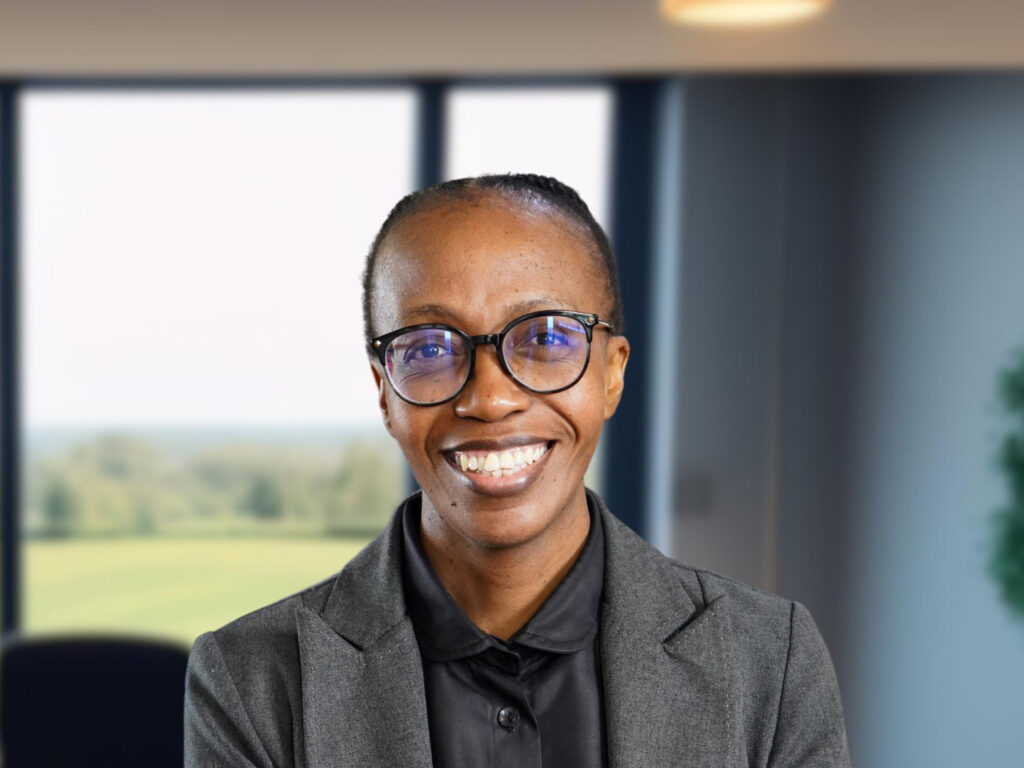
Cell C CFO El Kope isn’t easily fazed and is a firm believer in the ability to self-charge. She reflects on a career defined by challenging environments, cultural adaptability, and a leadership style that she describes as leading from the middle.
When El Kope took up the role of CFO of Cell C in 2024, following six months as acting CFO, she stepped into one of the country’s most dynamic telecoms environments. With a background spanning workplace management solutions, supply chain, logistics, beverages, and food production, her journey has been marked by a willingness to enter what she describes as challenging environments.
“I always want to educate and challenge myself. So I always try to find an opportunity and I don’t even go to friendly environments. I always go to what some people would term very harsh environments. I just call them challenging environments. I do enjoy the challenge,” she says. That perspective, she continues, has shaped her approach to finance leadership.
“My experiences have made sure that in my profession I remain flexible and detail-orientated without losing sight of the broader picture.” She also reflects that she is not easily fazed. Exploring several industries has given her the capacity to maintain mental clarity throughout turbulent times.
El explains that her resilience is tied to the discipline of self-charging and that in any challenging environment, she feels it is important to have the ability to self-charge in order for one to not lose sight of what one is trying to do.
“So I’ve been able to do that, and I enjoy it, to be quite honest. I enjoy those challenges. That agility, that attention to detail and that ability to pick oneself up. I'm constantly self-charging and self-challenging,” she says.
Learning from unstructured environments
El reflects that much of her career has involved stepping into environments that are not fully structured, and adds that people might underestimate how much one can get out of them. She explains that one can gain a lot from an environment that isn’t fully structured. Reflecting on her career, she notes that most of her experience has been across the rest of the continent, with DHL Supply Chain South Africa being her first purely South African role. That international exposure challenged her to adapt to diverse cultures and contexts.
“The need to understand different cultures, and being able to have a conversation with people without language, are skillsets that I believe make one stand out, skillsets I have learnt to master. I’ll never say anybody’s the best reader of people, but I’m aware. I’m aware of people from a completely different point of view. I can then manoeuvre different instances because of the cultural nuances and how those shape you. Because everybody’s so different, I manoeuvre instances very differently. I look at them from a different perspective,” she says.
For her, this approach translates into humility because understanding different cultures and learning to communicate has helped her approach everything in the humblest of ways simply because she approaches everything from a point of wanting to learn. At the beginning of her career, she recalls the influence of Maserame Mouyeme, now at Old Mutual, whom she describes as a mentor.
“Up until that point, I had never seen anybody who looks like me or sounds like me, be that powerful at engaging. And having worked for her and then having had her take her time to develop me, to understand me and to also empower me, left me forever humbled,” she says.
El admired Mouyeme’s originality and expressed that she was always funky, a marketing guru. When Mouyeme was a general manager of a division within the Coca-Cola company, El was inspired by how she did everything her way.
“I started my career with the whole thing that I was going to do what everybody else was doing. And for the first time ever, I saw somebody doing it differently and it made me think I could do it differently, could do it my way without it being viewed negatively or carrying any negative connotation. And that was the biggest turning point in my career.”
Taking a sabbatical
In 2022, El made the decision to take a sabbatical. She described it as a necessary pause. “For me, it was a very interesting position because my career was outside of the continent and there were also turnarounds. I’ve had to do a few turnarounds over time, whether it's repositioning, starting a business, closing a business, rebuilding. Over time, I moved from business to business, but found that I took so much of the last project with me to the next,” she explains.
“I think people underestimate how much a turnaround takes from you, or in a different way, how much you invest yourself in a turnaround. And when you then have to step out of that, it’s almost as if it’s a parting of ways in a relationship. You need to kind of let each other go. And I was busy jumping on to the next, on to the next. And this time around, I thought, no, I’m literally going to take the time out, one, for myself to detach, allow my old team to do the same.”
The sabbatical gave her the opportunity to re-engage with her career without baggage. By the time she started her next project, she entered it heavily, not with baggage, but with knowledge. No longer carrying strings attached to her previous role, she says this was very important for her. It also provided time for reflection and a pause.
“So it was a learning time for me on just re-assimilating myself back. But more than anything, it was a pause,” she says. After some rest, a new challenge awaited her: acting finance managing executive at Cell C, which meant returning to focus on a purely South African business and for her, it was not without challenges.
“It was a very tough decision for me to leave the rest of the continent because that’s what my career was about. I was always on a plane travelling to different countries.”
“For me it got to a point where I was deciding to come and give back to my community and where I came from was a great thing, but it was also very scary. The legislation I must relearn and reconfirm by myself. The ways of working are slightly different. People are different. And I had to take that time out to rebuild some of those basics for myself.”
Investing in oneself
El recalls that even in her interview for Cell C, the sabbatical came up. Someone actually asked her about it, and she realised it might still be considered taboo, though she feels it’s absolutely necessary if one feels the need.
“It’s supposed to be a good thing for the individual and that’s literally what it was for me. I needed to pause. I needed to rebuild and re-assimilate myself. And let go so I can walk into this challenge fully. And I was clear it was going to be a challenge. So that’s why I did it,” she says.
She believes the lesson for leaders is that taking time out provides clarity and reinforces the importance of investing in oneself just as much as one invests in a project.
“I think we need to be careful to prioritise – to not applaud busyness and to applaud delivery. If you get too much into a problem, you get so involved in this problem. And it’s in those moments when you step back and you give it a different look and you get a different perspective,” she says.
For El, stepping back also helps leaders remember their purpose and in the busyness, it often happens when one forgets one’s why. And yet, one’s why is very important, especially in the world that we live in now, where one can be reached 24 hours a day.
“You can work 24 hours because your mail is on your laptop. You have a tablet, it’s on your phone. You never switch off. Those moments of switching off are also important. It also, for me, talks to the reality that you are not just your profession or your work,” she adds.
Leading from the middle
El describes her leadership style as leading from the middle because for her, leading from the middle means she has that fine balance between coaching, supporting and empowering her team, while also playing to their strengths.
“You’re where you’re needed to be. I always make the joke that from the middle, I’m equidistant away from my strongest link and my weakest link. From the middle, I can pull up and I can push forward. I can still change direction. I can learn from my strongest and also help from my least strong. I can observe from a completely different point of view,” she says.
This approach has been important at Cell C, particularly during the turnaround, when she first started and the finance team was still being set up. She says this was a time when she then had to find the people who were already settled or good at what they did and let them run. For El, leadership is less about titles and more about balance and she sees leadership as a continuous exchange.
“You don’t stop learning just because you’re the leader. In fact, you learn more, from your team, from your stakeholders, from the setbacks and from the wins. The role is to connect those lessons and turn them into direction and momentum.” In the end, she believes that effective leadership requires humility and perspective.
“I think the strongest leaders are those who remain curious, who stay teachable, and who understand that their influence is not about control, but about enabling others. When your team grows, when your people grow, that’s when you know you’re leading.”