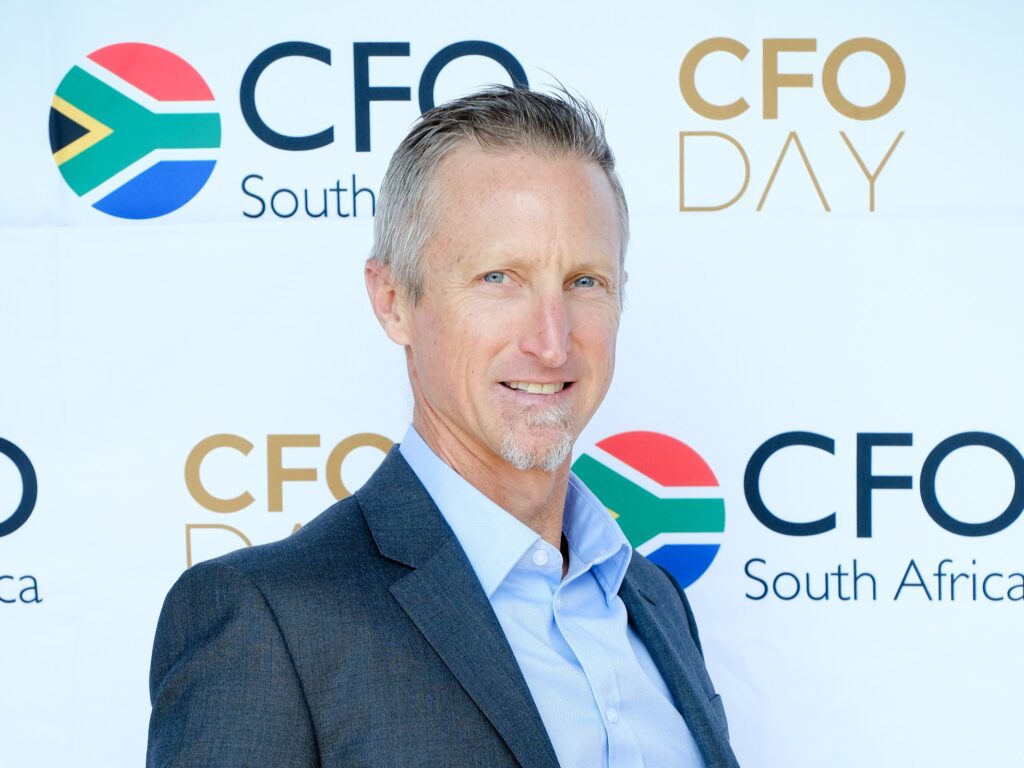
Nedbank CFO Mike Davis’s passion for his role is evident in his numerous achievements, including being crowned CFO of the Year at the 2024 CFO Awards – as well as awards for Compliance and Governance, and Strategy and Execution. It underscores Mike’s exceptional leadership and contributions to Nedbank’s success.
Since being appointed to the Nedbank executive committee in 2015, CFO Mike Davis has played an important role in driving transformation within the organisation.
As the winner of the CFO of the Year award in 2024, he has co-sponsored a core banking modernisation project together with Ray Naicker, the group’s CIO, in the modernisation of Nedbank’s technology stack and facilitating digital migration. He has also played a pivotal role in communicating Nedbank’s strategic vision to the market, with a particular focus on advancing the bank’s strong ESG credentials.
“I’ve only been CFO at Nedbank for four years, so I am really chuffed to be recognised with the CFO of the Year award,” he says. “I must add that the people I work with, those to whom I report and those who report to me, are part of a fantastic team and share in this award. I get to work with highly skilled individuals, and the work we do is engaging and fulfilling. It’s honestly rewarding for me to come into the office each day, and that makes all the difference,” he adds.
Before becoming CFO, Mike held the position of group executive for balance sheet management. He has significant industry-wide experience in finance, asset and liability management, regulatory, treasury, risk and capital management, and has worked in financial services for 27 years.
Increasing ROE, along with executing numerous critical aspects of the organisation’s strategy, remains a focus area for Mike.
Telling the equity story
As CFO, Mike emphasised that one of his favourite aspects of the role is being able to talk to the equity story, as well as delivering on strategy.
“Typically, when you do that, it results in positive financial consequences. Telling the story by demonstrating to our stakeholders that we are executing on our strategy, is something that I love doing,” he explains.
Mike notes that companies need to have targets and deliverables to measure their performance against. So, as CFO, being able to clearly articulate the organisation’s medium- to long-term targets, and delivering against those targets, is key.
He further adds, “The market doesn’t like surprises, so we use the opportunity through regular stakeholder engagements, SENS announcements and pre-close sessions; it’s so important to keep our communication open and transparent.”
For Mike, being appointed CFO at a large financial institution was a significant milestone that he didn’t take for granted. This includes being appointed to the Nedbank Group and Nedbank boards and the responsibility that comes with a large, listed company.
“With this, comes one of the many benefits of the role – the ability to execute and drive the strategy of the organisation,” he points out.
From Durban to Joburg
Hailing from KwaZulu-Natal and a Westville Boys Old Boy, Mike completed his articles at the Deloitte Durban office. He was offered the role of a senior manager at Deloitte, but he opted to move to one of his biggest auditing clients, NBS, in the risk space.
According to Mike, his time at NBS gave him solid group risk, regulatory and financial experience, before the company merged with Boland Bank to become NBS Boland. Another merger followed, with NBS Boland joining BOE Investment and Private Bank, becoming BOE Bank, which was then bought by Nedbank in 2002.
“At that time Nedbank had built a strong IT capability and they needed scale,” Mike explains. “They pitched to buy Standard Bank, but the Competition Commission and the Prudential Authority didn’t agree to that.”
As part of that merger, Mike had to relocate to Johannesburg in 2003, given that his role as head of the balance sheet portfolio was group-wide and run out of the head office. For Mike, being part of multiple M&As kept things interesting and engaging, particularly when it comes to the dynamics that play out when organisations with very different cultures come together.
As with any M&A, it was a challenge to navigate, but Mike sees challenges as opportunities. For one, he knew that coming to the Johannesburg head office, he was “the oke from Durban”; the guy from the smaller business being integrated into a larger Nedbank, which meant he had to compete to secure his new portfolio, and back up what he believed was good for the organisation.
“It was complicated, but I saw it in a positive light,” he adds. “The same applied when I put my hand up for the Nedbank CFO role – which I saw as a wonderful opportunity. I viewed it as ‘giving it a go’; and if I was unsuccessful, there was nothing wrong with that. The bottom line is that I got myself to a point where I had a chance to put my hand up for the role. With that attitude, you give yourself the best chance of being successful, and you don’t feel disappointed if you are unsuccessful, but rather take the lessons learnt.”
His best advice for taking on a complex challenge or opportunity? Take nothing for granted, and put your best foot forward.
“Overall, it’s been a journey to be part of the process of bringing different organisations together and rebuilding Nedbank as we know it today,” he says.
Tech stack and strategic unlocks
Mike explained that Nedbank’s strategy focuses on specific value drivers, namely growth, productivity, and risk and capital management, as well as five strategic value unlocks. The first unlock focuses on digital leadership, which, said Mike, is key to a bank’s efficiency and its ability to deliver market-leading clients experiences – the second strategic unlock.
“For example, the work we have been doing through the managed evolution programme, speaks to the evolution of our technology stack,” he says.
Mike pointed out that Nedbank has spent over R10.5 billion since 2015 on modernising the organisation’s technology stack. He has been involved for most of that journey, whereby the company opted for a best-of-breeds approach, as “no one has end-to-end technology, even if that’s what they pitch”. Taking this approach involved a degree of risk, but Mike remains confident that this has been the right approach.
“We are able to take products to market faster because attributes like pricing and billing now sit separately, so we can change them independently,” he says.
The third unlock focuses on areas that create value which involves shifting pockets on the balance sheet according to growing, holding, or market share loss objectives, also known as strategic portfolio tilt.
“We manage this initiative through our frontline businesses, and track progress through a sub-committee of our asset & liability committee. We drive execution into our frontline, using risk-adjusted processes, including pricing and capital allocation, among others,” he adds.
The fourth unlock is around efficient execution, including operating model shifts and the use of technology, while the fifth focuses on creating positive impacts, in part through sustainable development finance. “I sponsor [UN] Sustainable Development Goal 7, which is about clean and affordable energy, which we execute through all our businesses with a focus on renewable energy,” he says.
Sustainable development
Managing risk is central to Mike’s role and history, and doing so in a complex environment, locally and internationally, is critical. Having the right team is equally important to deliver on this mandate. “So surround yourself with good people,” advises Mike.
Mike adds that he has plenty he still wants to do as CFO for Nedbank. “We’ve put medium- and long-term targets out, like getting the organisation to an 18 percent ROE and a cost-to-income ratio of around 50c to the rand. I’d like to be in the seat when the organisation prints these levels on an ongoing basis,” he says.
Mike believes that Nedbank plays a significant role when it comes to ESG. With the bank’s greater than R900 billion lending portfolio, he believes that the financial services provider can make a huge difference around energy transition in directing how money is lent. He pointed out the bank’s sustainable development financing ambition and the introduction of sustainability-related financial disclosures through IFRS S1 and S2, which are being implemented.
“There’s so much more that’s coming. We are the number one financier of renewable energy as it relates to government-guaranteed and/or private power generation projects that is such an important part of our equity narrative, and the consolidation, aggregation and our focus on clean and affordable energy,” he explains.
As part of its sustainability focus, the bank has looked at high-emission areas, including thermal coal, and oil and gas portfolios, quantified the carbon emission intensity of these portfolios, and two years ago introduced glide paths supporting its just transition commitments. Mike highlighted Nedbank’s commitment to move towards net zero by 2045.
“You’ll see in our 2023 integrated report the glide paths for thermal coal, and oil and gas, which will decline by 47 and 26 percent respectively by 2030. We’ve also subsequently sized the carbon emissions associated with our vehicle finance and home loans portfolios. However, we have to balance our glide paths with a just transition – we can’t say we won’t provide finance to existing fossil fuel commitments, for example,” he says.
“The bottom line is that we want to take more of our lending portfolio into sustainable development finance, and we’ve sized that ambition at 20 percent in 2025 – with a focus on supporting nine of the [UN] Sustainable Development Goals,” he concludes.