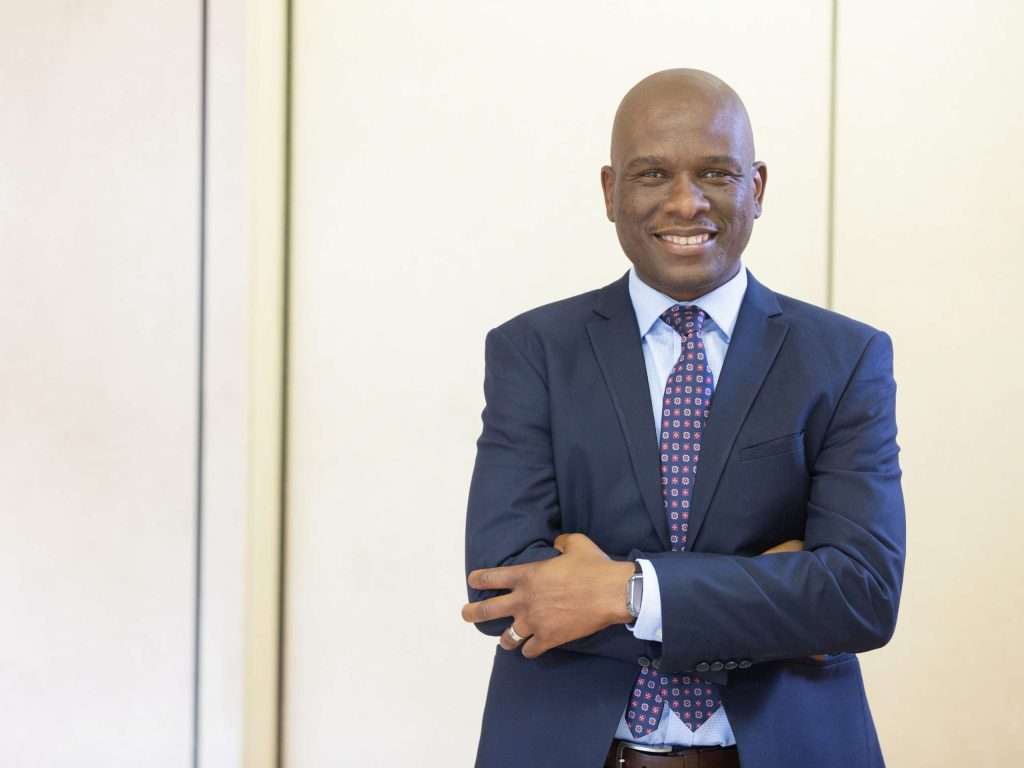
From the revenue service to conservation and now social justice, Soul City Institute CFO Dr Dumisani Dlamini has found a way to balance finance leadership with being a family man.
SANParks is one of his favourite organisations and his tenure as CFO was one of the most fulfilling of his career, Dumisani says.
He joined SANParks in 2017 and made a massive impact as the CFO during his time there, but it took relentless pursuit and some convincing on the organisation’s part to get Dumisani on board. He recalls thinking, “Leave me alone, I’m fine where I am. Why would I want to work in a park?”
After two months he agreed to hear them out. “And at that interview, because I wasn’t feeling it, I didn’t even wear a tie, but I wore a suit. And when I saw a guy walking out with a tie and a suit, I thought this thing is serious.”
And the rest is history. “It was the most fulfilling five years of my life, being the CFO of the organisation,” he says of his time at SANParks. His role encompassed not just developing a 10-year financing strategy for the organisation, but also being involved in the commercialisation, sustainability and fundraising parts of the business.
The double-CFO-Awards-winner – Young CFO of the Year 2016 and Public Sector CFO of the Year 2016 – started his career as a senior finance manager for Sars and was also the CFO of the National Arts Council before joining the body responsible for managing South Africa’s national parks.
But towards the end of his five-year tenure at SANParks, Dumisani became increasingly concerned about work commitments eating into family time. And despite the board renewing his contract for a further five years, he had to make some tough decisions. “It was very sad. When I resigned, they did not announce my resignation in the organisation for the whole month because they were hoping that I was going to change my mind. They even sent the chairperson of the auditor’s committee to convince me,” he says.
Finding balance
After a three-month handover period, Dumisani finally left SANParks. He then joined the Soul City Institute – a non-profit organisation that has made significant contributions in various communities across South Africa and the SADC region – as group CFO. And coming from a R3.2 billion revenue organisation to an NPO, the scale (or downscale) took some getting used to.
“The good thing about it is it gave me the opportunity to continue to be a CFO, but at the same time it had so much flexibility,” he says. The organisation works on a hybrid model, which works perfectly for him, Dumisani adds. “Now I have time to do homework with my kids, I go and see whatever they are doing at school. And there is no more travelling, because most of my work as a CFO is in Joburg. When I was at SANParks, you almost lived in your suitcase but it was necessary to fulfil the work of the CFO.”
Soul City is a social justice organisation, Dumisani explains. “Our focus is on young women and girls, and our work is built on the foundation of dismantling the patriarchal system. The organisation’s mission is to promote, support and amplify girls, young women and gender minorities, where they can live with dignity, exercise self- determination and have access to health and wellbeing tools to achieve their full potential’.
The Rise Young Women programme, for example, is associated with HIV testing, contraceptive use and awareness of gender-based violence support systems. The NPO also has a strong focus on child health issues.
“It’s been an incredible journey working with the Soul City team because I think all my life, if you look at my history in the organisations where I have worked, whether it’s Sars, the National Arts Council or SANParks, it really focused on business aspects, it focused on driving revenue, bottom line etc., but here you are focusing on community development, it’s a very fulfilling mandate, working with grassroots people, understanding their challenges and helping them overcome them. I’m privileged to be paid to work on those.”
He started his Soul City journey by reviewing policies, doing lots of work on automating processes to better support the implementation of donor-funded programmes related to various projects. “I think one of my key milestones was to look at how the organisation worked, and to see the level of procurement that was happening in the organisation at various thresholds. I thought it was important to establish a procurement function,” he explains.
Mitigating risk
“If you look at most NGOs, they are very informal by nature, focusing on mandates, they don’t have structures like finance, HR and things like that, because it just becomes expensive.”
Dumisani was able to convince the CEO of the importance of a procurement person, and it has been a runaway success. “Since we started with this function, we have made savings of over R2 million, both hard and soft savings, which is good for an NGO.”
Next on the cards was establishing a more in-depth risk management function – one that is becoming increasingly important in the fluid global landscape.
“When [Donald] Trump was first president we decided as an organisation that we won’t take any funding from America, because we could see [what was coming]. And when he returned, that decision had already been cemented. Many NGOs are closing down because they are fully or majority-funded by the US. It hasn’t affected us,” he adds.
“Where we are with risk management, because we have seen it work for our organisation, we have now cemented it. We have now established a risk management committee, we have appointed a risk champion, we have risk ethics officials, strengthening integrity management and also the prevention of fraud which is critical for any NGO,” he explains.
“If you look at how the organisation operates, it does not operate like an NGO, it operates almost like a mid-sized JSE organisation and the reason why we do that is because we are trusted with funds from donors and we want to make sure that we do the best that we can in managing those funds.”
While not leaving working with communities, one of the things the NPO is now looking at as a strategy is entering the corporate space. “We found that there are many organisations who would like to do a number of things as part of their corporate social responsibility but they don’t have means because they can’t focus on that, then that’s where we come in as an implementation partner,” he explains.
Family time
And in so doing, they hope to make a significant difference in the corporate – and NGO – environment. “And I think that will inspire many NGOs to say your scope can’t be limited to what you are doing. There’s more that you can do. The good thing about being a CFO of an NGO is that you don’t specialise, you look after multiple facets of things, and as a result you carry the organisation much more significantly.”
His newfound work-life balance has opened up several new doors, such as sitting on
a number of boards, including the UIF audit committee – he also chairs the risk management committee of IPID.
But spending time with family has become essential to that balance.
“I love cycling. My wife and I cycle a lot. And we’ve been on family holidays more than we have ever been. Last year we went to Dubai as a family trip in March, and in December we went to Thailand, with the entire family. I’ve never had the opportunity to do that with my busy lifestyle.”
Will he look at going back to corporate? “Probably as my kids grow up, and having more time to myself, maybe I’ll consider going back to corporate.”