South Africa’s leading finance executives gathered in Johannesburg at the 2026 CFO Day for robust discussions on growth, efficiency, digital transformation and sustainable value creation in an increasingly complex business environment.
“Loadshedding is behind us and now we need to move focus, like unbundling the industry. There is a lot happening and we need to do this taking into account the affordability of the consumer while balancing the capital requirements of the business,” group CFO at Eskom Calib Cassim said during his fireside chat at the 2026 CFO Day held at the Marriott Hotel Melrose Arch.
His remarks set the tone for a day centred on resilience, transformation and the changing role of finance leaders in navigating economic uncertainty while driving long-term value creation.
The atmosphere throughout the event was energetic and optimistic as South Africa’s leading finance minds gathered to unpack topics ranging from strategy and ESG to digital innovation and the systems powering sustainable growth.
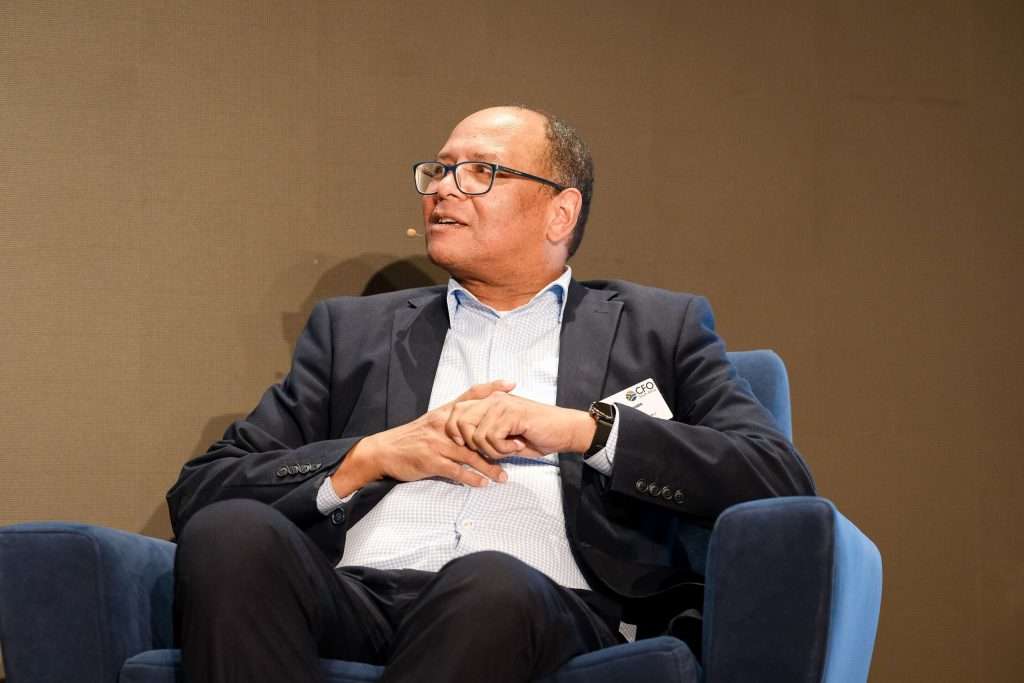
Speaking about turning a giant ship in choppy seas, Calib raised that when a company goes through difficult times, customers, suppliers, staff and unions are very important.
“Going back to the CFO, you appreciate these more because that time was difficult and at that point in time the system was very tough. The priority for me was to avoid eating the iceberg and going beyond stage six. I had to give hope to people and see the light at the end of the tunnel. I had to believe it and the exco also had to believe it,” he said.
Uniting as one team
He explained that he and his team had to accept that the only thing that mattered was stopping loadshedding and the company’s focus then changed from being an exco and management perspective to the whole company uniting into one team to focus on tackling loadshedding. This all needed a lot of focus and discipline, he added.
“I had the support of the board and the support of the staff. The organisation was so battered and abused and it was not nice, but you had to believe that it could be done. You have to believe it and as the leader if you don’t see it, then the people you are leading are never going to believe it themselves,” he said.
This was followed by a panel discussion titled The Efficiency Trap: Are CFOs Cutting Their Way Out of Growth? Panellists included Daniel Smith, group CFO at Lesaka Technologies; Clarissa Appana, group CFO at Tracker and Pierre Naudé, CEO at Dimago.
Dan started off by explaining that many businesses still had significant operational inefficiencies despite heavy investment in systems, people and processes.
“If I reflect and stand back and look at the business I’m involved in, are we truly efficient? We have a business, in my experience, that is growing, investing heavily in people, processes and systems, and is very positive in terms of bringing our new capabilities onto our platform,” he said.
However, he noted that duplication and fragmented processes continued to limit operational effectiveness.
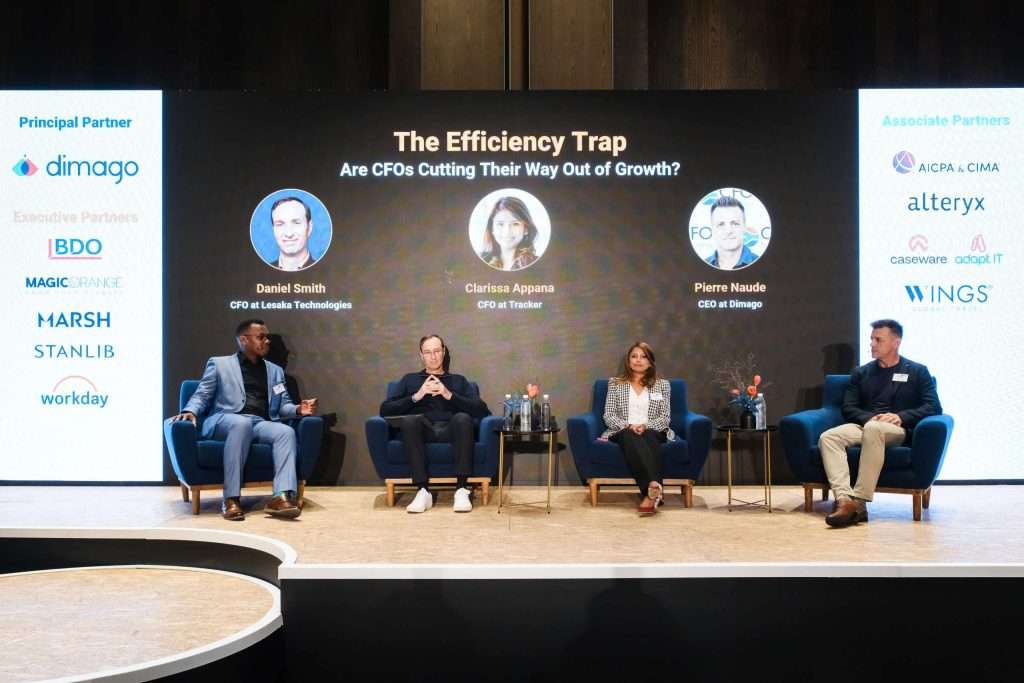
“There’s a hell of a lot of work to do in order to be, in inverted commas, efficient. And the efficiency is not just around costs. Efficiency should also include improving revenue generation and optimising processes to support business growth. There’s also efficiency in growing a revenue line. It’s optimising processes and how we think about our businesses in order to grow,” he added.
Balancing competing business priorities
Clarissa agreed that while efficiency remains important, organisations need to avoid sacrificing innovation and long-term growth for short-term financial gains.
“When we came from the Covid era, there was a lot of cost cutting, and somehow that mindset remained at the expense of growth and innovation,” she said.
She described how CFOs often find themselves under pressure when balancing competing business priorities. “When you’re in a room with your CIOs and CHROs, the CFOs are pushed up against the wall because we are the gatekeepers, we are the ones holding the purse and the wallet,” she said.
She stressed the importance of carefully evaluating return on investment and the broader business impact of decisions. “We have to look at some sort of efficiency, but not at the rate of production and cost-cutting to an extent whereby we are limiting the organisation for a short-term view, as opposed to the long-term growth and view that will come through,” she said.
Pierre added that siloed decision-making was becoming a major obstacle to sustainable business value and explained that it is really creating silos in the business, with each area optimising for cost in isolation.
He argued that businesses needed to shift discussions away from pure cost containment and towards long-term value creation, particularly around automation and future capabilities. “A business weighing up how this impacts automation in the future versus what it does to the income statement now can make much clearer strategic decisions,” he said.
The future CFO
The last panel discussion of the day, featuring Onguma Safaris CFO Abrie Collard and Gregory Harrup, the sales leader of property and casualty at Marsh Risk Africa, was all about the future CFO’s role as an operator, strategist and architect of value.
Abrie spoke about the growing importance of trust, speed and decision-making agility within finance leadership. “I think we need to move in a direction where we trust our capital. Instead of spending two more weeks trying to perfect everything, businesses need to move,” he said.
He explained that CFOs increasingly needed to make fast decisions while balancing risk, budgets and operational priorities, saying that one can rely on one’s numbers, but also on knowing one’s business and understanding where one is heading, and that sometimes one can make the wrong decisions, but partnership and trust are critical.
Gregory reflected on how the CFO role continues to change depending on an organisation’s strategic priorities. “I think the role of the CFO is always going to be important in any business and finance leaders are increasingly expected to become more strategic while specialist teams manage operational financial functions such as forecasting, budgeting and analytics. So, that FP&A team is a direct arm of the CFO, but then the CFO can step out and act more as a strategic function to assist the CEO,” he added.
Throughout the day, delegates also explored concepts such as valuenomics, digital transformation, ESG and the systems required to drive sustainable growth in an increasingly complex economy.
The event concluded with attendees gathering in the common area to enjoy refreshments, network with peers and reflect on the expert insights shared throughout the day.
CFO Day was made possible by principal partner Dimago; executive partners BDO South Africa, MagicOrange, Marsh, Stanlib and Workday; and associate partners AICPA & CIMA, Alteryx, Caseware Africa and Wings Global Travel.