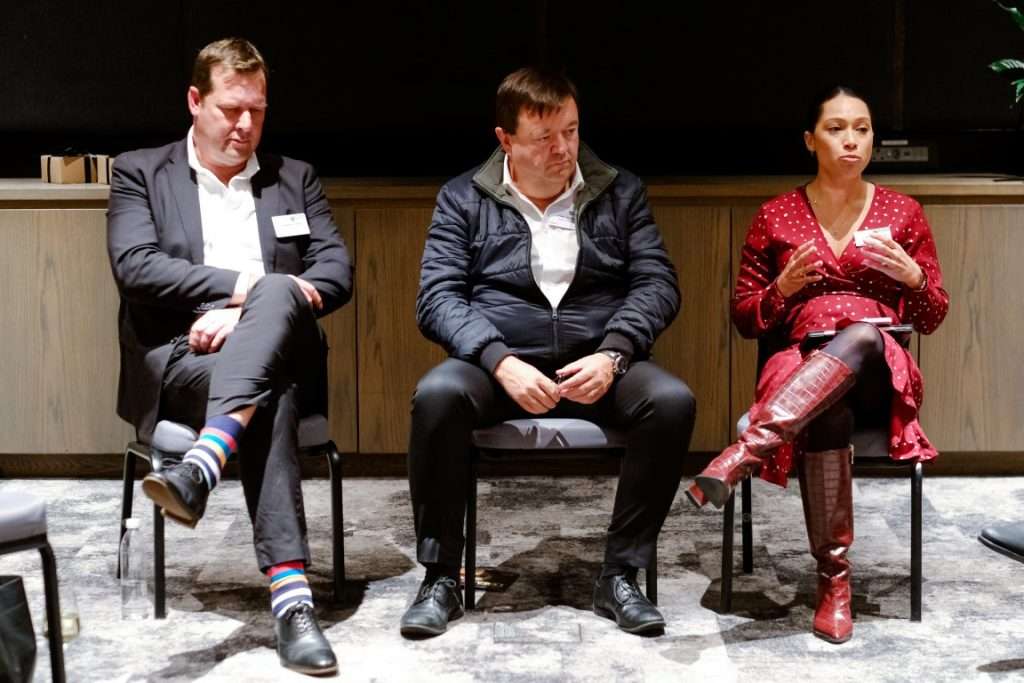
Peter Armitage, CEO at Anchor Capital, Tarryn Sankar, head of credit and investment research at Stanlib, and Christiaan Coetzee, national placement leader at Marsh, share how, while it can feel impossible to predict the future, CFOs can lead decisively by finding opportunity in risk.
Talking at a group breakaway session at the recent CFO Day in Johannesburg, the panelists emphasised that for CFOs to succeed in a world where things change every six months, they must work out the sensitivities in the in-conceivables, not to go down the rabbit holes with ‘what ifs’, and, critically, diversify risk.
The topical session entitled How seismic global events are shaping the future of SA Inc began with panel host Executive Communities Managing Director Joel Roerig, commenting on how global shifts, particularly when it comes to the US, are one of the main issues that keep CFOs up at night.
From playground politics to global trade-offs
Peter commented that US President Donald Trump, who recently marked 100 days in office, has achieved what he has due to creating volatility. “Trump has made us question everything we assume like the US has the strongest currency, and the Federal Reserve is independent,” said Peter. “He’s pulled funding and had a tariff tirade; he’s treating the world like a Monopoly board. He’s created panic.”
According to Peter, due to the weakening of the dollar against other currencies – and that money is now 25 percent more expensive – the short-term impact for South Africa is that inflation will kick up and interest rates will need to be kept high. He also highlighted that Anchor Capital’s business model has always emphasised the need for offshore investing, but it’s becoming increasingly difficult to predict the future due to the impact of geopolitics.
For Tarryn, geopolitics is one of the biggest risks that CFOs face. She explained that as a concept, geopolitics is like a playground – and different countries are the kids. It’s all about who plays (or doesn’t play) with who. She commented that CFOS must be able to join the dots between headlines and actionable insights.
“Drive strategic conversation about risk and how to manage your business to withstand the storms. Look beyond the noise and look at what are the long-term structural trends. Consider what the trade-offs are, and what can be absorbed,” she advised attendees.
“Risks are also opportunities. Ask yourself how you can plan for a wider range of scenarios. Leverage innovation, pivot to new markets and build actionable insights,” added Tarryn.
Back to risk management basics
Coming from an insurance perspective, Christiaan commented that over the last six years, there have been massive risk events affecting the world and South Africa: Covid-19, the July 2021 riots and the floods in KwaZulu-Natal. These events have all resulted in significant insurance losses.
“Insurance is the deployment of capital at a profit. These big events are causing insurers to lose capital, which pushes prices up. We have since stabilised, but if you look at any insurance exclusions document you’ll see mentions of grid failure, floods, and contagious diseases. As a CFO, can you really sleep if you have insurance? Insurers don’t want to cover systemic risk, that’s why you can’t get fire insurance in California,” said Christiaan.
Christiaan encouraged finance leaders to have the right conversations and use the tools at their disposal. “Insurance is a small component of risk management. CFOs need to buffer themselves – don’t become too lean so you can’t tolerate any risk,” he cautioned.
Tarryn added that CFOs need to nurture funding relationships before a crisis hits and diversify funding as much as possible. It’s also about going back to basics; it’s risk management 101. “Do you have liquidity, which comes at a cost? Do you have discipline on capital allocation?”
Peter echoed that relationships are key in navigating unpredictable times. “It’s all about people – I’ve sat with banks on both sides of the table; a lot happens beyond the spreadsheet. People are naturally supportive of those who are responsive and who have nurtured relationships.”
Opportunity amid uncertainty
Peter highlighted that things are not as bad as they seem. “We’ve told clients that they’ve actually made money this year – they’re up 10 percent and the rand is a few percent stronger than it was at the beginning of the year. However, I worked as a stock market analyst for 15 years, and it was bewildering that businesses hadn’t worked out the sensitivities of the inconceivable. Do the maths, then diversify.”
Attendees were also encouraged to regularly take a step back and ask themselves what they can control.
“I can control my response to uncertainty. I can have sound financial governance in place. I can focus on core business. I can be transparent, have lunch with my banker or asset manager to nurture that relationship, and I can hold two opposing views at the same time. It’s not all bad; look for the opportunity,” concluded Tarryn.