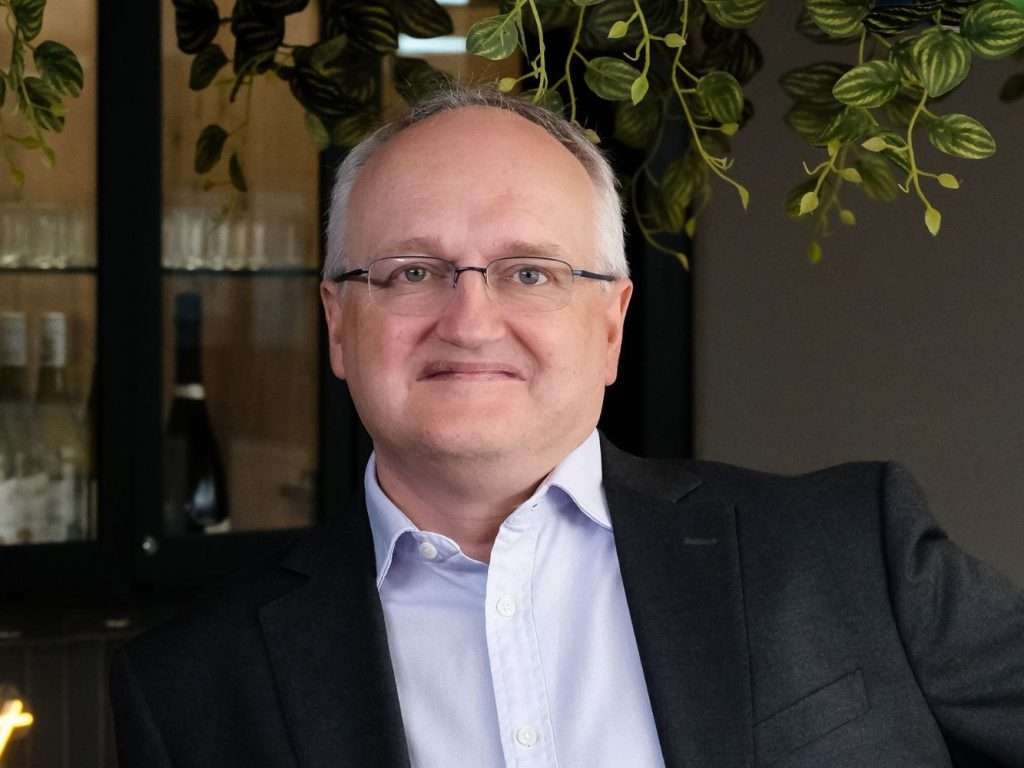
CFO Alex Smith walked into Edinburgh University planning to argue cases, he walked out ready to close them. The numbers, it turns out, had always had the stronger argument.
e4 Strategic CFO Alex Smith got his start in law, but he had a natural affinity for numbers that drew him to accounting. The Scot-turned-South African citizen shares his journey from law to finance.
Briefly tell us about your educational and career path into your current role
I’m originally from the UK, although you can probably tell by my accent. I’ve been in South Africa for the past 30 years, so people tell me my accent morphed into a bit of a South African, almost nondescript one. I was born in Kent, south of London, went to high school in Glasgow, in Scotland. After five years of high school up there, I then went to Edinburgh University and studied law.
How did you end up in accounting then?
I don’t quite know when the idea of becoming an accountant came up. But in Scotland, you don’t have to do accountancy as a degree to become a chartered accountant.
I was actually advised by a few of my dad’s accountant friends not to complete accounting as a degree. They said that it’s better to have another string to your bow and if I still wanted to do accounting, then I could still do it while bringing something different to the table. So yeah, I ended up doing a law degree.
And then from there went into the Scottish Institute, where you basically do three years of articles with a couple of board exams. I had to do an extra set of exams because I hadn't done accounting. But over there, the Institute controls the whole education process. I then did three years with what was then Pricewaterhouse, which really gives away my age because they kind of disappeared in 1998, right? So then I did a year post-qualifying in Edinburgh with them in the audit division.
So how did you end up in South Africa?
After the year in Edinburgh, I was basically looking for an international opportunity, I wanted to travel. PWC was very proactive in terms of encouraging people to do stints overseas.
I don’t speak anything other than English. So that kind of limited my options a little bit. I was looking at Australia, New Zealand, and then someone suggested Zimbabwe to start with, and then South Africa. I thought South Africa sounded kind of exotic. It was 1995, right off the bat of the 94 elections. I thought it would be an exciting place to be for a couple of years. I wanted to go to Cape Town but it was a small office. So I was persuaded to come to Joburg.
It was initially a two-year secondment – during that period, I met my wife. And so I decided to stick around. And PWC very kindly arranged for me to go permanent and get my permanent residence.|
So after settling into South Africa, how did your career trajectory play out?
I moved into transaction services doing due diligence work. I stayed there for seven years which was really interesting, including some international work. PWC liked to pull on resources into different countries. I went to the UK a couple of times and spent six weeks in Moscow on one occasion, which was fascinating.
And then at the end of 2005, I moved across to Altron as group financial manager for the first two years. Then my boss, who was also my boss at PWC, moved on and yeah, I was at the right place, at the right time. I got moved up into the Altron CFO role in August 2008, just before the financial crisis broke.
That sounds stressful, take us through what happened next?
It was a bit of a baptism of fire for me because I was a really green CFO. I’d only been in commerce a couple of years and suddenly it felt like the world was collapsing around us a bit. We had a cable business, in which the main input is copper. So we were carrying around about 4,000 tonnes of copper on the balance sheet. I think the price of copper went from $8,000 a tonne to about $2,500 a tonne in the space of like six weeks. So I think we took a write off. That’s a big number today. But in 2008, it was even bigger. Plus, we were taking hits on our gross profit.
How did you manage in these challenging times?
I spoke quite a lot to my wife, Jenny. She’s also a CA, so we met at PWC. She had come up from Durban, I came from Scotland and we settled in Joburg. But she was a great sounding board when things got really challenging and difficult.
That’s a very far leap from law, how did you manage?
Law is incredibly useful, particularly for a CFO. You’ve often got legal agreements coming across your desk. If you've got that sort of basic legal knowledge, it is really useful. I think it kind of educates you in a different way of thinking.
How different is South African law to Scottish law?
It’s actually quite interesting for a law geek. The South African and the Scottish legal systems are quite similar. Scotland’s got a quite strong Romano-Dutch influence from Europe before it combined with England. And that’s kind of similar to the way South Africa went in terms of having the combination of the English legal system and the Romano-Dutch. For me it was quite interesting that I ended up in South Africa.
Did you ever miss law while deep in PWC?
Nah, I’d pretty much made the decision before I started my law degree that I wanted to go the accounting route. As I came towards the end of my law degree, I thought a little bit about whether I should move into law. I had a particular interest in international law, as opposed to domestic, which is quite specialised but it was difficult to get into.
I kind of had a roadmap of where I was and where I thought I was heading. At school, ironically, I was always much stronger in physics and maths.
So law was a little bit of an interesting shift. And then accountancy was almost like, I guess, going back to the more numeric side of things. But I really enjoyed the combination of the numbers and all the analysis.
In your current role as CFO at e4, what are your roles and responsibilities?
I initially joined e4 in an interim CFO capacity, but I enjoyed the environment and felt it was a very positive fit, which ultimately led to the role becoming permanent in February 2025.
As CFO, I’m responsible for overseeing the finance function, with a particular emphasis on risk management, capital structure, banking relationships and cash flow. Another important focus area for me has been on refining our pricing methodology to ensure we continue delivering value to our customers while supporting the business’s long-term sustainability.
I inherited a strong finance team and robust systems, so my attention has been less on making fundamental changes and more on optimising what is already working well.
So now as a South African, who do you support in rugby?
I support Scotland. My kids get very upset about the fact that I support Scotland and I always get bombarded with Springbok merchandise. And I refuse to wear any of it.
What do you do for fun, when you are not at work?
I like to play a bit of golf which I know is a cliche, although I think cycling is the cliche now? I didn’t have a lot of time to play golf when I was at Altron, but now I play when I can, and it’s funny, I can’t hit the ball as well as I used to. But there’s nothing I like more than an early morning game.
How important has family been in your life and career in terms of having that support?
Very important. It’s easy to take it for granted at times. Family has always been really important to me. We are quite a close family and my wife and I have been married for 26 years now. Last year we celebrated our 25th wedding anniversary in the Maldives. It was beautiful. My wife has always been very supportive and understanding about my job demands and the hours. My two daughters are also very supportive and understanding.