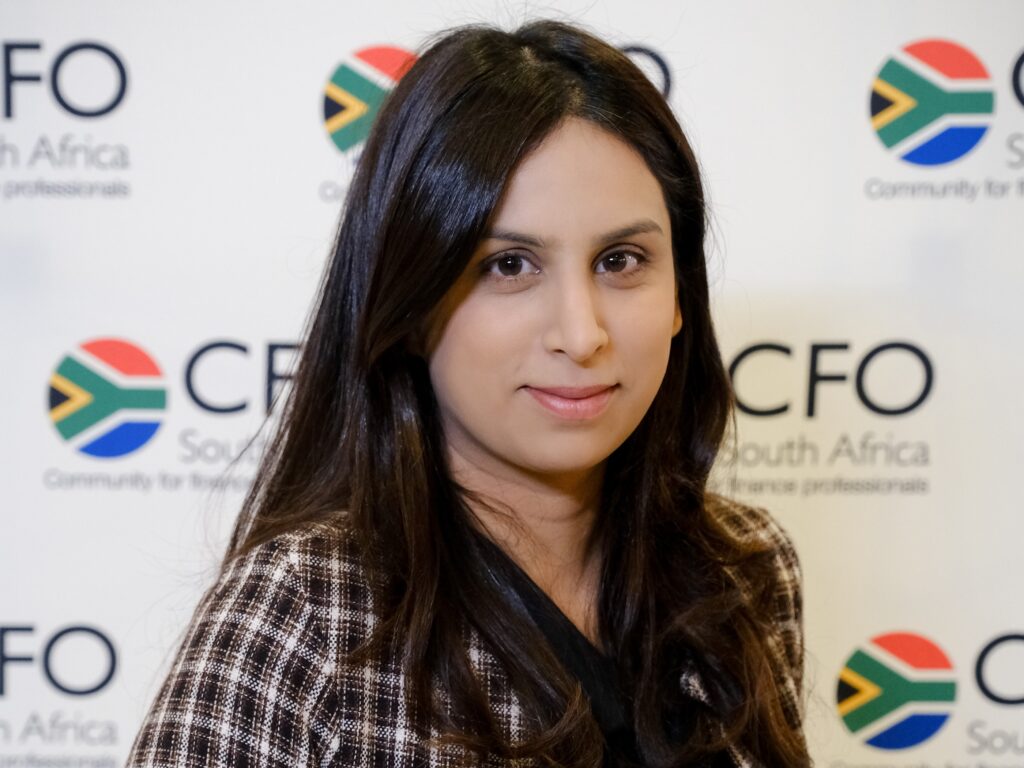
iOCO CFO Ashona Kooblall and CEO Rhys Summerton have lifted profit after tax by 39%, expanded return on equity to 35% and strengthened cash generation. With recurring revenue above 60% and a disciplined approach to acquisitions, debt reduction and share buybacks, Kooblall is focused on sustainable growth and long-term shareholder value.
iOCO Technologies CEO, Rhys Summerton and CFO Ashona Kooblall have grown iOCO’s profit after tax by 39% and its return on equity to 35%. The group is now buying back its own stock at what management calls a lower intrinsic share price.
When Ashona Kooblall took her seat on stage at this year’s Finance Indaba, she did not open with a number.
“We are obsessed with a culture of high-performance, a smart strategy and having the right people deliver that strategy,” the group chief financial officer of iOCO Technology Group told the room. “When you have that in place the numbers will follow, as we have seen at iOCO.”
She is equally clear that a demanding culture and a collegial one are not competing propositions - for her own teams or for the clients they serve.
From most finance chiefs, that would land as conference-stage warmth. From Ashona, it arrives with a set of audited results behind it. In the year to 31 July 2026, iOCO grew profit after tax by 39% while revenue rose just 3%. Headline earnings per share climbed 42% to 57 cents. Return on equity reached 35%. The gap between those two growth rates is the whole story of her tenure so far, and she is precise about why it exists.
Quality over volume
The phrase “quality of growth” recurs in conversation with Kooblall the way cost-cutting recurs in most turnaround stories, and the distinction matters to her. Adjusted EBITDA rose 21% and EBITDA 18%, lifting the group’s EBITDA margin from 9% to 11%. Net finance costs fell 32% to R61 million as bank debt came down to R480 million. None of it came from a single lever.
“The improvement was driven by stronger operational execution, better resource utilisation, disciplined cost management, improved operating leverage and lower net finance costs,” she says. “We also continued to shift our revenue mix towards more predictable, recurring and higher-quality earnings streams.”
That mix shift is the quiet achievement. Recurring revenue now exceeds 60% of the group total, and Kooblall is clear about what it buys her as a finance executive.
“Recurring revenue fundamentally improves the quality of our business. It enhances revenue visibility, improves earnings predictability and creates a more stable cash generation profile,” she says. “This allows us to plan capital allocation with greater confidence, make longer-term investment decisions and reduce earnings volatility.”
Ask her how much further margins can go and she is measured and not to be cornered into a promise that would cost the business later.
“Margin expansion remains an important objective, but not at the expense of future growth,” she says. “Our goal is not to maximise margins in a single year. It is to build a business that can compound earnings sustainably over time. Where we see attractive returns from investing in people, technology capabilities or acquisitions, we will continue to invest confidently even if that moderates short-term margin expansion.”
Chasing the triple crown
Press Kooblall on what all this discipline is ultimately for and the answer turns out to have a name. She calls it triple crown growth, and it is the idea she returns to most readily. It sets three wins a company has to achieve in the same year: revenue and margin growing together, free cash flow growing, and return on equity growing.
“Smart capital allocation is what makes the triple crown possible. Growing all three at once is what tells you a business is genuinely compounding.”
It is a demanding scorecard, and a more useful lens on iOCO’s results than any single line of the income statement. The first leg is visible in FY2026 without much interpretation: revenue up 3% while the EBITDA margin widened from 9% to 11%, which is margin and revenue moving in the same direction rather than one being traded for the other. Return on equity, the third leg, reached 35%. Cash generation sits between them, and the group has put improving cash generation and conversion at the top of its stated priorities for FY2027.
Acquisitions and the discipline of saying no
For Ashona, iOCO has moved into acquisition-led growth, concluding two deals late in the financial year and signalling an active pipeline. It is the part of the strategy that most often goes wrong at listed technology groups, and Kooblall and Summerton have evidently thought hard about where the brakes are.
The group looks for founder-led businesses with strong leadership teams, consistent earnings, attractive margins and clear cross-sell opportunities, with particular interest in managed services, AI and data, cybersecurity, cloud and industry software. Every deal must enhance earnings quality and generate returns above the cost of capital. Then comes the part she delivers without hedging.
“We need to see a clear pathway to value creation for our shareholders. Capital allocation discipline is one of our competitive advantages.”
The same framework governs what she calls the next-rand question. “Every capital allocation decision starts with one question: where will that rand generate the highest risk-adjusted return over the long term?” Organic growth comes first, then value-accretive acquisitions, then a resilient balance sheet, and only then returns to shareholders through buybacks. “The objective is not simply growth,” she says. “The objective is intelligent capital allocation and long-term value creation.”
A partnership with her visionary and smart CEO
Ashona places the turnaround in the context of a partnership rather than a solo performance, and she is openly admiring of chief executive Rhys Summerton.
The result is a leadership pairing in which a focus on growth and cash generation, high performance culture too, is not something imposed on the business but shared at the top. It shows up in her written review of the year, where she sets out a creed in four short lines: empower exceptional people, hold them accountable, allocate capital intelligently, execute relentlessly.
“Capital can be raised. Strategy can be refined,” she writes. “The sustainable differentiator is people and the quality of our skills and technology solutions.”
The case still to be priced
For all the improvement in the numbers, iOCO’s share price has yet to fully reflect it - a gap the group has stopped waiting for the market to close on its own. Its capital allocation framework commits to returning excess cash through buybacks and, in the company’s own phrasing, to leveraging the lower intrinsic share price. It is an unusually direct statement for an annual report: management believes the business is worth more than the market is paying.
Ashona will not be drawn on where the share price should sit, which is the correct position for a listed-company CFO. She argues the case on the numbers instead. A 35% return on equity. Earnings up 39%. Recurring revenue above 60%, bank debt down to R480 million, R2.1 billion of new multi-year contract wins, and FY2027 guidance of at least R680 million in EBITDA - roughly 11% above this year at the floor.
“Our responsibility is to ensure that every rand of capital entrusted to the group is allocated in a manner that maximises long-term shareholder value,” she says. Where the returns are not there, the capital goes back to shareholders. “Finally, where excess capital exists and opportunities do not meet our return thresholds, we return capital to shareholders, including through share buybacks.”
Put plainly, she explains that a company that buys its own stock while still funding acquisitions and cutting debt is making an argument about value with its balance sheet rather than its investor presentation.
The long view on technology investments
Ashona added that for a CFO, the hardest technology investments are the ones whose returns refuse to arrive on a schedule. Kooblall does not pretend otherwise.
“We look beyond traditional short-term payback periods,” she says. “Many technologies, particularly AI, create value by enhancing existing capabilities rather than generating immediate standalone revenue streams. The key question is whether the investment improves our ability to serve customers, win market share and generate superior long-term returns on capital.”
It is of a piece with how she describes the central tension of her job. “I believe one of the most important responsibilities of a CFO is resisting the temptation to optimise for a single reporting period,” she says. “Sustainable value creation requires balancing current performance with future opportunity.” The 35% return on equity, she argues, is the evidence that the two are not in conflict.
The road to R680 million
iOCO has guided to EBITDA of at least R680 million in FY2027, roughly 11% above this year.
According to Ashona, against that she sets a recurring revenue base above 60%, a diversified customer portfolio and R2.1 billion of new multi-year contract wins secured during the year.
“The companies that outperform over time are those that consistently deploy capital into the highest-return opportunities,” she says of the decision she believes will define the next three years. “If we remain disciplined in capital allocation while preserving our culture of accountability and excellence, I believe we can create substantial shareholder value.”
Which returns, in the end, to the Indaba stage and the order she put things in. The culture first, then the numbers. At iOCO the numbers have now caught up.