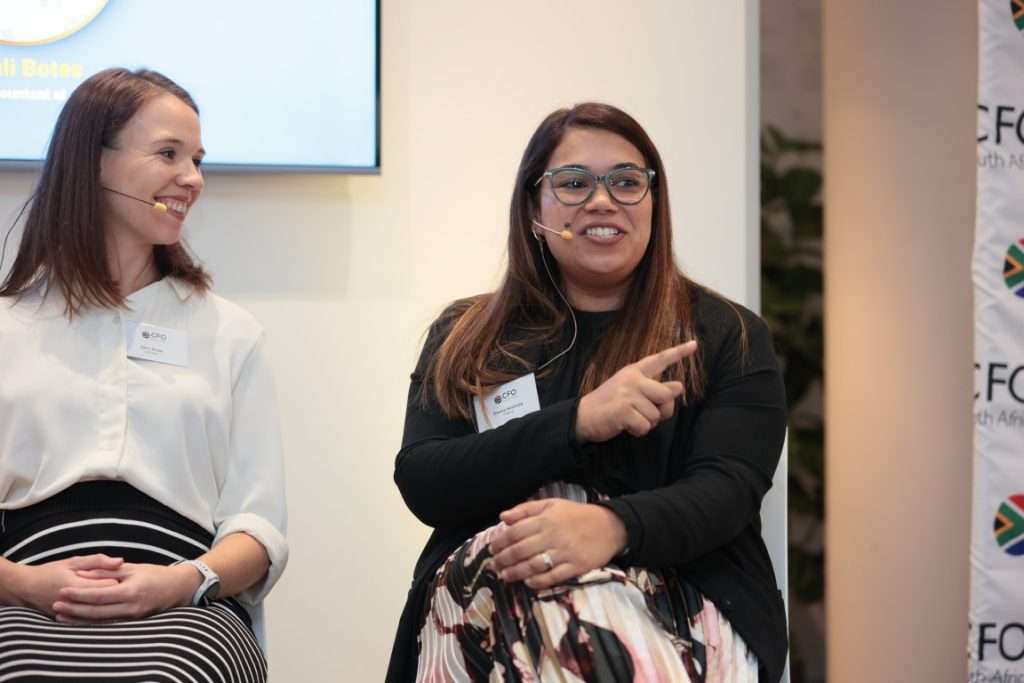
The voice of the younger generation was heard loud and clear at a recent CFO South Africa summit, held in the Mother City. JobJack's Zanli Botes and Oceana's Shaista Hendricks revealed how they believe finance leaders should build future-ready businesses for their employees.
For Zanli one of the best things the next generation can do is challenge the status quo. “What I mean by that is a mindset to actually challenge the way things have been done, and I know the initial thought might be that the next generation just wants to change everything, and that is not at all what I mean,” she stressed.
“It is not about redesigning the wheel, it’s looking at what has been designed and the ability to actually see areas of improvement, and ways in which you can be more effective,” Zanli said, adding that, for her, it is more about adding value and business growth.
Zanli believes a key question the next generation should be able to ask themselves is: Where does this, what I am currently doing, fit into the bigger picture and how does it actually add value?
For Shaista getting ready for the future of work is about leadership style. “For me, a key skill is having the ability to understand the diverse needs and motivators of the people we lead,” she said, adding that this applied across generations. “I feel like there’s not one size fits all when it comes to leadership and for me it really starts with self-awareness, it’s really understanding your own behaviours, your triggers. One of the things we really drive is creating a psychologically safe environment for new ideas, innovative thinking, critical thinking,” she explained.
“I find younger generations are driven by speed, by innovation and really having that sense of purpose, and I find it’s not so much really about the tasks itself, it’s about the experience, the impact and the sense of purpose that people feel. They want to feel connected, they want to feel like they are a part of something bigger. So, I feel where leadership will really succeed is if you have that more human-centred approach.”
When asked whether leaders were doing enough to ensure that finance professionals are given enough leeway to experiment, Zanli said that while business needs to create the space, she believes CAs should also have a desire to improve and be innovative. “But from a business perspective it is difficult,” she went on to say. “Time is limited, there’s a lot of deadlines but I do think it is important to create that space.”
It is important that companies make time for this, she added.
The conversation then moved onto the next generation and hybrid working models.
“What we’ve seen is that your teams are the centre of flexibility, the younger generation want hyper flexibility, we have seen sometimes working from home has led to better productivity. It’s definitely a question that gets asked in every interview I sit in – what is your policy on work from home? But it comes with its challenges, being able to collaborate, effective communication,” said Shaista.
“But I don't think it's so much about the remote working, it is about the flexibility. That is key to what the younger generation’s looking for,” she added.
Building a new culture
Up next was what kind of culture is being built, and the importance of emotional intelligence.
“It’s not a one person thing, I really believe it’s a culture and as a company and as individuals and as leadership, we have the responsibility to actually think of what type of culture we are creating, and what kind of leaders do we actually want to grow within the company. If we want to grow leaders who are innovative and adaptable, and who have emotional intelligence, we actually need to create those opportunities,” said Zanli.
The panellists were then asked what would be the one thing they wished they had learnt earlier. “Self-awareness is something I would have started much earlier in my journey, some of the things that helped me was regular feedback, and even coaching,” said Shaista.
The floor was then opened for questions.
“I think for me the big intimidation is realising I am working with someone who has a lot of experience, who has probably built up this finance function to the place where it is currently at,” said Zanli, on a question from the floor on what makes her uncomfortable as a young leader. She added that there is often a mindset that the young generation want to change things, which may not necessarily be the case. “I think it is so important to understand, when someone is older, what their reality is.”
“For me it’s that open communication and inclusivity,, so bringing us along, having those good conversations,” said Shaista. “Änd I think as a leader… you tend to follow someone who is credible, who’s not only delivering a message but it is how they are delivering it. Do I buy into it?”
Robust conversations continued on the terrace as formalities for the evening wrapped up - across the generations.
In case you missed out, you can catch up on the overview of the summit here.