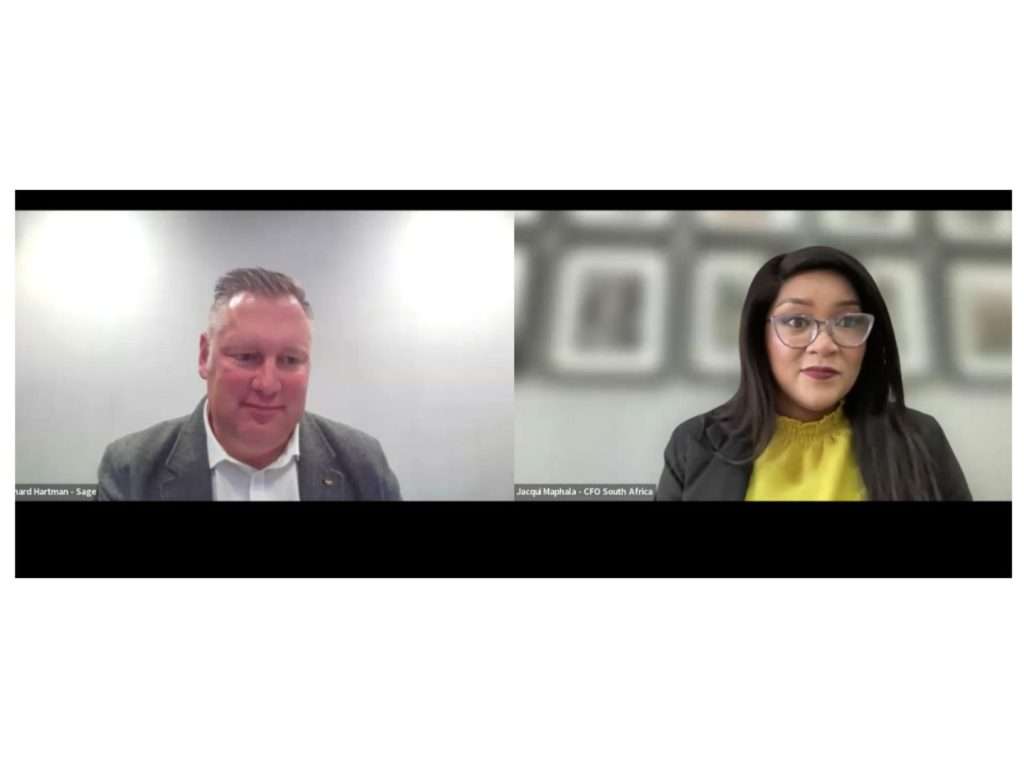
In a CFO South Africa webinar titled Revolutionising finance leadership in a changing world, Gerhard Hartman, regional vice president for Sage in Africa and the Middle East, shared insights from Sage’s global CFO study, highlighting how finance leaders are spearheading digital transformation, adopting AI and preparing their teams for the future.
In a packed CFO South Africa webinar that attracted over 200 attendees from across the country, Gerhard Hartman, regional vice president for medium business at Sage Africa and Middle East, shared company research showing that South African CFOs are not shying away from the digital wave.
The research showed that over one in five leaders in SMBs plan to adopt AI in the near future, and more than half intend to increase their technology investments over the next year. According to Gerhard, the message is clear: finance leaders are not just bookkeepers anymore, they are becoming the architects of digital transformation.
He explained that with over 40 years of experience developing software solutions for small and medium businesses, Sage is now doubling down on AI-powered innovation. The company has filed 17 artificial intelligence patents since 2021, underscoring its commitment to reshaping finance, payroll, and HR functions through intelligent automation.
The webinar kicked off with a live poll, asking attendees about their biggest challenge in adopting finance technologies. The leading response from audience members was uncertainty on which tech to choose from.
Uncertainty around AI adoption
This was followed by concerns over limited budgets and unclear return on investment. Gerhard wasn’t surprised. “Not being sure about what technology to bring into your organisation is a common concern. But that’s exactly why conversations like this are important,” he said.
Drawing on Sage’s global “Secrets of successful CFOs” research, which surveyed 12,000 finance leaders across nine countries, Gerhard revealed that CFOs are now seen as the key drivers of technology strategy within their organisations.
“CFOs are leading from the front. They’re aligning the C-suite, ensuring technology investments match business objectives, and guiding their teams through the change process,” he said
The study found that 75 percent of CFOs reported an increase in their responsibility for digital transformation over the past year, while 78 percent said that keeping up with new technologies, particularly automation, was critical to their success.
Additionally, 81 percent of CFOs said that automation allowed them to focus on more valuable tasks, while 61 percent reported actively incorporating AI-powered tools into their organisations.
Bridging finance, technology and talent
Gerhard emphasised that successful CFOs are also investing in future-proofing their teams. With technology evolving rapidly, the human side of transformation is more important than ever.
“It’s not just about choosing the right tools; it’s about making sure your teams are ready to use them. That means change management, upskilling and ensuring everyone understands the journey,” he said.
The Sage report also found that 80 percent of finance leaders expect AI and machine learning to significantly impact HR, recruitment, and talent management, reinforcing the need for CFOs to collaborate with other departments.
“Finance is no longer isolated from the rest of the business. The CFO is stepping into the world of people, helping to shape the organisation’s talent strategy as much as its financial one,” he added.
Gerhard also provided examples of how Sage is integrating AI across its product offerings, from cloud-native payroll and HR solutions to automated financial reporting tools. He highlighted two key use cases in accounting and finance where AI is making a tangible impact.
The first case he revealed was Accounts Payable (AP) automation. He said that traditionally, AP processes have been manual and error-prone, and with AI, organisations can now scan invoices, detect anomalies and trigger automated workflows, improving accuracy and freeing up time.
Gerhard explained that AI is also being used to identify irregularities in transaction postings, providing finance teams with real-time insights and flagging suspicious entries. “It’s like having an intelligent assistant monitoring your books 24/7,” he said.
In the HR and payroll space, according to Gerhard, AI is powering chatbots, generating real-time reporting insights, and enhancing integration between finance and people functions, an important step in breaking down traditional business silos.
Trust is non-negotiable
Gerhard stressed that no matter how advanced the technology, adoption hinges on trust. Quoting Sage CTO Aaron Harris, he said, “If customers don’t trust it, they won’t use it.”
This is why, Gerhard explained, Sage is investing not only in AI development, but also in user education, transparent algorithms and secure, cloud-native infrastructure. “Security, data redundancy, and regular updates are non-negotiables. Our job is to make sure that every finance leader using our tools feels confident and secure,” he said.
Gerhard also drew an important distinction between traditional AI and generative AI.
He explained that traditional AI uses historical data to provide insights, identify patterns, and support decision-making in real-time, and added that generative AI, on the other hand, predicts future outcomes using advanced data modelling techniques.
“Both are essential. Whether it’s forecasting revenue, optimising expenses, or planning talent requirements, AI is no longer a future concept. It’s already here,” he said.
“This shows the resilience and forward-thinking mindset of finance professionals in our market. CFOs understand that technology is not a threat, it’s a strategic advantage,” said Gerhard.
As the webinar drew to a close, Gerhard left participants with a challenge: embrace change, invest in the right technologies and lead the transformation from within.
“Successful CFOs are no longer back-office number crunchers. They’re trusted advisors, digital champions, and strategic partners,” he said.