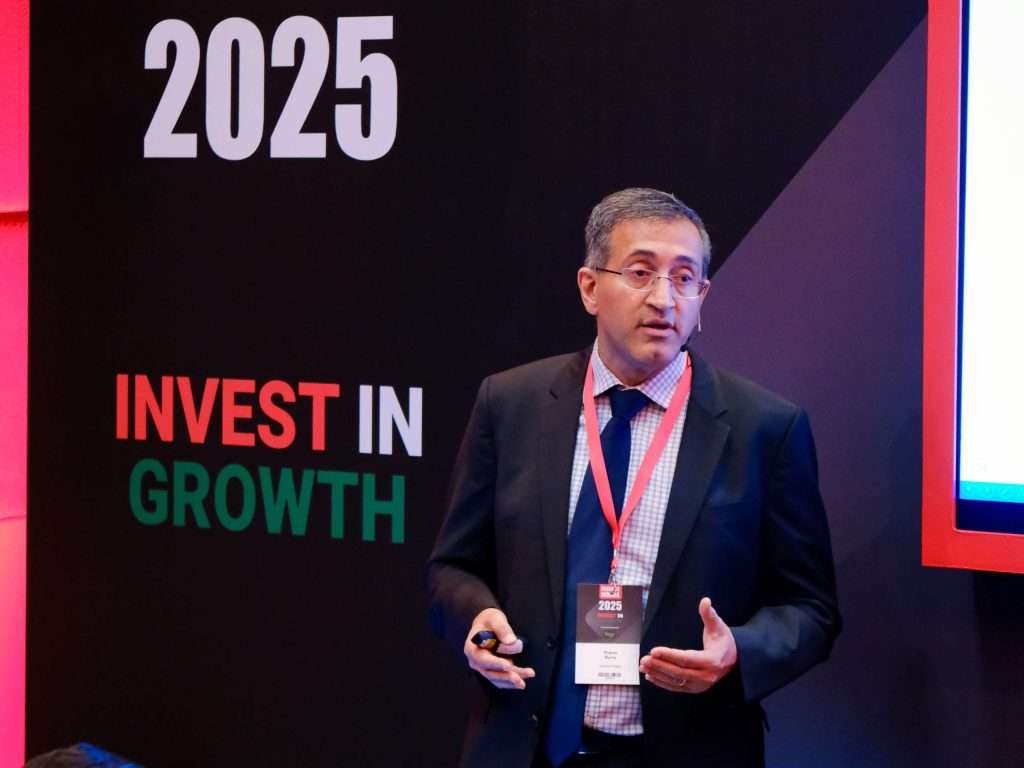
Analytix Engine CEO Pravin Burra led a session at the 2025 Finance Indaba where he invited the audience to think of revenue assurance as a science.
Pravin addressed a room full of finance leaders eager to understand how customer behaviour can shape profit in a 2025 Finance Indaba session dubbed Profit science: Exploring a unique approach to revenue assurance.
“How well do we truly listen to what our customers are telling us through their actions? We don’t know what’s going on in each customer’s head, but we can observe their behaviour and we can respond to their behaviour. A large part of profit science is just listening better,” he said.
Pravin explained that the real work of finance today lies in observation. He stated that every professional, whether they are selling a financial product or presenting a business plan, must learn to translate behaviour into insight.
“Regardless of our business, we do need to sell. Even if you are in finance in a building, you have to sell your business plan. The important thing is, can we differentiate the different types of people we interact with into different needs, and can we match them with a good value proposition, not a good product?”
He described this as the bridge between marketing and finance. While marketing departments often study customer profiles, finance leaders, in his view, are better placed to turn that knowledge into measurable outcomes. He described profit science as a practical discipline for closing the gap between behaviour and result.
“Any large company gets a lot right. Otherwise, they would not be in business. What makes the difference is how well they listen to their customers’ behaviour and translate that into their value proposition,” he said.
The evolution of customer needs
Pravin then turned to the idea of mapping journeys, saying businesses often think of the customer journey as a single line from interest to purchase. In reality, he believes, each person moves along several paths at once. He argued that revenue assurance depends on seeing how these journeys overlap.
“There are three or four journeys, not just one. There is the life journey, the product journey, and the process journey. When we talk about journey, it is not one journey. There are actually several and probably more,” he said.
The Analytix Engine founder used simple examples to illustrate the point. He painted a scenario in which a customer begins an insurance application online and abandons it halfway through. As he sees it, understanding these breaks is more valuable than launching new products.
“If the queue is too long, a customer says they will come back later, but they do not. That journey is also important. These small drop-offs tell us more about our customers than surveys ever can,” he said.
Pravin went further to trace his life through the purchases that marked each stage, including a kettle at university, a couch in his first flat, a car and a home. He encouraged businesses to anticipate the next step, noting that customer needs often evolve.
“When I was at university, my budget extended to toasters and kettles. If you looked at targeting me as a long-term customer then, I was not worth much. But when I bought my first car and my first house, that changed. If you are a bank that wants to finance my car and my house, this is the time to get me,” he said.
He reminded attendees that the most valuable forecasts are built on educated guesses grounded in real data. For CFOs, his address was a call to leverage analytics for value.
“You can see what 20-year-olds are buying, what 30-year-olds are buying, what 40-year-olds are buying. You can guess this journey and make educated guesses as opposed to minor guesses. It is possible to do this right,” he said.