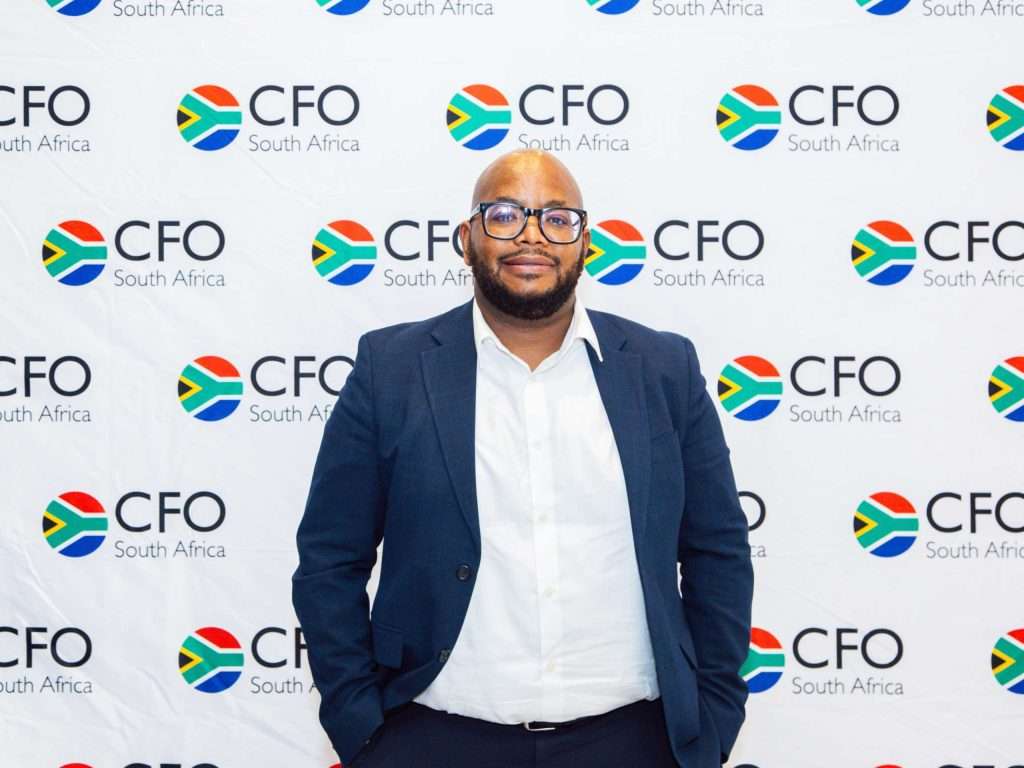
Inspired by a Martin Luther King Jr quote about excellence in every task, Water Utilities Corporation CFO Thabang Mogodi is focused on developing people, modernising finance and helping build institutions that can thrive long after individual leaders have moved on.
“If a man is called to be a street sweeper, he should sweep streets even as Michelangelo painted, or Beethoven composed music, or Shakespeare wrote poetry. He should sweep streets so well that all the hosts of heaven and earth will pause to say, ‘Here lived a great street sweeper who did his job well.’”
This inspirational quote by American civil rights activist Martin Luther King is a mantra that Thabang Mogodi, CFO of Water Utilities Corporation (WUC), Botswana, lives by. Thabang is an exacting professional who is fastidiously meticulous about his work and equally passionate about mentoring his team.
“I entered the public sector driven by the aspiration to apply my skills and experience toward the advancement and progress of the public sector; this was predominantly the primary motivation behind my decision. I can be painstakingly meticulous, but sometimes it hampers me from completing the assigned tasks as I seek perfection, which is not always attainable,” he muses.
Though he concedes that this relentless pursuit for perfection remains his Achilles heel, he points out that he tempers it with his love for coaching and mentoring, which is perfectly suited for his role in the public sector, where the skills and resources are not comparable to those found in the private sector.
Shedding light on the youth
Being the biggest fan of personal development and mentoring, Thabang has taken to this extra role of coaching and mentoring like fish to water. “It gives me great joy to help people grow and do better than they did the previous year, month, week or day. I read a lot on leadership because I want to be the best leader I can be. I am an avid reader of John Maxwell's works on leadership and biographies of inspirational leaders like Steve Jobs and Richard Branson. I use a lot of their principles on leadership and business, which I find valuable,” he says.
Thabang’s passion to mentor the younger and less experienced team members is understandable, as it is informed by the need to impart his academic acumen in accounting and business, which somewhat came naturally to him during his student days.
He recalls that his father’s influence ignited his love for accounting and business while helping him solve a math problem during primary school days. Thabang ended up getting the hang of mathematics and chose business and accounting as his electives in high school, in which he excelled. His proficiency in both subjects continued at university and it came as no surprise that he chose them as his majors.
After earning his first bachelor’s degree, he studied for the Association of Chartered Certified Accountants (ACCA) qualification. Between 2007 and 2010, he served articles at one of the Big Four firms. He later realised his strengths and interests aligned more closely with financial management and strategic finance leadership than external audit.
Thabang cut his teeth in the private sector until his current role, which he describes as a major career transition. Describing the difference between being a finance leader in the private and public sectors, Thabang says the fundamental distinction lies in mindset. In the private sector, the CFO is guided by a profit motive and ensures that the entity's operations provide a return on investment to shareholders and make commercial sense.
“In the public sector, the CFO’s role is a fusion between ensuring the financial sustainability of the entity and driving the social obligation imperatives to the citizens. The challenge from a CFO perspective is that the social obligation element often outweighs profitability, and some of the projects you fund are more of a social obligation, with little prospect for a return on investment. So, you find yourself trying to change the mindset to make the commercial aspect the primary criterion for funding and the social element secondary, which is not always possible nor desirable,” he says.
Putting effort into modernisation
At WUC, Thabang is focused on modernising the finance function through stronger reporting disciplines, capability development, revenue assurance initiatives and leveraging technology to improve decision-making and accountability.
The future CFO must evolve from scorekeeper to strategic architect, leveraging technology, analytics and automation to drive institutional resilience and long-term sustainability.
For Thabang, leadership is less about authority and more about stewardship, capability development and creating systems that outlast individuals. Beyond financial stewardship, Thabang is passionate about building resilient institutions. He believes finance functions should not merely report history, but actively shape operational strategy, governance outcomes and long-term sustainability.
Reflecting on his career, Thabang singles out his appointment as CFO of WUC as one of his career highlights. He served as a Senior Financial Controller prior to this appointment. He says the lowest ebb in his career has been the entity’s inability to publish its financial statements on time.
“As an accountant, you want to finish the audit and report on the financial performance on time, you want to get that newspaper spread that shows the numbers - there is a sense of pride in that. When that does not happen for one reason or another, it is very frustrating. I have always believed that everything is within my control, but I have since learned this season that certain things are outside my control. I have done all that I could to get the audit completed, but it is what it is; a lot of stuff is outside my control,” he says with an air of resignation.
Hopes and aspirations for Botswana
The married father of two young children aged six years and eleven months, Thabang, has radical ideas on how Botswana can overcome the economic downturn and the growing fiscal deficit, which peaked at nearly 10% of GDP in 2024. He says drastic policy changes are required at the policy level to significantly reduce the public spending model, which is expensive and unsustainable.
He points out that Botswana has a population of two million five hundred thousand people that is scattered around the expansive country, with most of the populace concentrated in the major cities of Gaborone and Francistown.
“There are scattered communities where citizens require public services like roads, electricity, medical care, and water in remote settlements where the population is very small, in some instances comprising a thousand people. In terms of geography, Australia is similar in many ways to Botswana, and the country has managed to address this issue by concentrating people along the coast, where the state can streamline and channel public spending, while the centre of the country is largely depopulated.
“Botswana may need to rethink long-term infrastructure planning and service delivery models to ensure sustainability, particularly given the high cost of servicing sparsely populated areas across vast geographic distances,” he says.
The self-confessed workaholic admits that he finds it difficult to relax, but when he does unwind, he prefers to cycle, quadbike, game, spend time with family and friends and play board games.
“I also enjoy building financial and business models, and I want to learn the Python programming language to merge it with artificial intelligence (AI) solutions. This will help me with applications such as reporting requirements and data mining, so that’s what I do in my spare time. I enjoy it and am not sure if it's relaxing,” he quipped.