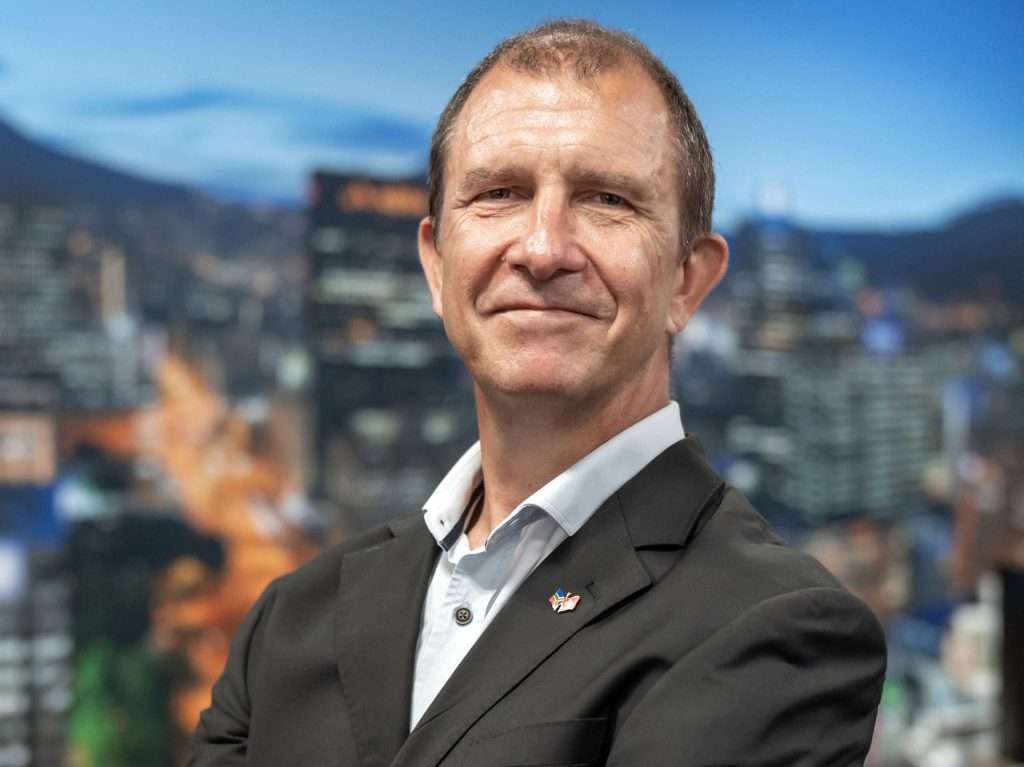
Kevin Jacoby, CFO of the City of Cape Town and 2025 CFO of the Year, steers an R84-billion budget – and he will tell you, without hesitation, that none of it would be possible without his wife.
Kevin Jacoby grew up in Stutterheim, a town in the Eastern Cape so small that it did not have a single robot. He matriculated in 1987 and had no clear idea what he wanted to do with his life. His mother, a clerk at the magistrate’s court back then, quietly sorted that out for him.
She arranged his first job interview – with the Auditor-General’s office in East London – and registered him with Unisa for a BCom before he had even agreed to it. “She said it is going to be a BCom, it has accounting and economics included as part of the degree so it must be good. Economics was not even a school subject in those days,” Kevin recalls, laughing. “And that’s how my life after school started.”
More than three decades later, Kevin, who also walked away with the 2025 Compliance & Governance Award, is approaching his 15th year as CFO of one of Africa’s best-run cities. He has been in what most would recognise as a CFO role since the age of 23 – a career so improbable it sounds scripted. And yet, when you speak to him, every twist makes a certain kind of sense.
The AG’s office gave Kevin his footing, but it was a chance encounter in Queenstown that truly launched his career. The municipality’s finances were in disarray – years behind in its administration – and a contractor named Mr Moolman, from Parow in Cape Town, had been brought in to sort things out.
He spotted something in the young Kevin and made him an offer. “He took a liking to me and the work I was doing. And the offer was he would teach me at night, if I would work for him during the day. And that is where my career just took off in leaps and bounds.”
Fortunate timing
Kevin gave up his social life entirely. Within three years he had completed his degree, accumulated extensive experience and progressed to the position of town treasurer back in his hometown of Stutterheim at 23. “I knew exactly what I wanted to achieve from a young age,” he says. “I was totally tied to that idea, and I saw this as my opportunity.”
His timing was, in his own words, fortunate. The early 1990s was when municipal systems were shifting from manual to computerised and Kevin’s energy and adaptability allowed him to navigate the change faster than most. He moved from Stutterheim to the Amathole District Municipality in East London – an organisation 11 years behind in its financial administration. He caught it up and as result, Kevin’s reputation as a fixer, builder and systems-creator began to take shape.
Kevin has now been CFO of the City of Cape Town for more than a decade, overseeing a combined capital and operating budget of approximately R84 billion. He describes his current environment as a “perfect storm” – a rare alignment of leadership, values and institutional will that he does not take for granted.
At the centre of that storm is a relationship between two vastly different kinds of leaders. City manager Lungelo Mbandazayo, whom Kevin has known from early on in their careers at the City, leads with what Kevin calls “an absolute fear of failure”. Executive mayor Geordin Hill-Lewis, by contrast, is driven by innovation and an unyielding desire to be progressive.
“He does not have to tell you that you are failing – you can figure it out yourself. There is an amazing power to being around him. I have not felt that for a long time.”
The result, Kevin reflected, is an organisation where no one can afford to stand still.
“I have a city manager who will not accept failure, and an executive mayor who keeps raising the bar. You can just imagine the kind of energy that creates,” he said.
“When you find yourself in an institution where the ethics and values that you hold are entrenched – where the leadership, the management team, and your own family all line up – what you have is a perfect storm. It does not always work out like that. So, I see myself as extremely fortunate.”
Creating collaboration
One of Kevin's most significant contributions to the City happened almost entirely outside the formal scope of his CFO role. About eight years ago, the City Manager asked him to investigate a persistent frustration: the engineers’ data on capital project delivery and the finance department’s data on creditor accruals and payments kept telling different stories about service delivery expectations, leaving senior executives and politicians providing oversight unable to make sense of either.
Kevin saw it immediately for what it was: a structural problem with cultural consequences. Different departments stored information in different systems. Meetings were dominated by arguments over whose numbers were correct and no one was making progress. He set about creating a single, up-to-date data source that everyone could agree on.
“We had to stop arguing about the data before we could argue about why service delivery progress was not being made. Once we got the blame game out of the way, we became partners,” he explains.
What began as an ad hoc intervention became what Kevin calls “collaboration meetings” – structured sessions where engineers, finance staff and governance administrators sit together around shared data and work through delivery constraints in real time. The impact has been measurable and significant. When the current mayor arrived, the City's capital delivery capacity stood at roughly R5.6 billion per year. It now exceeds R10 billion, supporting an ambitious R120 billion 10-year infrastructure pipeline established by the mayor after considering sector plans aligned to city strategy.
“When you experience a mega project of say R5.9 billion being constructed for water reuse and you know you played a role, no matter the size of the role, you sense your contribution to the economic development of your employer,” Kevin explains. “That’s what the data journey has done for us in the governance structures of the city.”
Being vulnerable
Ask Kevin about the changing role of the CFO and he will talk about caring. Not the surface-level kind, he is quick to clarify, but genuine, informed, reciprocal care that takes years to build and requires a certain kind of institutional stability to sustain.
In practice, this looks like knowing when a director’s father is ill and rescheduling accordingly. It looks like what Kevin calls the “huddle” – management sessions built on radical transparency, where mistakes are never hidden and no one is made to feel that an error is the end of the world. It looks like team coaching and leadership courses, and an insistence that people work from their strengths rather than flagellate themselves over their shortcomings.
“People will not allow you to care for them if you do not show your own vulnerabilities. Once that relationship starts, it creates a never-ending story of City family productivity.”
His next experiment in that spirit is perhaps his boldest. Launched in February 2026 is what he half-jokingly calls the “Kevin I need help button”. It is a direct-access channel allowing any City employee, from the most senior director to the most junior clerk, to contact him directly for guidance on navigating legislation, procurement processes, tender processes, or standard operating procedures. It only takes for the city employee to press the button and the enquiry workflows to Kevin.
“I naturally have a support team with a strong city network and professional administrative leads to help me field what is sent after the button has been used.” He knows it could be overwhelming. He is doing it anyway as making progress with enablement is what his focus is on. “So many people, eager to make progress, are so far from me and sometimes struggle to navigate our legislative and governance space that are blocking service delivery,” he explains. “The cost of not trying this button is too high.”
Putting in the effort
When Kevin reflects on his career, two threads run through everything: the institutions that shaped him, and the people who made it possible. Among the latter, his management team – including his manager in his office, who joined about two and a half years ago – features prominently. So do his two children, both now working as project managers, with whom he has recently discovered an entirely new kind of conversation considering their work experiences and the areas he focuses on.
But most prominently of all is his wife.
“Someone asked me once: who is more important in this family – the children or your wife?” Kevin says. “I always say my wife. Because the children would not have a happy space if it were not for her. She has always been ready to pack a bag and go wherever this career has taken us, even as we moved further from family in the Eastern Cape. None of it would have been possible without her.”
At 55, Kevin wakes at 5am, five days a week, for high intensity cycling training. This year will be his fifth attempt at the Absa Cape Epic, the toughest mountain bike race in the world. He also competes in the Attakwas, a 120km race over the Attakwas mountain range that separates Oudtshoorn from Mossel Bay, with around 2,700 m of climbing. He described it as “absolutely amazing”. The race has a nickname – the Hell of the South. He also added that one suffers to complete it.
Sport, for Kevin, is not a hobby. It is a philosophy made physical, a space where effort produces results without ambiguity, where discipline compounds over time and where failing at something you have worked hard for teaches you more than succeeding at something you have not.
He believes his physical discipline is the reason he has been able to sustain his professional commitment. This is not despite the demands of running an R84-billion budget, but because of the daily practice of showing up before anyone else is awake and doing the hard thing anyway.
“Sport teaches me that I reap what I sow. If you do not put in the effort, do not expect the results. It is almost the only space in life where there is no subjectivity in the outcome.”