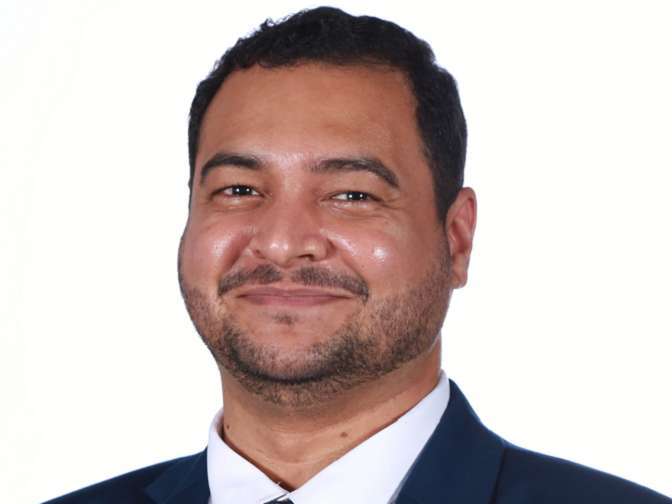
Ricardo Sardien’s rise to CFO is a testament to the power of structured discipline and the relentless pursuit of personal growth over environmental odds. He demonstrates that leadership is built through incremental improvement and the wisdom to prioritise effectiveness over simply being right.
When Ricardo Sardien reflects on his journey to becoming group chief financial officer of Old Mutual Botswana, he doesn’t begin with boardrooms or balance sheets.
He begins with tracing his genesis in the crime-infested township of Mitchells Plain on the Cape Flats – an environment where direction was not assumed and outcomes were rarely guaranteed. In a nutshell, a place which shaped him long before any professional title did.
“There were shootings in our street and on our school field. Stabbings were a regular occurrence and violence was all around us. It wasn’t unusual. That was normal,” he recalls.
The risks were not distant headlines; they were part of everyday life. Friends could easily be drawn into situations that were difficult to escape – he lost a close personal friend to this internecine violence which has engulfed his hometown until this day. As a young boy, he understood early in his upbringing that environment could unintentionally dictate direction.
At home, however, there was a different set of rules. His father ran a tight ship. There were boundaries and expectations and the rules did not bend easily. “My father always said we don’t grow up in our neighbourhood, we don’t grow up in our street – we grow up in our home. As a child, it felt restrictive, unfair, even frustrating,” he recounts.
Choosing a different path
Watching his friends enjoy the much-sought freedom in their prime and fraternising with their peers while he remained under the tight supervision of his father was not always easy.
But with time, he realised that this discipline insulated him from the harsh reality of the gangster-ridden neighbourhood. The stringent home environment did more than shield him, it also created stability in an otherwise unpredictable environment. More importantly, it gave him an opportunity to focus on his studies.
There was no dramatic epiphany, no Damascus-esque moment that opened his eyes to the single defining moment that education was the right path for him. On the contrary, it was a gradual realisation that books, and not bullets, is what defined his destiny. “Once I accepted that I didn’t want to be out there, the question became: what am I going to do instead?” he reminisces.
Ricardo wholeheartedly threw himself into his studies, not just as an academic exercise, but as a deliberate strategy. Teachers recognised his potential, and one intervened to help him enrol at a stronger-performing school outside his immediate area. “That changed everything,” he says. “Had that not happened, my life could have looked very different,” he says.
He leant towards technology at first and used his spare time to build his own computers. Ricardo loved systems, even earning an accolade as the top student in information systems in his first year at university.
But accounting offered something structured. “It was clear. There was a pathway. I focused on where I had an edge,” he says.
That approach – honest self-assessment followed by full commitment – became a pattern in his life.
A test of readiness
Years later, that pattern was tested when Ricardo stepped into the CFO role at Old Mutual Botswana. The transition was swift and came with limited handover. “You’re suddenly the one people are looking up to,” he says with a small smile. “And you’re thinking, this can’t be because I’m still figuring this out.”
He stepped into the role in November, and the December year-end audit cycle arrived quickly. There was little time to settle into the role. “I remember sitting in that first audit discussion thinking that this is happening now. Around the table were auditors and senior leaders expecting clarity and confidence. You can’t hide in that situation. You either know the answer, or you don’t,” he recounts.
He prepared meticulously, challenging his own assumptions before anyone else could. The pressure was real. “You question yourself. You wonder whether you’re ready.”
Yet in that discomfort, something shifted. Instead of seeing doubt as a weakness, Ricardo began to recognise it as evidence of growth. “If you’re outside your comfort zone, that’s where development happens,” he says. “If I didn’t feel stretched, I would have been worried.”
Rather than waiting for confidence, he built competence – one meeting, one decision at a time.
Reinvention beyond comfort
Relocating to Botswana added another layer of change. Professionally, it was a step forward. Personally, it meant leaving behind familiar support systems – it required resilience.
“Executive roles can be isolating,” he admits. “There’s professional distance. You don’t have the same freedom socially,” he points out.
Instead of allowing that transition to narrow his world, he used it to expand himself.
He pursued courses in artificial intelligence. He completed his MBA and a CPA qualification through CPA Australia. “I’ve always believed that if you’re standing still, you’re going backwards,” he says. “Development doesn’t just happen. You have to pursue it,” he says.
Despite his fastidious commitment to upgrading himself, Ricardo is quick to point out that continuous learning is not about adding credentials, but rather about remaining relevant and capable in an environment that evolves quickly.
Learning to lead people
Because of his aptitude and a knack for learning, Ricardo concedes that technical excellence came naturally more than emotional intelligence which required deliberate effort.
“Coming into the workplace, I probably wasn’t the most emotionally intelligent person. I soon realised that in rooms filled with high performers, being technically correct was rarely enough and it dawned on me that being right isn’t the same as being effective,” he admits candidly.
In a bid to improve his emotional intelligence, he learnt to listen more carefully and to understand different perspectives before responding. “I appreciated that leadership is as much about influence and trust as it is about analysis. It’s not about being the smartest person in the room. It’s about bringing the room with you,” he points out.
That shift, as he describes it, is an ongoing process.
Measuring progress differently
From the outside, his rise to CFO might appear decisive. Internally, he describes it as incremental. “I don’t compare myself to other people,” he says. “I compare myself to who I was last year.”
That simple shift removes distraction and sharpens focus. Growth becomes personal rather than competitive. “Small improvements compound. You don’t always see it immediately, but over time it creates real separation.”
His advice to younger professionals is equally grounded. “You’re never going to feel fully ready. Take the opportunity. Then build the capability,” he advises. Readiness, in his experience, is something constructed, not discovered.
Today, Ricardo’s responsibilities extend beyond traditional finance oversight into broader operational and transformation initiatives. Yet he speaks less about arrival and more about momentum. “There isn’t a finish line,” he says thoughtfully. “There’s always another skill to build.”
Looking back, he sees a consistent thread. The discipline at home created stability. Academic focus created options. Responsibility created growth. “Circumstances are real,” he reflects. “But they don’t get the final say.”
For Sardien, progress has never been about dramatic breakthroughs. “It has been about steady reinvention, deliberate preparation and the quiet decision – repeated year after year – to be better than before,” he thoughtfully concludes.