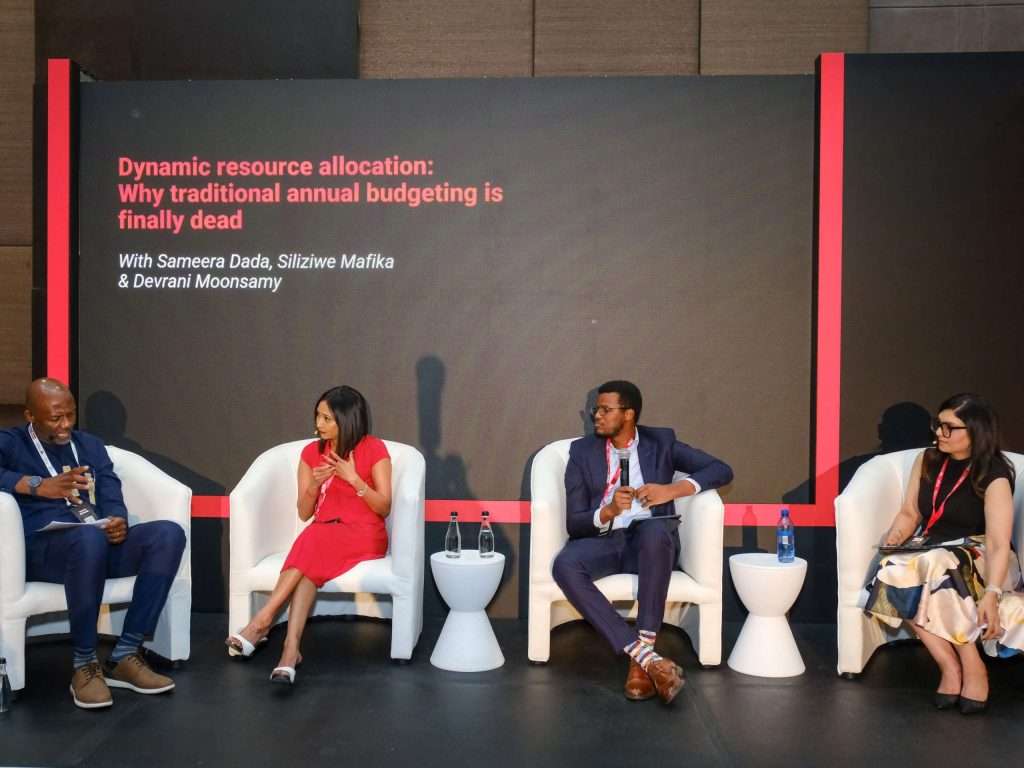
At the Finance Indaba on 22 October 2026, finance leaders discussed flexible capital allocation in a panel titled Dynamic resource allocation: Why traditional annual budgeting is finally dead.
Sameera Dada, CFO at Strate, said the annual budget is not dead, but the habit of fixing how money is spent for 12 months has to go. She was joined by co-panelists Siliziwe Mafika, partner and CFO programme lead at Deloitte and Devrani Moonsamy, CFO at the Ombud Council.
“The idea of allocating resources once a year and believing it would remain optimal for the next 12 months is definitely dead,” Sameera said. She said that while Strate still needed a baseline for capital management and governance – the budget should act as an anchor and a set of guardrails while the response to changing assumptions becomes more dynamic.
Asked what would replace the annual budget, Sameera named three things: a clear strategy and risk appetite, forecasting and scenario planning and clear governance for resource allocation, including approval lines, investment criteria and accountability.
Siliziwe said targets, forecasts and budgets have been muddled into one, but each should be kept for its own purpose.
Move money on clear triggers
Sameera advised that leaders must use judgement to separate temporary volatility from structural change. About 65 percent of Strate's revenue depends on the listed equities market, so volatile markets can push revenue above budget. “It would be very wrong for us to turn that into a permanent cost or permanent investment, because the driver is temporary,” she said. If the change is structural, funds should move, but only with a business case, investment criteria and a governance process.
Similarly, Siliziwe emphasised that leaders should also avoid reacting to every movement. An insurance client had 150 KPIs and found it needed far fewer, perhaps 10 to 20. It now uses thresholds to decide when a movement justifies action.
Keep controls tight while the budget flexes
Devrani argued that flexibility does not mean loosening control. The Ombud Council submits its budget six months before the financial year starts and uses the first quarter to adjust it. She involves budget owners in spreading the budget across the 12 months and meets the people who actually spend the money every month. They prioritise the next one or two quarters, where forecasts are more accurate.
“The controls really need to be strict, monitored and implemented effectively for us to be able to do dynamic resource allocation,” she said.
Culture decides whether it works
Siliziwe pointed out that systems and data are no longer the main obstacles. Culture is. “It's psychologically difficult to give money back,” he said, adding that when mistakes lead to blame, people double down on failing projects. He referenced how Formula 1 teams, which have a no-blame culture, let people make decisions and act.
Devrani noted that public sector teams rushed to spend their budgets in the last quarter, which strains finance and procurement. Sameera said finance should tell business leaders that the budget is not a target. “We should be measured on the outcomes we have achieved as a business and how they align to our strategy,” she said.
Sameera highlighted that forecasting is not about being right every time. “We are not aiming for 100 percent accuracy or perfection,” she said.
Along the same lines, Siliziwe said technology can pull scattered information together quickly, but the hard part is acting on it. “It’s easy to get the information and insights. What’s hard is decision-making and action,” he said. A copper company he works with has moved from monthly scenario planning to three scenarios a day, much as Formula 1 teams simulate the next 10 laps before deciding whether to pit.
The panel's message was that CFOs can keep the annual budget as a guardrail, but should agree on the triggers for moving money, hold controls tight and make it safe to stop a project that is not working.