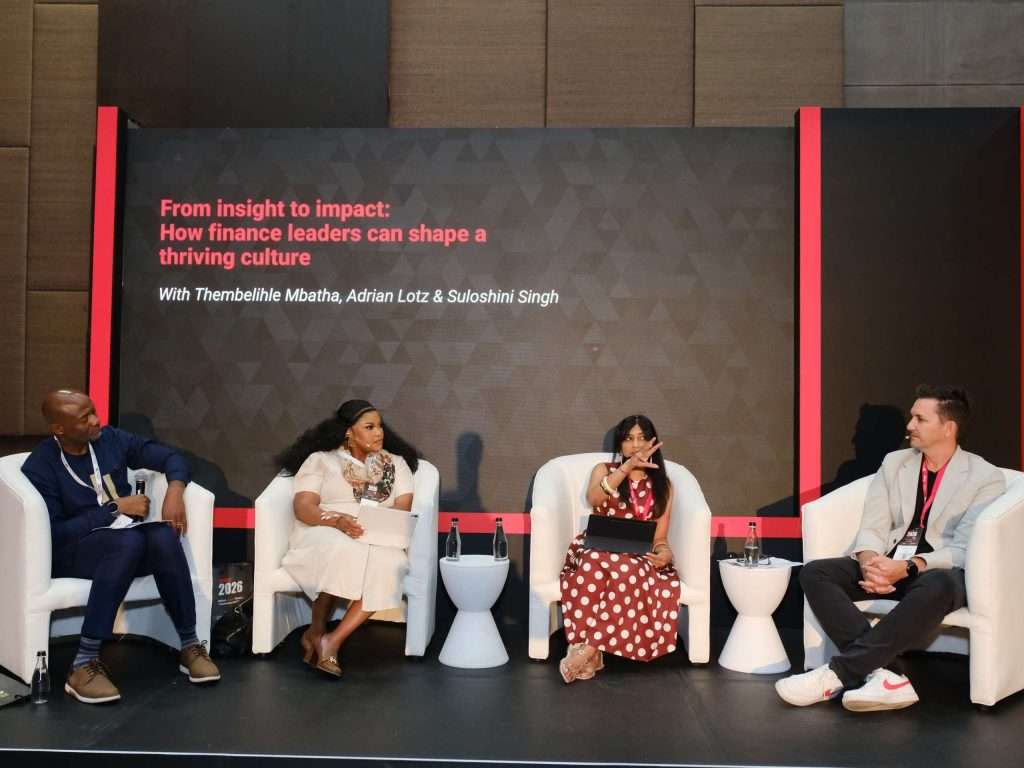
Finance professionals play an essential role across sectors. During a panel discussion, senior finance executives shared how people can explore non-linear career paths.
Traditional finance careers often take on a linear path. At the 2026 Finance Indaba, Adrian Lotz, co-founder and financial director at Ilitha Telecoms, Suloshini Singh, CFO at Optimi, and Thembelihle Mbatha, CFO at Mintek, shared how finance careers can open a world of opportunities across industries.
During a panel discussion titled From insight to impact: How finance leaders can shape a thriving culture, Adrian highlighted the importance of considering personality when looking at career options.
“A career lasts almost a lifetime and your personality and interests do change. I did articles and went into banking. I did a CFA after my CA(SA) qualification. I worked in banking overseas and realised I did not enjoy it.” Adrian said.
This realisation led him to entrepreneurship.
He added that personality also defines the kind of organisations finance professionals should work for.
“For example, a very structured organisation versus a less structured one. I became an accountant because I am a structured person. However, I can also operate in a very unstructured environment and not everybody can cope with it.”
Suloshini added that finance careers are now more front-facing and visible, challenging the old trope about finance professionals focusing strictly on the numbers.
“Historically, the people in front were the CEOs, business development directors, or sales directors. They were the flamboyant personalities. Unfortunately, that is no longer the case. If you are in finance, you will not be stuck behind an Excel spreadsheet or a screen in a dark corner. You must display your charismatic side because you will be speaking to customers and suppliers, not just the bankers.”
She added, “If you want to grow in your role, sometimes you need to step away from your comfort zone. Rely on your peers and superiors to help guide you through that process. If necessary, get an executive coach.”
Embracing depth and breadth
Suloshini urged finance professionals to have depth and breadth across industries. “You will have different experiences, and you will gain different insights from every industry. I went from automotive, marketing, manufacturing, and I am currently in education.”
She also emphasised the significance of traditional qualifications which underpin a finance career. “The qualifications are still important. You must understand the fundamentals of debits and credits but also have those different experiences.”
Thembelihle said technical capabilities will enable finance professionals to build careers across sectors.
“As an accountant, you are expected to tell a story when you look at a balance sheet, and that is going to be one of your superpowers if you are going to have to thrive in the career. CFOs are now often referred to as chief value officers because whatever the numbers say, you must tell the story. There is a special skill in what we studied.”
Adrian highlighted the need for finance professionals to also develop narrative capabilities.
“The finance team led by the FD or CFO should be seen as a dynamic team that leads the company in their own unique way. You also have insights into the business and touch every single part of it. With that, you are almost doing a disservice to your company if you cannot communicate what is happening in the business internally and externally.”
Building a finance career in the public sector
While the private sector allows financial professionals to carve out their own path, Thembelihle explained that the public sector requires finance professionals to pursue a linear career trajectory.
“There is still rigidity in government and the traditional way of getting to the top still matters. You need to have completed your qualifications and articles and served in a senior managerial position,” Themelihle said.
She added that finance professionals must be intentional when pursuing a public sector career.
“I went into the public sector first because I am passionate about it. However, I needed to start working when I got my degree because by the time I completed my CA(SA) qualification, I needed at least four years’ experience to get into the entry-level space for a supervisor role in government,” she said.