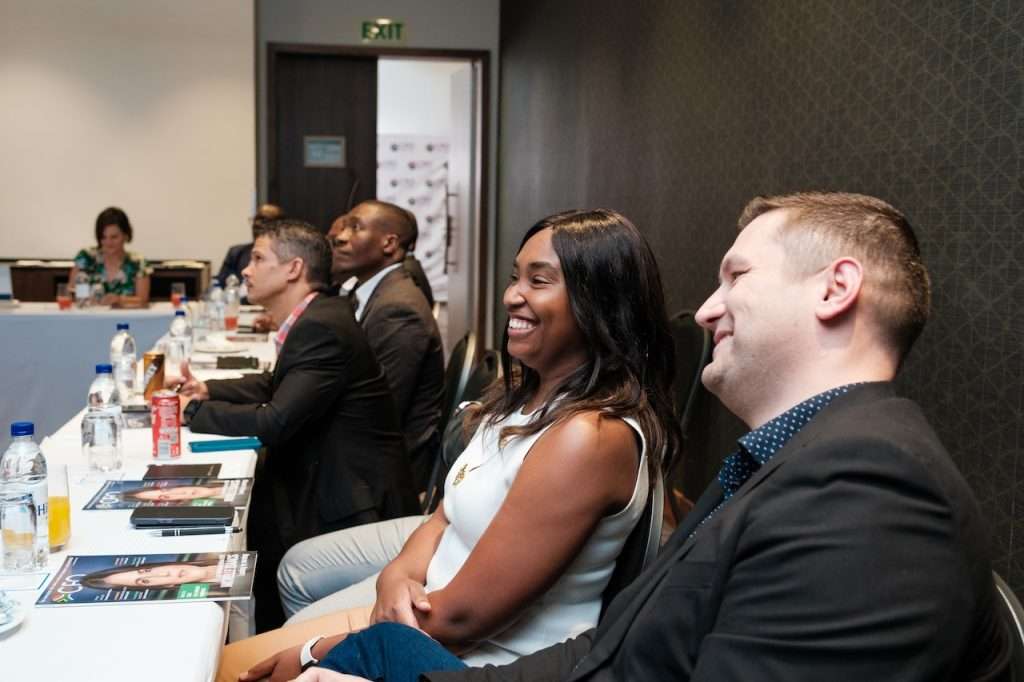
The evening of 19 February marked the beginning of Namibia’s entry into Executive Communities, as an elite group of nearly 30 chief financial officers gathered for the country’s first CFO event.
For the first time in Namibia’s corporate history, at least 30 chief financial officers gathered in one room not to defend numbers or sit through a technical update, but to speak to one another as peers.
The inaugural dinner, held under the Executive Communities banner at the Hilton Windhoek, marked the debut of what is set to become Namibia’s first structured CFO community. Executive Communities connects finance, HR and IT executives, boosting their knowledge, networks and careers through down-to-earth engagement, world-class events and original content.
The initiative forms part of the regional expansion of Executive Communities whose mandate is singular: build independent platforms where sitting executives can engage frankly about leadership, risk and value creation.
The mood in the room was deliberate and reflective. These were finance leaders who carry balance sheets, regulatory scrutiny and board expectations daily. Yet many admitted this was the first time they had convened in a forum exclusively designed for them.
Until now, interactions among Namibia’s CFOs have been informal, often reactive and industry-bound. What has been absent is structure, continuity and a platform anchored in the realities of the role itself.
That gap is what Executive Communities is seeking to close across the region, following a similar engagement in Gaborone, Botswana last month.

A platform built for the role
“We are not here to sell to each other,” KC Rottok Chesaina, Executive Communities director told the gathering. “We are here because the role demands a space where CFOs can think out loud without posturing.”
The approach also extends to succession. High-potential finance executives identified as future CFOs are included in development programmes, reinforcing the long-term objective of building leadership depth.
Namibia’s executives responded to the clarity of that model. In a market where finance leaders often carry both commercial and political accountability, the need for peer exchange is acute.
“If you miss a clean audit, you are not just answering to a board,” one public sector CFO said. “You are answering to the nation. The pressure is constant.”
Another was more direct. “The CFO carries the risk, even when the decision was not theirs. Accountability in this role is absolute.”

From compliance to capital allocation
The discussion quickly shifted from governance to strategy. Several participants challenged the outdated perception that finance is backward-looking.
“We were trained to report history,” one CFO said. “But history does not grow companies. Forecasting does. Capital allocation does. Strategic courage does.”
Another reframed the mandate bluntly. “If you are only producing numbers, you are already behind. The CFO today must shape the future of the business, not just document the past.”
That shift has implications for technology, data and capability. Artificial intelligence emerged as both opportunity and warning.
“If we are still running critical functions on spreadsheets in five years, we will have failed,” one executive said. “AI is not a buzzword. It is a governance issue, a risk issue and a competitiveness issue.”
Others emphasised that automation will not replace finance leadership but will expose weak processes and skills gaps.
“Technology will not take the CFO’s job,” a participant noted. “But it will expose CFOs who have not evolved.”

The weight of the economy
The backdrop to the dinner is a Namibian economy under pressure. Margin compression in key sectors, fiscal constraints and investor caution were recurring themes.
“When margins tighten, finance becomes the stabiliser,” one CFO said. “You are balancing prudence with growth every quarter.”
There was consensus that the CFO’s influence now extends well beyond finance teams. In many organisations, IT, procurement and even HR report into the office of the CFO. The role is increasingly that of integrator and risk custodian.
“You are the one who sees the full picture,” one executive remarked. “Everyone else sees a department. The CFO sees the enterprise.”
A beginning, not an event

By the close of the evening, the appetite for continuity was unmistakable. Quarterly engagements, thematic discussions and broader inclusion of emerging finance leaders were all proposed.
“What we have started here cannot end here,” one CFO said. “If we want stronger institutions, we need stronger financial leadership. That requires community.”
Those in attendance were:
Abisai Nghimwenavali, Millenium
Abrie Collard, Western Investment
Arlington Matenda, Standard Bank
Batsirai Pfigarai, NamPost
Chris-Johan Hartman, Capricorn Asset Management
Cornwell Chadya, Namibia Water
Dakalo Mandiwana, Gautrain
Daniel Liebenberg, Motovac
Donatius Vinsentius, Sandvik
Geraldine Meintjies, Onguma
Hannes Kotze, Choppies
Ise Riedel, WCE
Janine Londt, Santam
Julius Nghikevali, NIDA
KC Rottok Chesaina, Executive Communities
Kennedy Urikhob, EIF
Lizelle Pell, Starr
Lloyd Londt, Bank of Namibia
Maria Moses, CRAN
Michael Gotore, Nampower
Rachel Boois, ECB
Scholastika Mwetulundila, NIP
Shanco Renton, NAC
Sinsikus Amwiigidha, Metro
Stefan Hugo, Future Media
Thekiso Lefifi, Executive Communities
Thabang Mogodi, Water Utilities Corporation
Zenaune Kamberipa, Bank Windhoek