Top CFOs Riaan Davel, Joe Ndala, Stephen Mahlare and Taryn Woodbridge explained how to discover a purpose-driven strategy.
During the first CFO Summit of the year, which took place on 19 February, top finance executives took the opportunity to explore how purpose-driven finance leadership can redefine success by balancing shareholder returns with stakeholder impact
DRDGold CFO and 2024 CFO Award winner Riaan Davel, CFO of Zutari and 2018 CFO Award nominee Joe Ndala, 2024 CFO Finance Transformation Award winner and CFO of Mercedes-Benz South Africa Taryn Woodbridge, 2018 CFO Awards nominee and CFO of Marsh Mclennan Africa Michelle Pienaar, and executive director for finance at Barloword equipment Stephen Mahlare revealed how they are driving a purpose-driven strategy at their organisations – and for society – in a panel discussion.
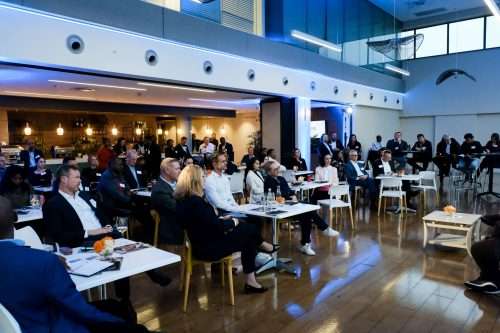
The discussion began with them explaining how purpose drives their companies and the decisions they take as CFOs.
Riaan began by pointing out that DRDGold is one of the oldest listed companies on the Johannesburg Stock Exchange and how, as a purpose-driven company, the gold miner wants to “reverse the environmental legacy of mining. We’re a business – we have to make money – but our model is not to make as much money as quickly as possible. We care about the impact mining companies have on both communities and the environment – helping to remove that negative environmental legacy is the purpose that drives everything we do,” he said.
Taryn concurred and went further: she said, “People need to identify their contribution early on. When a financial controller makes sure that paying suppliers on time is important, they realise that when we celebrate that there have been no production stoppages, this is how they’ve contributed towards that success.”
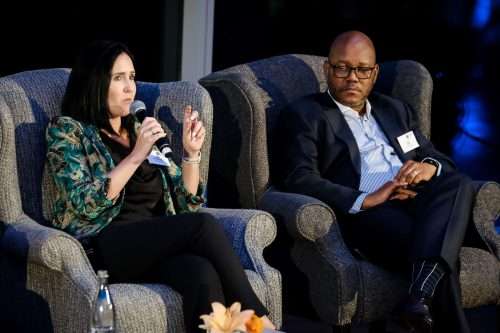
Joe said impact and grit are both important in the engineering industry. “Whatever we do, we just want to make sure that in the triangle of things that are happening in life – whether it's the environment, the economy or communities – we touch everyone. We no longer say we build roads, we say we are connecting communities. From one side to the other – whether they are transporting goods, or people – they need a road.
“Grit is about owning it and getting it done - if you design something and there's a mistake from your design, it's going to be visible, you cannot bury it. Because of that, it creates a system where everyone must do their best, with proper quality in the workmanship, because sustainability needs to be there."
Stephen agreed that it’s all about sustainability and long-term vision. “When we look at our company values and purpose pyramid, at face value what we do is sell and service Caterpillar equipment. But selling equipment for the purposes of illegal mining doesn’t align with our values.”
AI and its role in a purpose-driven organisation
Values and purpose are important, but improving operations and introducing artificial intelligence (AI) into the organisation remains a key priority to the CFO. Taryn said, “Introducing AI requires a mindset shift from all of our team members, some of whom still feel a sense of anxiety and fear – fear about how this technology will impact them in their lives.
“It’s about working together with IT, and being relevant for the future. In finance we are expected to do more with less, to be faster, quicker and use real-time data to make decisions. All of this presents our people with an opportunity to upskill and reskill.”
Focus on sustainability and impact
Apart from the opportunities that technology presents its about focusing the minds of the finance team on the importance of working together. Stephen said, “I encourage people in my finance team to not sit back when the operations team is out having conversations with customers. Finance people must tag along and find out what our customers want. That’s how we ensure that we work as a team."
Riaan added, “Our take on [sustainability] is to get involved: embody the purpose beyond words on a document but embody it in a business model. I love that our finance team fully gets involved in understanding the business – sustainability doesn’t sit in some other department. That same team takes ownership for planning and executing that business model”.
Riaan noted that integrated reporting is not just a concept for them: it forces the team to think beyond finance and embrace the idea of sustainability across the entire business.
Joe concluded the discussion by saying that, “there’s a difference between just having a vision and having purpose. When you have a purpose, it’s something that grounds you - where you’re going, what you do and how you are going to do it. So you will never do something that doesn’t align with your values. You have a right to say no if you believe that it goes against your purpose.”