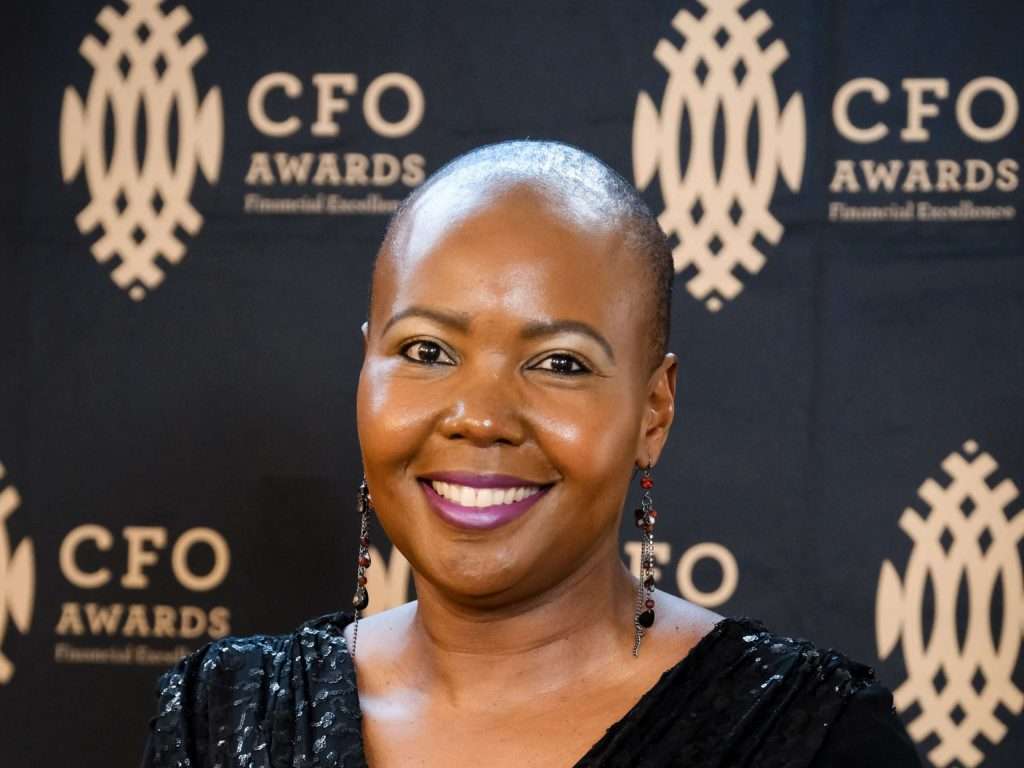
Through her collaborative and inclusive leadership style, Abigail Mukhuba has helped Sanlam to deliver on the new accounting standard.
Sanlam CFO Abigail Mukhuba hit the ground running when she joined the financial services giant, transitioning from the mining industry at the height of the Covid-19 pandemic.
“I joined in October 2020, at a time when Covid-19 was still a major force shaping the world. Changing employers is always an adjustment, but doing so during a pandemic added a unique set of challenges. Moving from a workplace where I saw my colleagues daily to leading teams remotely required a new level of adaptability. The impact of Covid-19 varied across industries and organisations, especially insurance organisations, and navigating those differences became an essential part of my leadership journey.” says Abigail, a 2024 CFO awards nominee.
While the world fought a devastating virus, Abigail was tasked with steering Sanlam’s finance team through its transition to the then new global accounting standard for insurance contracts, IFRS17.
IFRS17 was created to ensure consistency and transparency in how insurance companies globally calculate their profits, risks, and financial health. Sanlam was among the first companies to deliver on that new mandate on the African continent and in the world.
“I joined the group at the back end of the process. The implementation of IFRS 17 was the result of over five years of dedicated work by teams of actuaries and accountants, culminating in the first set of results post the standard becoming effective. While adapting to a new accounting standard was not unfamiliar to me, doing so in an industry I had not previously worked in was both a challenge and a learning experience.
Stepping into the unknown was daunting, but it also pushed me to grow in ways I hadn’t anticipated,” she recalls.
An enabling leader
True to her leadership style, a collaborative and inclusive one, Abigail credits the entire team with the successful implementation of IFRS 17.
“Early on, I had to recognise that while I was the team leader, success depended on leveraging the expertise of each team member. Delivering on our mandate required trust, collaboration, and the ability to rely on those with deep technical knowledge in their respective areas,” she adds.
“As a leader, it's important to acknowledge that you don’t deliver the work alone. While we may be steering the ship, providing direction and making key decisions, the real value is created by those closest to the work itself. Their expertise is what drives results – without them, there would be nothing to lead,” she points out.
Abigail also stresses the importance of giving team members feedback and acknowledging their contributions, saying people need to understand they are not competing but rather working together to deliver on a mandate. “Everyone has a role to play, and as a leader, your duty is to create an environment that enables them to play their role.”
Almost five years into her tenure at the helm of finance, Abigail counts those early days at Sanlam as yet another key milestone in her career.
Spending her formative years primarily with her grandparents as her parents sought work opportunities in the cities, she remembers how her maternal and paternal grandparents nurtured her interests and cared for her in a way that made her feel loved and cherished as a child.
“Grandparents treat you like you are the most special person on earth, and they really make you believe that you can do or become anything,” she recalls fondly.
While she was the daughter of a high school accounting teacher, she did not pursue accounting as a high school subject. “We never discussed our subject choices with our parents at that age – we chose the subjects we excelled in. Our school did not even have accounting as a subject choice,” she explains.
Leaving a long queue
Accounting wasn’t a blip on her radar when she was deciding on what to study after finishing high school either.
Abigail went through the UNISA registration processes with her sights firmly set on industrial psychology. Eventually, she got to the arts faculty to register for a BA, a requirement at the time for industrial psychology. But the sea of students in a seemingly never-ending queue ended that quest. She desperately turned her attention to a shorter, faster moving line with the overhead sign reading ‘accounting sciences’.
While she had a basic understanding of what accounting sciences was, she asked her mom for more information. And in the few moments that followed, Abigail pivoted and set sail on a new career path.
“I have no patience for queues – I see them as a waste of time. In fact, I’d rather skip a meal than stand in line at a restaurant,” she says, laughing as she recalled how she joined the accounting sector.
But, decades later, she has no regrets. “I have never looked back since.”
As she continues this chapter in her career, Abigail has now shifted her focus to greater accountability within the finance fraternity at large.
At the 2024 CFO Awards, she was inspired by how the event brought together finance professionals from both the private and public sectors.
It became clear to her that evening that there was a greater need for more collaboration between the two sectors. “At this juncture, South Africa cannot afford to wait for solutions to come from elsewhere – we must take ownership of crafting them ourselves. In the financial services sector, this means not only assessing how public-private partnerships are unfolding, but also setting clear goals for ourselves and for the country.
“More importantly, we must measure progress frequently, hold ourselves accountable and continuously refine our approach. It’s not just about identifying where we’re succeeding, but also being honest about where we’re falling short, so we can course-correct and drive meaningful change,” she says.
Abigail believes the time has come for the financial sector to take even greater ownership of its role in South Africa’s future. “We’re always looking at the president and everyone else. We need to start looking at ourselves.”