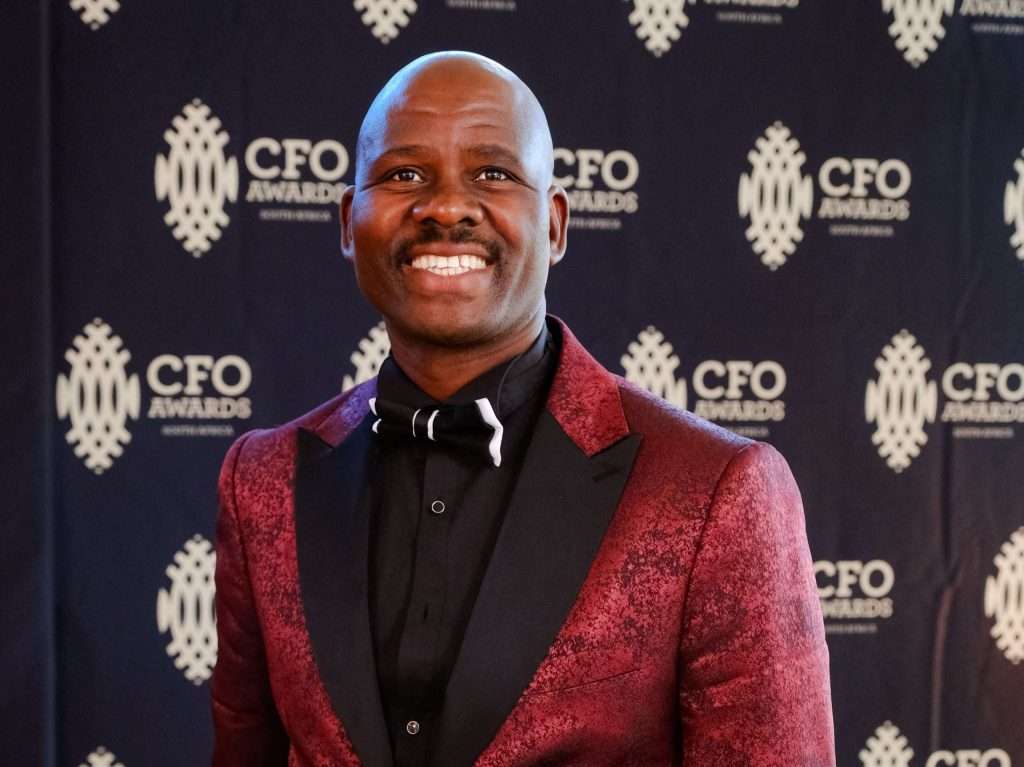
From failing board exams and losing his mother just before qualifying as a CA(SA), to helping steer Proconics towards growth, CFO Bongani Ngcongo’s journey has been defined by endurance. Whether tackling the Comrades Marathon or difficult boardroom decisions, he believes resilience, integrity and purpose are what carry leaders through the toughest moments.
There is a photograph in Bongani Ngcongo’s office that says more about him than any title ever could. Alongside framed qualifications and milestones sits an image of a honey badger, small, fearless, relentless. To Bongani, the animal symbolises resilience. “Nothing can defeat me,” he says with a quiet laugh. It is not arrogance. It is survival.
That spirit has carried him from a determined young boy growing up with limited means to becoming the CFO of Proconics, one of South Africa’s leading engineering firms specialising in agile, multi-discipline projects for critical infrastructure clients. Since joining the company in 2018, Bongani has helped steer extraordinary growth, guiding the business revenue to quintuple this year.
Yet when he speaks about success, balance sheets and boardrooms are only part of the story. For Bongani, life has always been about endurance – emotional, spiritual, social and physical. It is why, long before dawn breaks, he can often be found running through quiet streets, chasing the rising sun.
“I’m a runner. The feeling after doing a 10km run in the morning, with the breeze and the sun coming up, is unbelievable. You feel refreshed. Whatever stress was there disappears,” he says.
Running, for him, is not merely exercise. It is restoration. After difficult days and demanding decisions, he laces up his shoes and runs until clarity returns. “When I come back, I’m better. I’m a fully present father to my children and a fully present husband to my wife. Running ignites me.”
His greatest running challenge is the legendary Comrades Marathon. This year marked his fifth attempt at the gruelling ultramarathon between Durban and Pietermaritzburg, a race that stretches close to 90km and pushes the human body beyond its comfort zone.
“It takes a lot of mental strength. The last 20km are not about your body anymore. Your mind is running. Your body refuses, but mentally you keep pushing yourself.”
As he describes runners being cheered on by strangers shouting their names from the roadside, his voice softens. “That’s why they call it Comrades. People encourage you the whole way. It reminds you that you are not alone,” he says.
In many ways, the race mirrors his own life journey, painful climbs, moments of exhaustion, but an unwavering refusal to stop.
Changing course for the better
Bongani joined Proconics as CFO in 2018 after building extensive experience across mining, petrochemicals and finance. Before Proconics, he served as financial manager at Masana Petroleum Solutions and Rio Tinto Management Services respectively. Earlier in his career, he spent about a decade at Sasol Mining, where he began as a TOPP trainee in 2005 before becoming senior financial manager in 2007.
But the road to becoming a chartered accountant was far from easy.
Growing up, Bongani knew education would become his escape route. He remembers telling his sister while still in primary school that he would one day become number one in his class. At the time, she dismissed the idea. Instead of being discouraged, he worked harder.
By matric, he was relentlessly pursuing bursary opportunities, visiting firms personally and following up constantly. “I would even go to call one of the big accounting firms on weekends asking about my application. That’s how determined I was.”
Eventually, he secured an opportunity to study at the University of Zululand (degree) and the then University of Natal, now University of KwaZulu-Natal (CTA). Later, a bursary from auditing firm SizweNtsaluba VSP then which is now known as SizweNtsaluba Gobodo and Grant Thornton helped him complete his studies and begin his professional journey.
During his training years, Bongani strategically chose Secunda when other trainees avoided it. While many viewed the town as remote and undesirable, he saw opportunity. “That was my strategy. I knew the core operations of Sasol were there and that was a very critical point for me,” he adds.
The decision proved transformative. At Sasol, he immersed himself in every aspect of finance, treasury, budgeting, audit, reporting and capital approvals. More importantly, he was entrusted with meaningful responsibilities early on. “You were not making tea. You were doing real work with real impact. I had to be able to quickly catch-on and do my best,” he says.
Even so, qualification did not come easily. He failed parts of his board exams before eventually passing and qualifying as a CA(SA) in 2009. Rather than viewing failure as defeat, he treated it as another hill to climb.
Then tragedy struck.
Navigating tough times
In 2008, shortly after writing what would become his final qualifying exam, Bongani’s mother died after being struck by lightning. For a moment, the memory still overwhelms him. “She was the pillar,” he says quietly. “She prayed for me. She protected me.”
Although she never saw him officially qualify as a chartered accountant, Bongani finds comfort in knowing she witnessed the beginning of his success. By then, he had already progressed professionally, built a new home and started changing his family’s circumstances. “She was proud, she saw that her son was doing well and that is why I believe she would be so proud of what I have become right now,” he says.
His father lived long enough to witness the full journey and as he recalls him proudly pointing at his son’s car and joking that it belonged to him too. “He would say, ‘This is my car’. And I’d say, ‘Okay father, you are right’.”
Today, family remains central to Bongani’s life. His children already know the careers they hope to pursue. His son plans to become a pilot, while his daughter dreams of becoming a veterinarian, a goal she has held onto since primary school. “When I asked if she wanted to become an accountant like me, she said no immediately,” he laughs.
Holding the steering wheel for better heights
He encourages ambition in his children because he understands the power of direction. Long before he became a CFO, Bongani had already decided who he wanted to become.
At Proconics, that same sense of purpose has shaped his leadership style. When he joined the business in 2018, the company held a Level 4 B-BBEE status. Under his leadership, Proconics achieved Level 1 status in 2020, opening doors to significant contracts with state-owned entities and accelerating growth. But Bongani insists financial leadership is never only about numbers.
“The most important thing is understanding the business. Finance supports the business. You need to understand people, operations and growth,” he says.
That philosophy has expanded the modern CFO role far beyond spreadsheets and reporting. Over the years, Bongani has overseen HR, procurement, project accounting and strategic transformation initiatives. Today, he spends as much time discussing technology systems and AI-driven efficiencies as he does financial statements.
“It’s not really about the numbers anymore. The CFO has become a holistic business leader,” he explains.
One of the defining moments of his career came during the Covid-19 pandemic, when businesses across South Africa faced unprecedented uncertainty.
At Proconics, leadership made the painful decision to sacrifice a portion of their own salaries to protect jobs and keep the company afloat.
“We said the company must survive, and our people must survive. Another difficult chapter followed when the business experienced significant project losses, forcing leadership to make the agonising decision not to pay bonuses for the first time in the company’s history. For me, it became one of the toughest calls I ever faced. The bonus was not only for employees. It was also for us as executives. So you are managing conflicts of interest,” he says.
He remembers the weight of balancing people’s expectations against the long-term sustainability of the business. Yet he also learnt one of leadership’s most important lessons: transparency matters. “You need to be truthful. You need to explain the picture clearly so people understand why decisions are being made,” adds Bongani.
Instead of hiding behind corporate language, Bongani and the leadership team met repeatedly with employees to discuss scenarios, risks and realities openly. He believes people are more likely to support difficult decisions when they are given the full picture.
It is here that Bongani’s philosophy around resilience becomes most powerful. He does not romanticise hardship. He acknowledges the fear, the uncertainty and the emotional toll of difficult decisions. But he believes leadership requires courage, especially when outcomes are unclear.
“You cannot be indecisive. Sometimes you must make the call. Faith also anchors me through uncertainty. I attend church regularly and speak openly about the role prayer plays in my life. I believe I am where I am because of God,” he says. “Prayer helps me reflect and keeps me grounded,” he says.
His spiritual discipline mirrors the mental discipline he develops through running. Both require endurance, consistency and reflection.
The developing role of the future CFO
When Bongani speaks about the future, he does so with the cautious awareness of a finance leader navigating South Africa’s evolving economic and legislative landscape. Regulatory changes, procurement requirements and shifting B-BBEE rules weigh heavily on his mind because they carry real implications for business sustainability.
“What keeps me awake at night is changing legislation and how it affects the future of the business,” he says.
Yet even here, his instinct is not to panic, but to prepare, engage stakeholders, analyse scenarios, find solutions and keep moving forward. The same approach defines how he sees leadership itself. He believes that the CFO today must balance all stakeholders because they are not only protecting the company financially, they are protecting its future.
That future includes embracing technology, improving operational efficiency and ensuring businesses remain sustainable for generations to come. Bongani is already heavily involved in driving ERP transformation and exploring how AI can support smarter decision-making within Proconics.
Still, amid the complexity of strategy, governance and transformation, he returns repeatedly to one core principle: integrity. The legacy he hopes to leave behind has little to do with titles or financial milestones.
“I want to be remembered as an ethical leader. In a profession often exposed to pressure, temptation and competing interests, I believe honesty matters more than ever. Every decision must align with your values. You must ask yourself, ‘Can I defend this decision? Does it protect my integrity?’” he says.
For Bongani, it is the kind of leadership philosophy forged not in comfort, but through struggle, through failed exams, grief, difficult boardroom decisions, sleepless nights and long kilometres on unforgiving roads. This is why the honey badger means so much to him.
Because resilience, for Bongani Ngcongo, is not about appearing invincible. It is about continuing anyway.
It is waking before sunrise to run while the rest of the world sleeps. It is standing in front of employees and delivering difficult truths with honesty. It is carrying the memory of a mother who never saw the final chapter of the dream she helped build. It is refusing to allow setbacks to define the outcome.
And somewhere between Durban and Pietermaritzburg, when the body begins to fail and only the mind remains, Bongani finds a lesson that extends far beyond the road.
“If I finish Comrades, then any obstacle at work becomes small. It cannot defeat me. Like the runners who call his my from the roadside, life has tested me repeatedly. But with every challenge, I keep moving forward, step by step, kilometre by kilometre, decision by decision, determined to finish the race well,” he says.