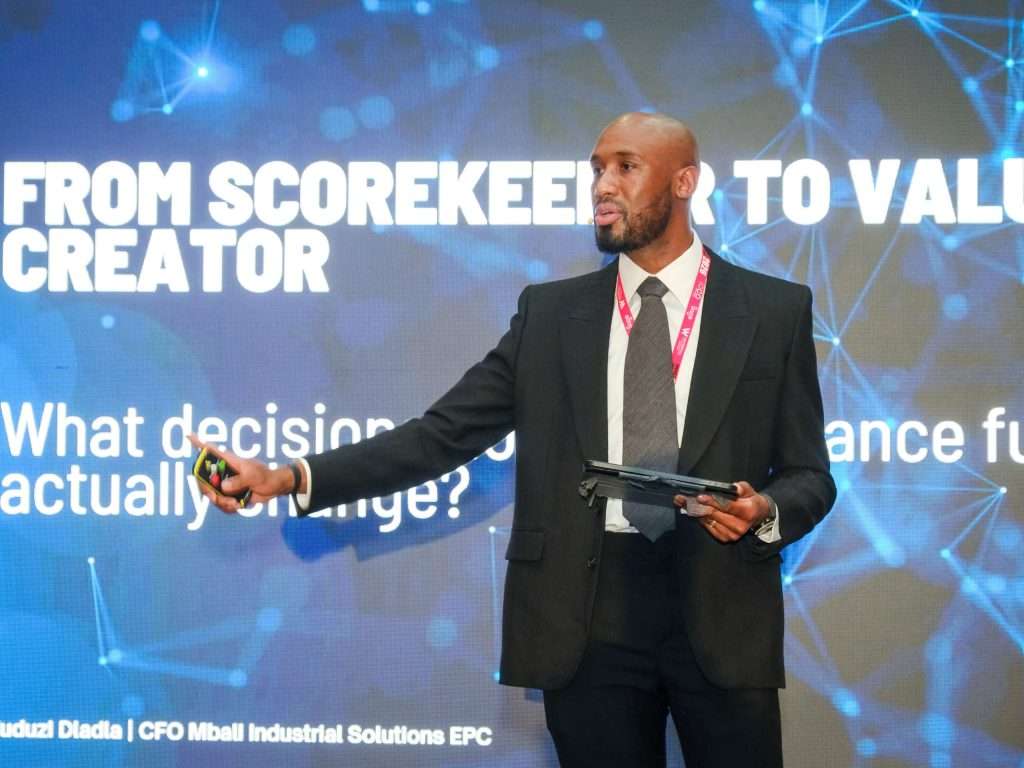
At the 2026 Finance Indaba, Mduduzi Dladla, CFO of Mbali Industrial Solutions EPC, challenged finance leaders to move beyond reporting historical performance and become strategic partners who shape decisions, protect liquidity and influence business outcomes.
Finance teams should be involved in business decisions before problems emerge, rather than being called in to rescue a struggling operation, according to Mduduzi Dladla, CFO of Mbali Industrial Solutions EPC.
Speaking during a Sage session at the 2026 Finance Indaba, titled Turning Insight into Impact: How Modern Finance Teams Drive Better Business Decisions, Mduduzi challenged finance leaders to reconsider how their organisations measure the value of the finance function. “We're not firefighters who are putting out fires but we are strategists who are making a difference,” he said.
According to Mduduzi, the test of a modern finance team is not simply whether it produces accurate reports on time, but whether those reports influence decisions across the business.
From historical reporting to forward thinking
Mduduzi said finance professionals are often skilled at explaining what has already happened, while the business needs insight into what comes next.
“Often in finance, we’re excellent history narrators who can tell the best story of what has already happened by reconciling bank statements and explaining past transactions. The issue is that business is live every single day and there are daily obligations, payroll and operations functions that need to be serviced, yet finance is often lagging 30, 60 or even 90 days behind.”
He argued that technology, integrated systems and forward-looking analysis are essential to changing this dynamic. “We cannot remain a finance profession built on spreadsheets. Excel is not going to work on its own anymore. You need to integrate ERPs and technology to transition into a value creator,” he added.
The shift, he explained, requires finance teams to identify risks before they affect operations, provide early warnings to executives and participate in decision-making from the outset.
Why cash flow changes the conversation
Drawing on his experience in the engineering, procurement and construction (EPC) environment, Mduduzi highlighted the difference between securing contracts and having cash available to deliver them.
“In our business, we have an active R2.2 billion order book, so we easily assume money will flow smoothly. I used to have linear thinking, assuming a R100 million contract over 10 months meant banking R10 million every month.” he explained.
In practice, procurement, project establishment and certification can delay payment, even after a contract has been secured.
“Liquidity is the most fundamental element you need to manage, whether you are a CFO or a finance or business manager. If you switch off the background noise and focus on keeping the business liquid, you will always remain relevant because you can resource the business to meet its obligations,” he added.
Five shifts to turn insight into impact
Mduduzi outlined five priorities for modern finance teams, including shifting their focus from historical reporting to forward planning to breaking down departmental silos and linking accrual budgets to cash management. He also called for a move away from manual spreadsheets towards intelligent systems, with finance professionals acting as strategic partners rather than gatekeepers.
Technology, he cautioned, is only part of the equation. “Technology is an enabler, but leadership creates impact. You can deploy Sage Intacct or another ERP, but without leadership taking ownership, it will not yield results.”
For finance leaders looking to translate insight into action, Mduduzi proposed a 90-day roadmap. The first 30 days should be spent listening to operational teams, followed by 30 days redesigning internal processes and a final 30 days implementing changes and testing their effectiveness.
His closing message was a call to redefine finance through four pillars: data, insight, influence and execution.
“Ensure your organisation cannot proceed with major strategic decisions without finance being seated at the table. Let us not merely support our businesses; let us help build their future,” he concluded.