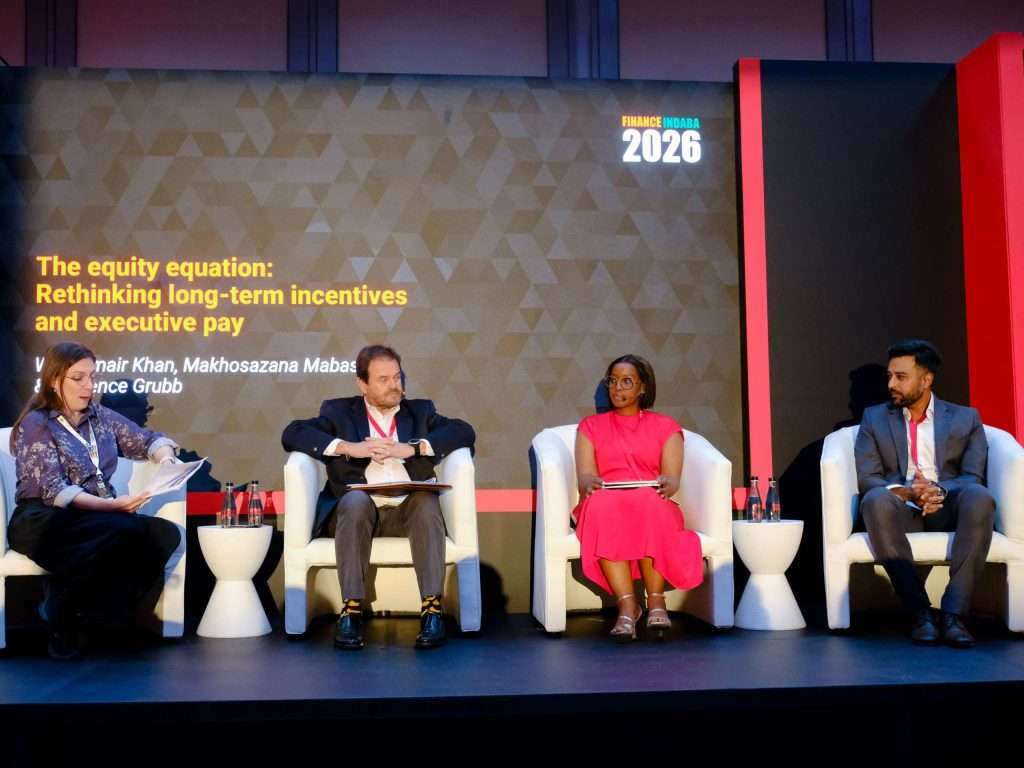
At the 2026 Finance Indaba, finance leaders sat down to discuss how organisations can design remuneration frameworks that reward performance and ensure that executive incentives support long-term value creation.
Executive incentive structures need to be defensible. This is the sentiment shared by finance leaders during a session titled The equity equation: Rethinking long-term incentives and executive pay, featuring Laurence Grubb, MD at Khokhela Remuneration Advisors, Makhosazana Mabaso, partner: executive reward, tax and legal services at PwC South Africa, and Omair Khan, CFO at Anchor Capital at the 2026 Finance Indaba.
“The incentive structure needs to be defensible. It is only defensible if it is anchored against a strategy,” said Makhosazana. She added that at the start of an incentive structure, strategy is key; however, organisations often do not review the alignment between strategy and incentives a few years later to ensure it is still relevant. She emphasised that organisations must consider changes in performance conditions and geopolitical shifts.
“We must ensure that the remuneration is driving the right behaviours which are aligned to the strategy,” Laurence added.
Stakeholder needs
The panel also discussed the importance of considering all stakeholder needs regarding incentives. Omair said, “Anchor Capital is a services business, and the client is always on top. Then we have our staff and shareholders, and we must balance it all. If the balance is not there, then too much can tilt two ways, and then the longevity of the business can be skewed.”
Makhosazana added that organisations cannot satisfy all stakeholders such as shareholders, employees, and the public when it comes to remuneration. She highlighted that low-level employees want fairness and recognition. Their efforts need to translate into pay, whether it is fixed pay or bonuses.
She also noted that regulators want transparency through disclosure, and the public will question whether the remuneration makes sense. “If you look at all these stakeholders together, it is true that you cannot satisfy everyone.” She stressed that remuneration committees must consider all stakeholders when developing an executive incentive framework.
Short and long-term incentives
“We must look at the pay mix, which is the guaranteed pay, and the short-term incentive and long-term incentives, and ensure that the ratio between those is sensible,” said Laurence. He added that if executives have high guaranteed pay and low variable pay, there is little incentive for them to perform well.
“We must look at the structure of each scheme, the short-term and the long-term. How is that scheme designed? Is it structurally sound? What measures are they rewarding for? Are there too many measures, or are they enough?” Laurence said.
He added that incentives must have targets. “Make sure that the target is set sensibly, and there is enough performance to warrant the incentive that they are going to get. You do not want a target that is unreasonable because your executives will never achieve it and will be discouraged.”
Incentivising with equity
Omair noted that not all employees are interested in equity as an incentive and organisations need to consider that some prefer cash incentives.
He also added that ownership can be a powerful tool to drive behaviour. “You must look at ownership from a decision-making perspective. If you make decision makers think like owners, you can drive the behaviour very differently.”
He added that people do what is best for the company when they have a level of ownership. “If I am an owner, I am thinking about the bottom line and what is best for this company for the next five years to 10 years,” he said.
“Our long-term incentives are equity-based. We think about the business like shareholders. Our senior management is aligned to the different shareholders, and we are creating the right behaviour while building a sustainable business,” he said.