Artificial intelligence is changing how professional services firms operate, from automating routine finance tasks to reshaping how junior professionals are trained. However, the technology also raises questions about data governance, accountability and the skills finance professionals will need to remain effective.
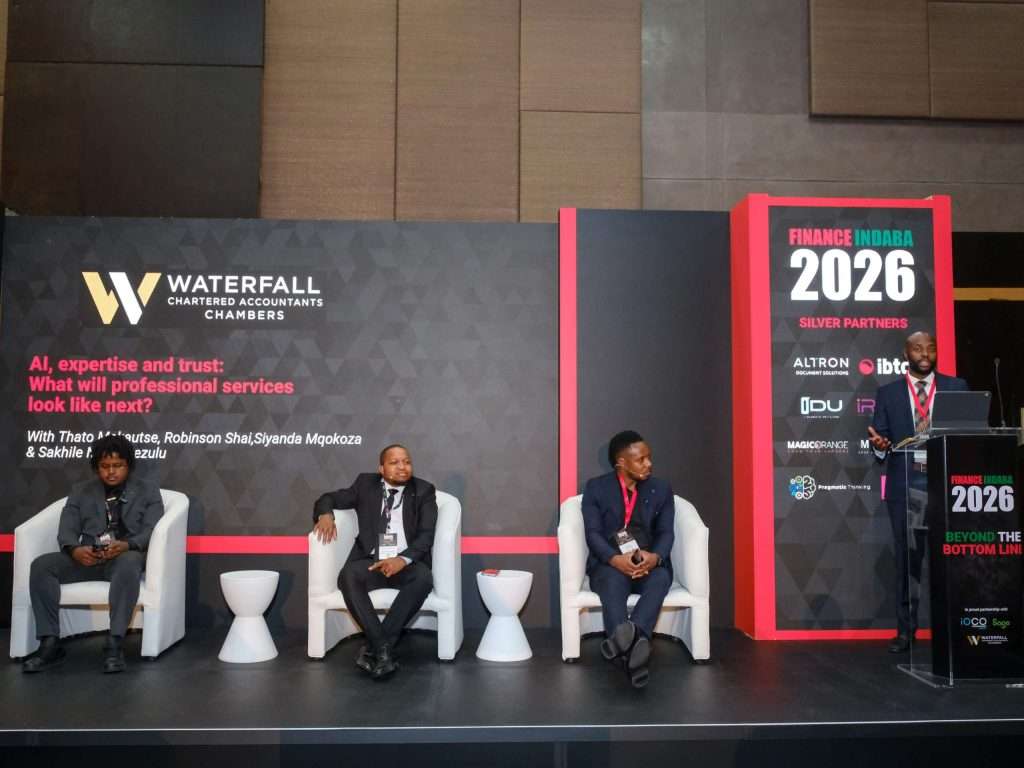
At a panel discussion titled AI, expertise and trust: What will professional services look like next, leaders from Waterfall Chartered Accountants Chambers discussed the opportunities and risks associated with AI adoption, as well as how organisations, universities and training institutions can prepare the next generation of finance professionals.
The discussion featured Thato Makautse, president of Waterfall Chartered Accountants Chambers; Cinga Nyangintsimbi, CFO of Waterfall Chartered Accountants Chambers; Sakhile Mngomezulu, MD of DLD Empire Inc; and Siyanda Mqokoza, chief AI officer at Waterfall Chartered Accountants Chambers.
The panellists agreed that while AI can perform many finance tasks faster than humans, professional judgement and accountability remain central to the role of finance professionals.
AI adoption requires governance and oversight
Siyanda highlighted the efficiency gains AI can deliver to finance teams, while emphasising the need for human oversight and quality control of AI-assisted work.
“AI will give us an opportunity to do more with less as more of our workflows become automated. This also presents risks in terms of data protection and governance as finance teams work with sensitive data, and this is where the human in the loop comes in. If you think about the true value of a finance professional, it lies in their professional judgement and accountability,” he said.
He also raised concerns about the profession’s approach to AI governance, particularly when employees use public-facing AI platforms to process sensitive information.
“In my opinion, the profession is really behind when it comes to AI governance. Simply having an AI policy that provides guidelines for how AI is used is not enough. We need to have a framework that includes technical controls and processes to drive the governance process,” Siyanda said.
For finance leaders, this means moving beyond policies to establish the technical controls and processes needed to manage AI-related risks, protect sensitive information and ensure that AI-generated outputs are reviewed appropriately.
Maintaining trust and protecting client data
As pressure on employees increases, the risk of non-compliance with data governance guidelines also rises, potentially exposing confidential client information. Thato highlighted this as a key consideration for professional services firms adopting AI.
Cinga compared the development of AI safeguards with the evolution of other technologies, arguing that protections become increasingly important as technologies become more widely adopted.
“AI, similar to a lot of technology we’ve used in the past, is but a catalyst. For example, the first car we built did not have airbags or seatbelts, but over time it made sense to introduce those safeguards to those technologies. I believe that as AI becomes more embedded, we’re going to go through a similar transition,” he added.
Cinga also stressed that finance professionals remain accountable for the information they handle and share, recommending safeguards such as multi-factor authentication and role-based access controls to protect client data.
Rethinking finance training and performance
AI is also changing how finance professionals develop their skills, particularly at junior levels, as routine tasks become automated and AI-assisted reporting becomes more common.
Sakhile emphasised that finance leaders should first develop a holistic understanding of the finance function before making decisions about organisational design, roles and responsibilities. “Finance leaders should carefully consider organisational risk, the future of the company and the capacity that is needed before making changes to the organisational structure. I believe that an initial sit back and watch approach is best,” he said.
He added that organisations must reconsider how they coach finance professionals and measure their performance as AI becomes more integrated into finance workflows.