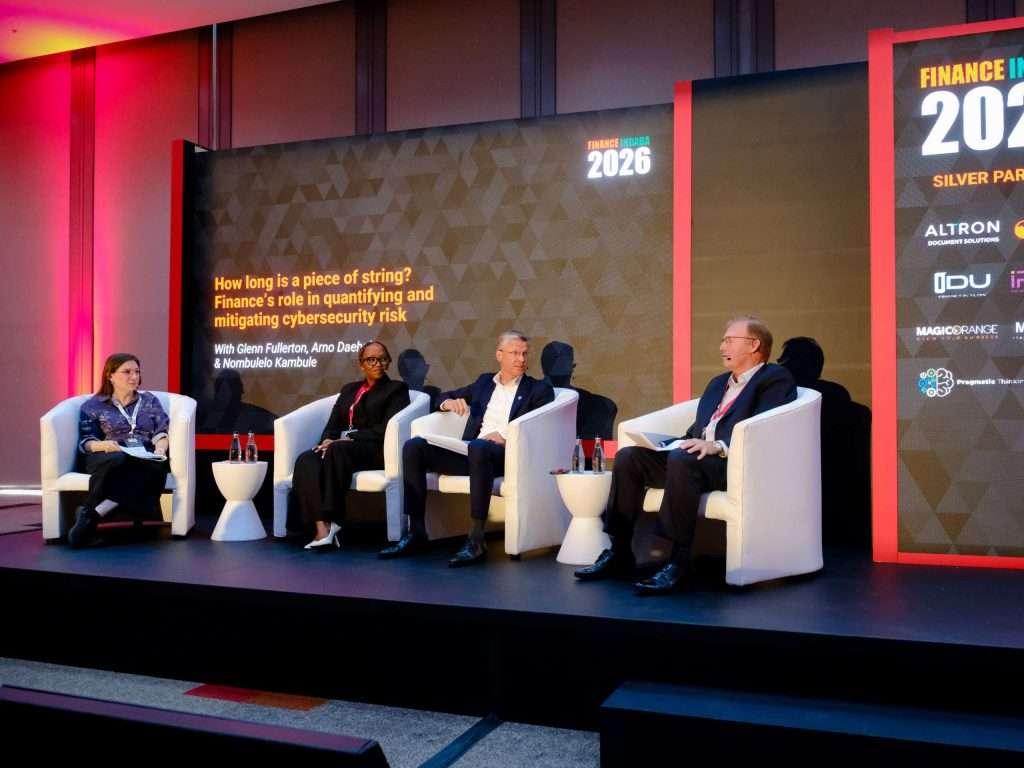
In an insightful session at the 2026 Finance Indaba, Arno Daehnke, chief finance and value management officer at Standard Bank; Glenn Fullerton, former CFO at Nampak Limited and Nombulelo Khambule, partner, cyber strategy and transformation at Deloitte Africa, explained how a major cyber incident can halt core operations, strain liquidity, expose sensitive data and put staff safety and wellbeing at risk.
During the 2026 Finance Indaba taking place at the Sandton Convention Centre on 22 October 2026, leaders agreed that executives and boards must take active responsibility for measuring and reducing cyber risk. For finance and technology leaders, the message was that cyber security is no longer solely an IT matter.
When an attack happens, automated systems become unavailable and organisations face slower operations and sudden financial pressure. Cash flow tightens, bank covenants become harder to manage and statutory deadlines, such as publishing interim results for the JSE, still apply. A breach at a financial institution or within its value chain can also lead to deposit outflows, loan impairments and wider liquidity stress.
Arno said large institutions model these impacts in detail. “We manage more than R3 trillion in assets and people’s deposits, so risk management and stress testing are central to what we do,” he said.
“We modelled the potential effects, including loss of confidence in the bank, deposit outflows, the need to raise funding, customer communications, loss of business and loan impairments if clients could not repay. These scenarios help us quantify the impact on capital, the bank's ability to continue operating, revenue and costs.”
Nombulelo said more complex value chains amplify the risk. “Our value chains have become much more complex. A financial payment system or manufacturing production line can involve multiple systems, original equipment manufacturers, third-party providers, people and regulators,” she said.

Threats come through suppliers, extortion and new technology
Attackers use ransomware, steal credentials through Active Directory and target smaller suppliers in the value chain that have weaker defences. New risks, such as quantum computing and unregulated AI tools, add to the pressure.
Arno said one of Standard Bank's scenarios looked at a breakthrough in quantum computing. “The cryptography used to secure our systems may need to be revised in a quantum-computing era. We modelled a scenario in which global data encryption was compromised and hackers triggered a systemic event,” he said.
On ransomware, he revealed, “Industry data showed that in 2022, around 50 percent of attacks were settled through bitcoin payments. The most recent data shows roughly 30 percent are settled through ransom payments.”
Nombulelo said criminals operate like well-funded businesses. “Cyber threat actors include highly motivated individuals, organisations, groups and syndicates. Just as we go to work to serve customers, this is their day job. They are well funded and operate at an extraordinary pace, constantly innovating and expanding the scale of their attacks,” she said.

The human cost
Beyond balance sheets and systems, the panel said cyber incidents take a heavy toll on people. Staff who work around the clock to restore systems face exhaustion and stress, attackers use stolen personal data to harass executives and their families and in industrial settings an incident can put workers’ physical safety at risk.
Glenn shared his experience during a Nampak breach. “The hackers contacted me through multiple phone numbers. At first, I did not answer, but eventually they reached me at a critical point. The hacker threatened me and had been contacting our family. It becomes very personal,” he said.
How to prepare

The panel said organisations must move beyond compliance checklists and build resilience across the business. This includes full-day simulations, manual fallback procedures, preserving digital forensic evidence for legal and insurance purposes and building security into technology before it is deployed.
Glenn said an incident response plan is essential. “Never underestimate the importance of an incident response plan. Audit committees can sometimes fall into a tick-box approach, but until you have lived through an attack, you may not understand what needs to be done or how quickly,” he said.
Arno revealed that Standard Bank runs regular simulations. “We simulate incidents internally, sometimes with regulators and often with board members. We work through a scenario over an entire day, which helps build the muscle memory needed to respond,” he said.
“These situations need to be simulated so people can make mistakes in a controlled environment and build experience for a real incident.”
Nombulelo called for security to be built in from the start and for leaders across the business to be involved. “Security will need to be built into technology solutions from the outset, before innovation is deployed,” she said.
“The days of working in silos are over, particularly in cybersecurity. Everyone, not just cybersecurity specialists, needs to understand the risks and their impact on the organisation. Leaders in particular must educate themselves so they can lead effectively through a breach or incident.”
Glenn closed with a simple message for leaders: “Be prepared. Be very prepared.”