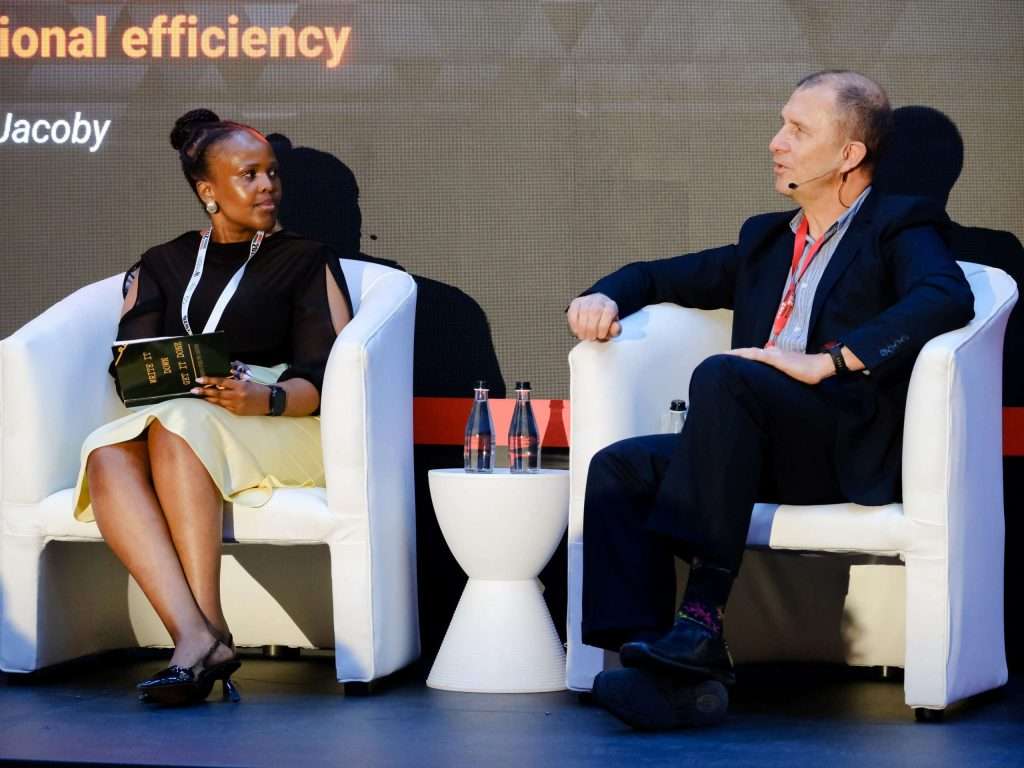
In a session at the 2026 Finance Indaba titled Compliance without constraints: Navigating the PFMA and MFMA while maintaining operational efficiency, top public sector finance leaders explained how finance chiefs can strengthen accountability while removing operational barriers to service delivery.
The session focused on how public sector finance leaders face a difficult balancing act: protect public funds, uphold accountability and deliver services without unnecessary delays. Under the Public Finance Management Act (PFMA) and Municipal Finance Management Act (MFMA), procurement must be fair, expenditure must withstand scrutiny and financial controls must work. Yet when projects stall and budgets remain unspent, compliance is often blamed.
For Andisa Zinja, CFO of the Trans-Caledon Tunnel Authority (TCTA) and Kevin Jacoby, CFO of the City of Cape Town, the challenge lies in how organisations interpret and implement legislation, particularly when fear of consequence management discourages officials from making decisions.
“There’s healthy respect for compliance and then there’s fear. Fear in itself is not necessarily a bad thing, but when that fear becomes paralysing, public sector finance professionals get into a state of being unable to move, do their jobs or deliver on the services, then that becomes an issue,” Andisa said.
The consequences extend beyond internal processes. Delayed decisions can push infrastructure timelines back, increase costs and affect citizens who depend on public services. “When there is a healthy respect for compliance, organisations can deliver quality on time, within budget and derive value from that,” she added.
From control to enablement
Kevin believes finance leaders must move beyond designing controls and help colleagues navigate them.
“The easiest thing a CFO can do is create controls, but we reach a sense of maturity when we re-engineer our roles and take on a role where you tutor people on how to navigate those controls within that legislation,” he explained.
At the City of Cape Town, this approach involved using data to identify blockages throughout the project delivery value chain. The journey for Kevin began with a simple yet impactful question: why did engineers’ reports on project progress differ from those produced by finance teams?
The city had historically operated with infrastructure budgets of between R5 billion and R6 billion, delivering approximately 84 percent to 86 percent of those budgets. As infrastructure ambitions increased, Kevin worked to build datasets, strengthen collaboration and connect financial oversight more closely to project execution.
He instituted collaboration meetings that brought together professionals across the value chain, from project preparation to contract management and delivery, with the result being Kevin now consulting with up to 2,000 people per month through an enablement programme.
The city subsequently recorded R12.24 billion in infrastructure expenditure, breaking through its previous spending plateau.
Making accountability constructive
Andisa added that improving processes must go hand-in-hand with changing how organisations approach mistakes and consequence management. “We need to frame consequence management differently so it does not come across purely as an HR matter that is punitive. It should be seen as more transformative, with the aim to correct and create a learning organisation,” she explained.
She cited a failed bid that had to be cancelled because of a technicality, recalling a colleague’s observation that people generally don’t come to work with the intention of making mistakes.
“It’s my belief that humans ordinarily are good and have good intentions, so the systems and culture we put in place must come from a positive angle, not a punitive one,” she added.
Andisa further emphasises formal authority under the PFMA or MFMA cannot deliver results if employees are afraid to exercise it. “To get rid of fear, you must change the culture. You may have formal delegation structures under the PFMA or MFMA, but if there’s no psychological safety built into the institution, decision-making will lag,” she said.
Confidence to make decisions
Kevin explained that the City of Cape Town introduced an ‘enablement button’ on employees’ desktops, allowing staff to raise operational blockages, including anonymously. He committed to responding within two days with guidance on resolving problems.
At TCTA, Andisa said transparency, communication and accountability are essential when things go wrong, including when audit findings arise.
“When things go wrong, rebuilding credibility requires three important things: transparency which includes stating what went wrong, why and how to fix it. Finance leaders must also communicate clearly and take accountability,” she concluded.