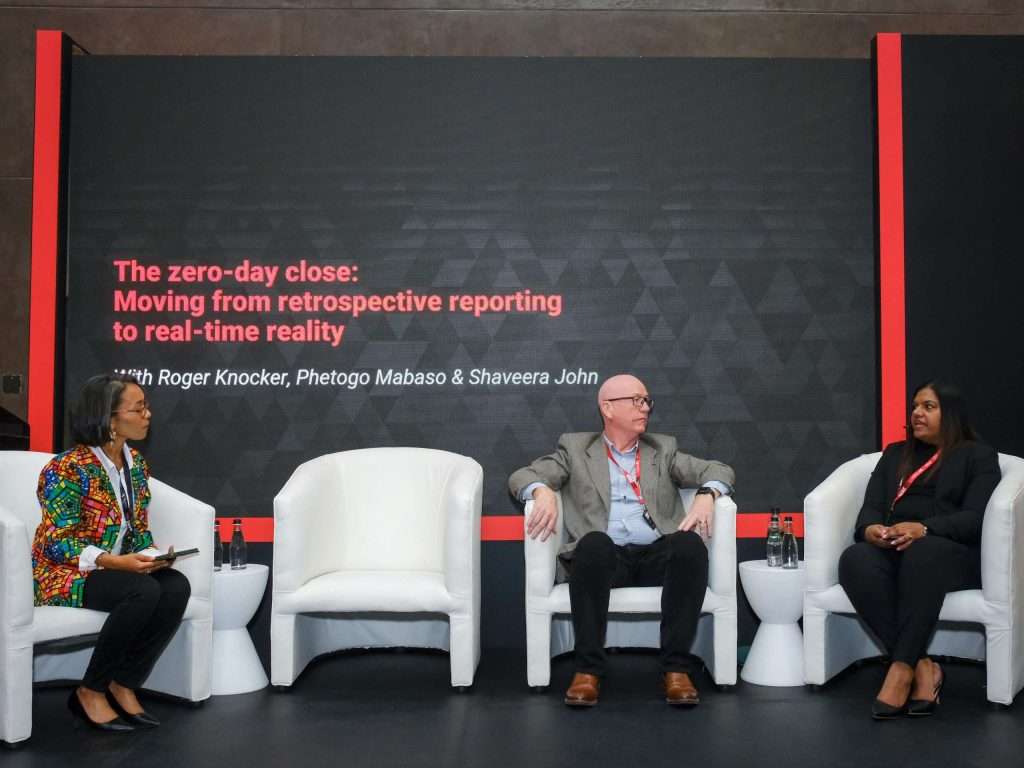
In a 2026 Finance Indaba session titled The zero-day close: Moving from retrospective reporting to real-time reality, Roger Knocker, CEO of FP&A and Shaveera John, CFO of Malander discussed how AI is beginning to challenge how those in finance gather information. This allows more time for interpretation and anticipating what comes next, ultimately enabling businesses to make better decisions.
With AI and automation, the time finance teams spend gathering information, reconciling accounts, checking numbers and explaining what happened in the last month, has been significantly reduced. Yet, what happens to controls and data quality when speed becomes the objective? And if we’re afforded so much more time, what should we be doing with it? The panel tackled these and other pressing questions around overseeing automation and maximising the benefits it offers during their discussion at the event.
“What finance typically does is identify the variances and the opportunities and then they hand off to business but often nobody follows through,” Roger said. This directly affects the bottom line. Yet, if teams had to follow through on all the opportunities identified in finance, if they had the time to do so and could get to the zero-day close, and spend all their time on business optimisation and value cost, there would be hundreds of millions to be taken from this process,” he added.
Shaveera argued that real-time reporting in finance is absolutely achievable and that many companies are doing it. “In optimising the finance function in business, Malander frequently finds that the challenge is that information is not readily available to make decisions. You can’t make a decision based on three weeks old information.”
Finance teams need to ensure that the information required for decision-making is readily available to the CFO. Traditional finance often operates in really siloed approaches, without understanding how different departments impact one another.
“For us to make decisions on a timely basis, we have to have information available to us and many companies have realised that they can’t use outdated information any longer,” Shaveera added. Either the opportunity passes, important decisions are made using wrong information, which can be very costly to the business.
“The CFO has to make a strategic decision, create strategic alignment and have accountability to ensure that the decisions they are making are empowering the business and the CEO to make decisions with the most relevant information available to them.”
Implementation strategies
“Today, we can undeniably automate multiple processes in a business,” said Roger. Yet many companies lack documented processes, limiting effective technology adoption.
Roger said automating repetitive processes, using AI for reconciliations to reduce manual workloads and implementing workflows for data collections can help companies shift the focus to data interrogation. “We also need to upskill teams to understand the business impact of their tasks rather than treating them as tick-box exercises.”
Shaveera emphasised that maintaining discipline is foundational to efficient finance functioning. “Bringing discipline is number one. Understanding what you’re doing and the impact it has and matching that with the deadline is very important. Technology is the enabler for speed, processes promote consistency, but discipline is what ultimately drives the results.”
The panel concluded that month-end should be treated as a continuous process rather than a single event. Panellists warned that waiting until month-end to address reporting issues could indicate process failure. By implementing controls earlier, teams can better troubleshoot and maintain capacity for the demands of the current month.