
Sage Africa and Middle East managing director Jordaan Burger told attendees at the 2026 Finance Indaba that AI and automation can help finance teams accelerate reporting, identify risks earlier and provide strategic insights, provided organisations maintain trusted data and strong governance.
Artificial intelligence and automation are changing the role of finance teams, shifting their focus from historical reporting towards forward-looking analysis, faster decision-making and strategic business support, according to Sage Africa and Middle East managing director Jordaan Burger.
Speaking at the 2026 Finance Indaba about the evolution of finance, Jordaan said finance leaders face growing pressure to close their books faster, improve financial controls, identify risks and support business growth while meeting increasingly complex reporting requirements.
“Finance teams are expected to deliver faster, look into the future and move beyond reporting historic numbers to explain what has happened and what is likely to happen,” he said.
He added that businesses expect finance teams to demonstrate efficiency while maintaining reliable reporting and strong governance across their operations.
“We need the numbers to make decisions, strengthen governance and financial control, while ensuring that our systems remain reliable and that errors and fraud are prevented,” Jordaan said.
AI can create capacity for strategic work
Jordaan said AI should not be viewed solely as a way to complete existing tasks more quickly, but as a means of creating capacity for finance professionals to contribute more strategically.
Rather than spending most of their time capturing data and analysing historical results, finance teams can use automation to focus on business performance, forecasting and decision support.
“If AI were only about efficiency, we would simply do the same amount of work in fewer days, but its real value is creating additional capacity for finance teams,” he said.
He said this capacity could allow finance professionals to provide strategic direction and influence other business functions, including marketing and sales, by giving them the information needed to make informed decisions.
He argued that organisations adopting AI and automation could develop a competitive advantage over those that continued relying on manual processes.
“Three years from now, businesses that have adopted AI and automation could be significantly ahead of competitors that have not embraced these technologies,” he said.
Faster reporting and earlier risk detection
Jordaan highlighted month-end reporting as one area where connected financial systems can help businesses improve efficiency.
He cited an educational organisation that had expanded from 800 students in 2023 to 6,000 students, while reducing the time required to prepare month-end numbers from 14 days to three days after implementing Sage Intacct.
The organisation also uses the system’s contract management capabilities to manage student accounts and monitor the profitability of different courses.
He said AI-enabled financial tools can also help finance teams identify unusual transactions before errors become more difficult to detect.
He pointed to general ledger outlier detection in Sage Intacct, which identifies anomalies based on transaction data, including the general ledger account, transaction value and other dimensions.
“When the system identifies something unusual, it flags the transaction to the financial manager, providing a preventative control before an error becomes more difficult to identify,” he said.
He also highlighted the role of live dashboards in improving access to financial information, allowing business functions to monitor relevant metrics without repeatedly requesting reports from finance teams. He said finance professionals should be able to build their own reports and provide other departments with dashboards tailored to their needs.
Trusted data remains essential
Jordaan said AI tools are only useful when they operate within the right financial context and produce reliable insights.
He explained that Sage's approach involves developing AI capabilities around financial information rather than simply placing general-purpose language models on top of enterprise resource planning (ERP) or human resources systems.
“We cannot lose our customers' trust by providing them with incorrect insights, which is why the financial context behind the data and the outputs matters,” he said.
He also described how Sage is developing its platform to allow businesses to connect external AI tools to their financial systems within a controlled environment.
He said the company's model context protocol (MCP) server and AI gateway for Sage Intacct allow businesses to connect tools such as Claude and OpenAI to their ERP environment, with support for Sage X3 also planned.
According to Jordaan, the approach is intended to allow businesses to work with the AI tools they prefer while maintaining control over access to their financial information.
He cautioned finance leaders against adopting AI without considering the reliability of their underlying systems and the governance required to manage the technology. “Speed without trust creates more work, and finance leaders must ensure that AI strengthens the quality of their information rather than creating confusion,” he said.
Applying AI across different business needs
Jordaan said the applications of AI and automation vary according to the operational requirements of different industries.
For manufacturers, he highlighted inventory management, supply chain complexity, margin pressure and forecasting accuracy as areas where integrated financial and operational reporting can support decision-making. For professional services businesses, he pointed to resource utilisation, project profitability, revenue forecasting, billing and cash flow visibility.
He cited Sage Intacct as an example of automation that uses activity information from tools such as Outlook and Microsoft Teams to propose timesheets for employees.
He said the capability could help professional services businesses capture work that might otherwise be omitted from timesheets, with Sage reporting an increase of more than 20 percent in billable time for a professional services business using the functionality.
For small businesses, he highlighted automated support for routine financial administration, including drafting reminders for overdue invoices.
Non-profit organisations, he added, can use financial management tools to track grant funding, report on how funds are applied and maintain transaction records for audit purposes.
Jordaan said these applications demonstrate how automation can reduce repetitive administrative work while giving finance professionals more time to focus on financial analysis and business priorities.
Finance leaders must retain human judgement
He said organisations should begin their AI strategies by considering how they want their finance functions to operate in the future, rather than introducing technology without a clear objective.
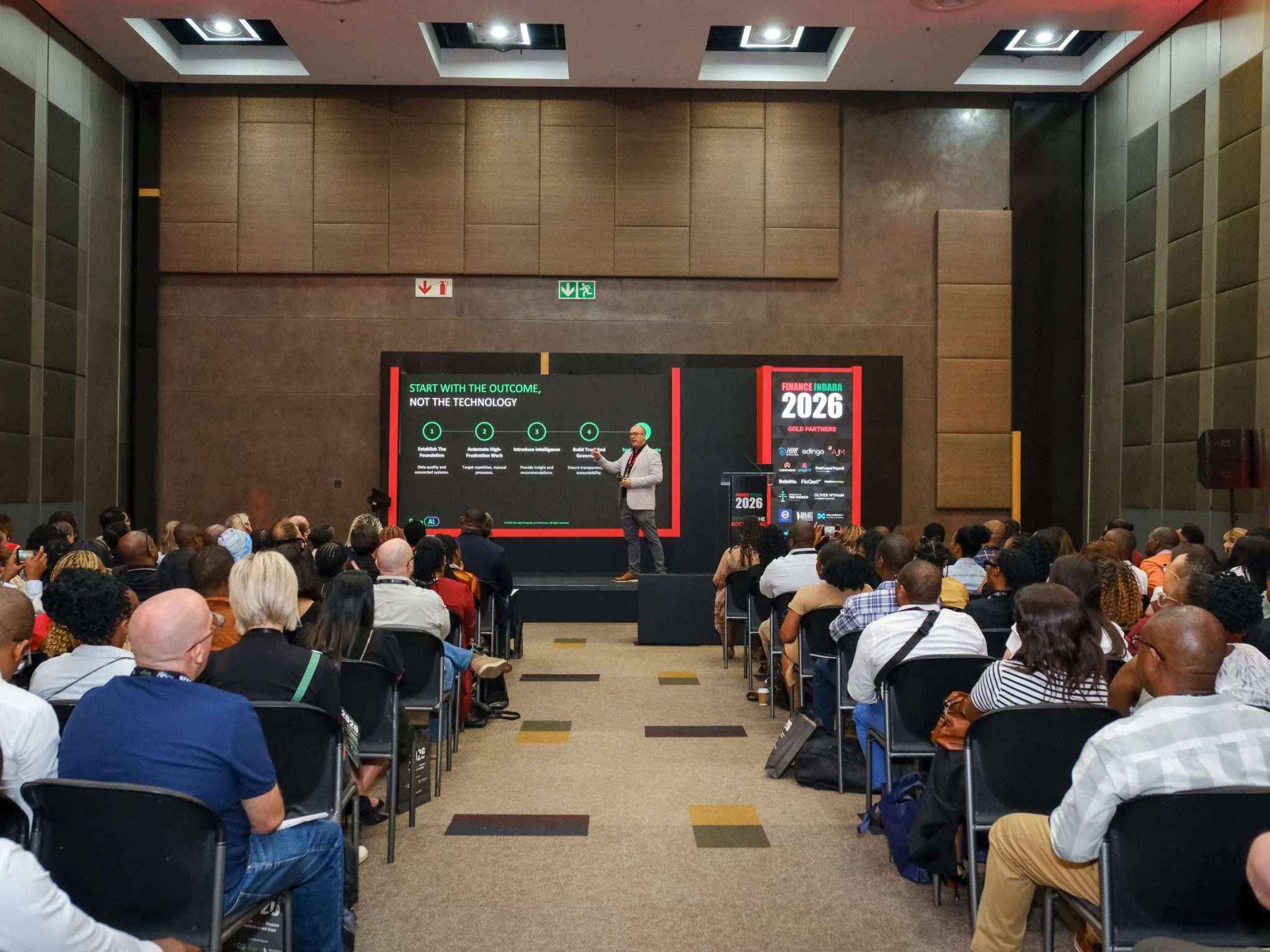
He encouraged finance leaders to establish a strong data foundation, automate tasks that cause frustration, identify where AI can provide useful insights, and build appropriate governance before expanding successful applications.
He described an example from Sage's commercial finance team, where an AI agent was developed to answer recurring questions from a sales executive about budgets, sales volumes and annual contract values.
He also explained that finance teams could use similar approaches to improve access to information while allowing finance professionals to concentrate on more complex analysis and decision-making.
However, he stressed that technology should complement rather than replace human judgement, particularly when decisions require an understanding of circumstances that cannot be assessed through historical data alone.
“AI is not going to replace humans, because creative thinking and human judgement remain necessary when every business situation requires its own assessment. Repetitive tasks, data capture and the analysis of large datasets were among the areas where AI could be applied most effectively,” he said.
Jordaan concluded that finance leaders should focus on building trusted data foundations, automating routine work, strengthening governance and scaling applications that demonstrate value.
“The future belongs to finance leaders who combine trusted data, intelligent technology and human judgement to create lasting business value,” he said.