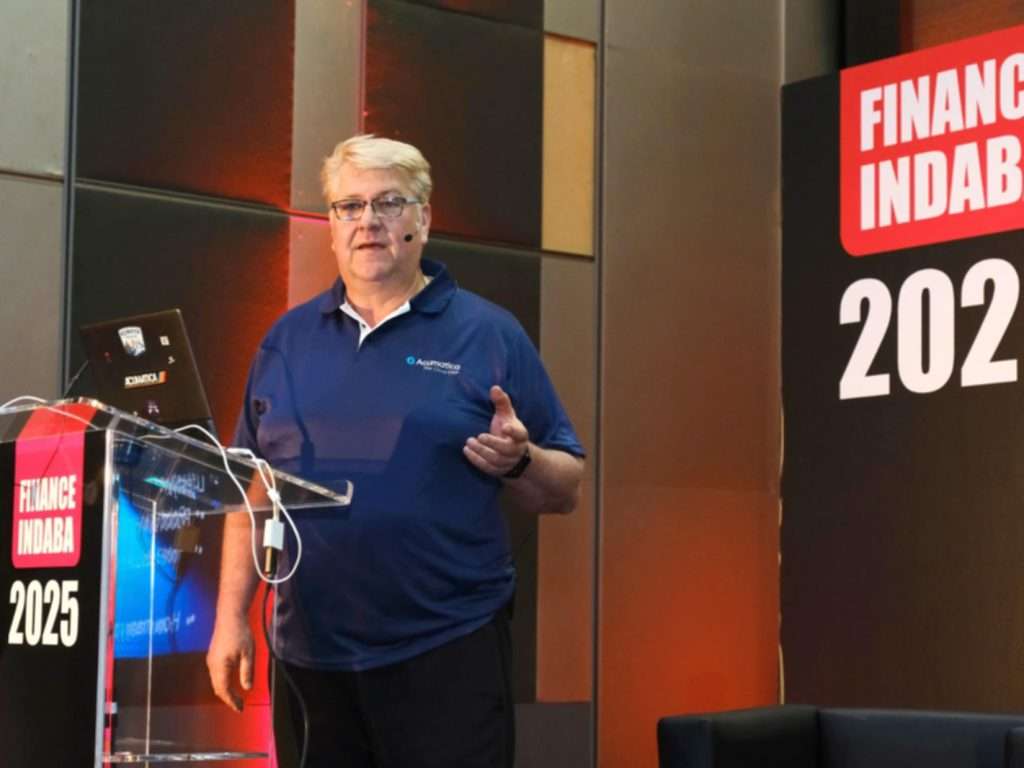
At the 2025 Finance Indaba, Acumatica’s regional head Bernard Ford delivered a thought-provoking session on how artificial intelligence is reshaping business at lightning speed, and why CFOs must act now to harness its power rather than fear it.
AI is no longer a futuristic concept, it’s here, expanding at an exponential rate and redefining the rules of business. That was the message delivered by Bernard Ford, regional head of Acumatica, during his session titled Riding the AI tsunami: Future-proof your business now at the 2025 Finance Indaba at the Sandton Convention Centre in Johannesburg.
Joined on stage by a virtual co-host, an AI-generated avatar named Carly, Bernard opened his address by highlighting the rapid evolution of AI, describing it as “the most powerful technology ever seen in human existence”. He told delegates, “AI is already here. It’s not coming. It’s happening faster and faster, and if we don’t move with it, we’ll be left behind.”
He explained how AI systems learn through machine learning and deep learning, teaching themselves and improving continuously. “When we talk about exponential growth, people think it just means ‘big’,” he said. “But in AI terms, it means doubling. And right now, we’re seeing that doubling happening in days or weeks.”
He outlined the difference between large language models (LLMs) such as ChatGPT and a new generation of small, agentic models that specialise in specific tasks. These smaller systems, he noted, are cheaper, faster and able to run directly on devices, known as “the edge”, from smartphones to cars.
Bernard described the present moment as a turning point in human history, comparing the AI boom to the internet revolution. “It took the internet 46 years to reach a quarter of American homes – ChatGPT did in just five days,” he said.
Bad data far more dangerous
However, he didn’t shy away from the challenges ahead. He explained that job changes are inevitable and when artificial general intelligence (AGI) arrives, and it could be in as little as five years, it is possible that there will be a massive disruption, he warned. “But while AI will replace some jobs, it will also create new ones and drive efficiency and abundance,” he said.
According to Bernard, industries set to thrive in the AI-driven economy include microchip manufacturing, data centres and energy, all critical for powering AI infrastructure. Yet he emphasised that success in this new era hinges on data readiness. “Your data must be clean, structured and secure. Bad data is far more dangerous than open data,” he said.
He urged CFOs and business leaders to start preparing now through executive buy-in, data audits and pilot projects. “AI adoption isn’t optional, it’s essential. If your organisation doesn’t upskill and integrate AI, your competitors will,” Bernard cautioned.
As he concluded, he demonstrated how Acumatica has already embedded AI into its business systems, from workflow automation to cybersecurity. His message to finance leaders was clear: “This is our moment. The tsunami has arrived. We can either ride the wave or be drowned by it.”