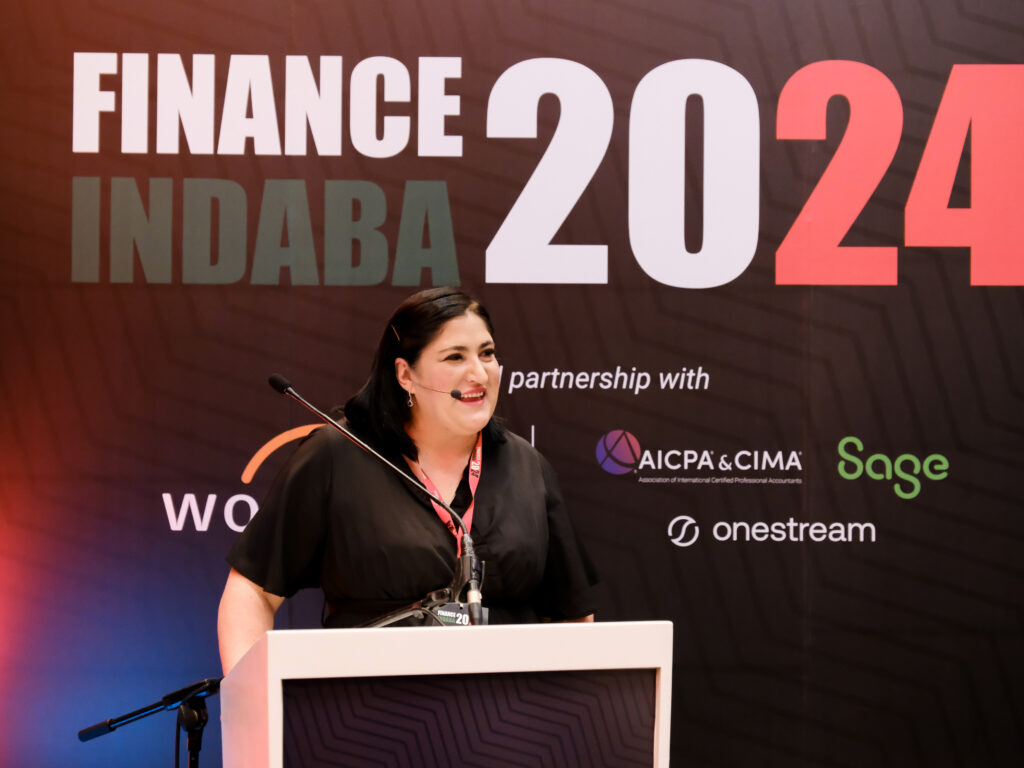
Looking into how businesses can integrate AI tools as part of their daily duties, business leaders at the 2024 Finance Indaba, held at Sandton Convention Centre on 10 October 2024, shared how to make the most of these technologies.
In a session titled, ‘You AIn’t seen nothing yet: AI revolutionising the workplace,’ three speakers shared how if AI is adopted properly, it can help better the functioning of most businesses.
Sean Berrington from Technology Consulting EY opened up the discussion with a slide on what he has learned from engagements with their customers after adopting AI tools.
Sean explained that as we make use of these AI models, it is important to ensure we assess their full capacity.
He went on to discuss how essential it is for this technology to communicate with their target audience in a way that is relevant to them from a language and a maturity point of view.
“Make sure you really understand the tool and what the tool does. Also be quite clear of where that tool is from a maturity point of view,” Sean said, sharing a story of how a banking client that was planning to make use of an AI chatbot pulled out the tool because the chatbot was functioning as a three-year-old as opposed to an adult.
“All tools have degrees of maturity. And one of the things we have learned is equate it to a kid, equate it to a toddler, equate it to someone growing up. Depending on where that tool is from a maturity point of view is really dependent on the use-case you want to drive.”
Sean also shared how organisations who have adopted the use-case or problem-solving approach to solve a broader organisational challenge have achieved faster AI adoption from an AI point of view than others.
It’s not about the tool, it’s about the use-cases that you are trying to solve,” he said. “Think about the problem, think about the use- case and use your AI tool to solve that use-case.”
Sean then asked the audience to look into prompt engineering, which is the art of asking questions the right way, explaining that we must ensure that we train and equip our teams with skills to learn how to ask the relevant questions.
MD of Adcorp Group, Heidi Duvenage, described how artificial intelligence has simplified, improved and personalised the hiring process.
In 2013 she created SkillsMap Africa as a joint venture with Business Connexion, and they launched the country’s first tracking and reporting job seeker app.
Currently, she looks after recruitment agencies such Cararol, Charisma, D&E and Kelly.
“In all my years in recruiting, it is sad to see how little progress has been made. In many ways we are still sieving through thousands of CVs as part of their recruitment process. So it’s really been at the top of mind on how we can better that and how we can move forward.”
Since 2017 Heidi has been working alongside technical experts to implement AI tools in various stages of the recruitment process. “It’s not one specific solution, it is small little automation [steps] throughout the entire process that really makes the difference,” she shared.
Heidi presented slides on how the application is processed, beginning with the upload of a resumé to the system and ending with the AI tool sifting through the suitable candidates and sending the shortlisted ones.
“This has honestly been transforming for our teams,” says Heidi. “So, instead of having to send one by one to each candidate, you can automate the process and the machine can chat to the candidate and get them up to a certain point so that you can then focus on the final five or six,” Heidi shared.
“These technologies are there to build better efficiency, and it is up to us to see how we can better that process,” she added.
Yolanda Stander, the head of model development and stress testing at Investec, shared how her job is about managing and developing all the credit impairment and stress-testing models at Investec.
She explained that with the use of AI tools and algorithms they were able to highlight when there has been a significant increase in the credit risk.Using algorithms they could also model client behaviour based on the economic cycle and calculate the risk under different economic scenarios.
“We have needed to train people to know what these models mean and how to use them. AI has changed our business in how we look at our clients and the way we manage our clients.”
Yolanda also shared how AI has taken over certain tasks and allowed people to advance in new skills.
“At Investec what we are doing in my team specifically is that we are combining skills. We are almost becoming experts in more than one field to be able to do this role and be successful,” Yolanda shared.
Yolanda also expressed that with the use of AI, there is now more time to focus on the business training and to monitor the process.
“I think for us because of the amount of work that AI has been able to take away from us, it means we now have time to do things like workshops and understand the business. We are also able to have more constructive conversations with our clients because it does all the hard work for us,” she said.
In conclusion, the speakers emphasised the importance of the human element in the operation of these tools and that the audience should view AI as a tool rather than a replacement, because human adoption and engagement are required to achieve the best results from these AI tools.
It is also important to keep updating these tools and ensure that they comply with regulations. And most importantly, if you train AI nonsense you will get nonsense out, the speakers shared in their parting conversations.