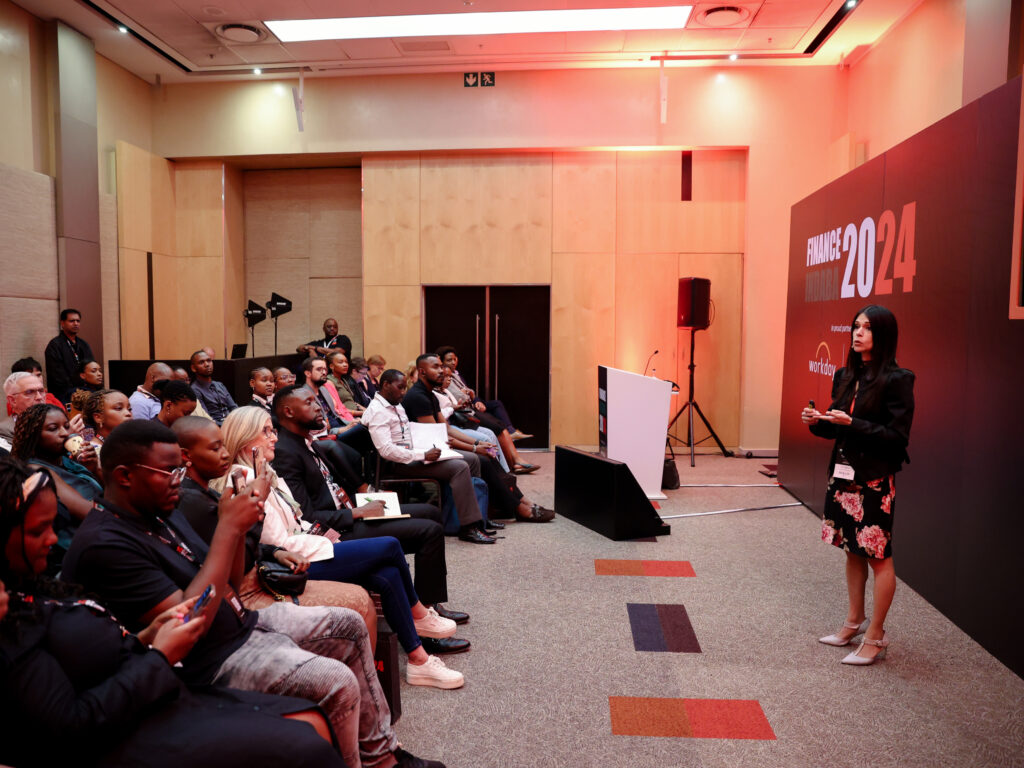
2024 Finance Indaba attendees received expert advice on how to get comfortable with the uncomfortable.
During an enlightening session at the 2024 Finance Indaba titled Leading yourself through uncertainty: Insights and methods to guide yourself through change, Lori Milner, director of Beyond the Dress, shared insights and tactics to deal with one of life’s constants: change.
Lori began the session by saying, “If we had to describe change, it’s moving from a comfort zone to a courage zone. Certainty keeps us stuck because what you know seems safer. We need to look at what our relationship to certainty versus uncertainty is. As Tony Robbins says, ‘Quality of life is proportional to the amount of uncertainty we have.’ We need to see change as an opportunity; it’s not an event, it’s a process.”
According to Lori, many of us are experiencing “change fatigue: the relentless pace of change is draining us, so we need to have change resilience. That’s resilience with a big ‘R’ and a small ‘r’. Capital ‘R’ resilience is needed for the likes of pandemics and great loss, while the lowercase ‘r’ version is for everyday situations, such as a bad performance review or getting stuck in a traffic jam, when you’re already late.
There are tools to develop these different types of resilience, like ‘state management’. Lori explained, “Think back to a time you nailed something, and then to a time when you hung your head in shame. You’re the same person, but it depends on the state you were in. What if you can decide what state you’ll be in, and move from being triggered to a state of calm confidence?”
There’s also a tool from self-improvement guru Tony Robbins called ‘The Triad’, based on body language, shifting focus, and the language you use that all combine to create meaning. For example, when you feel stressed and take a few deep breaths you can reset your nervous system: what you focus on you feel, and being aware of your own self-talk.
“Anxiety shows you that you’re either trying to control the external or the future. Do an anxiety audit: what do I know, not know, who can I reach out to, what can I influence, and what must I let go of? We want things to happen on our time and according to our plan, but what if your greatest setback is your greatest set-up?”
Lori pointed out that as soon as we attach meaning to a situation it changes everything. Blue ticked with no response – they’re ignoring me. Your team is late with a project deadline – they don’t respect me.
“But is it true? This is the lens through which we see the world, and we can shift it using thought management. Up to 80 percent of our thoughts are negative and recycled; we become what we think about. Thought management, however, is a manual process and we must regularly check in, because the conversations we have with ourselves are the only ones we can control,” noted Lori.
Lori highlighted that because we crave certainty, a belief is something we feel certain about – and we need to question some of them, as many are inherited. For example, “I can only rest if all my work is done”, “Success is sacrifice”, “If I ask for help I’m a burden”, “If something good happens, something bad is on the way.”
According to Lori, one belief that really holds us back is imposter syndrome (almost everyone in the audience nodded in agreement, which was telling). She suggests a reframing: think about what it’s like to be a tourist, when failure is an adventure. If you go to a new place often, then you become a local; you know the language and shortcuts. Then you become braver and more confident, and become an expert guide.
“If you’re moving to the next phase, you’ll feel unsure, but it’s about being okay with the discomfort. We want to be the guide all the time, because we’re overachievers, but we need to give ourselves a break; acknowledge our wins and integrate them.
“The more we can control our inner world the more we can navigate whatever change shows up,” she concluded.